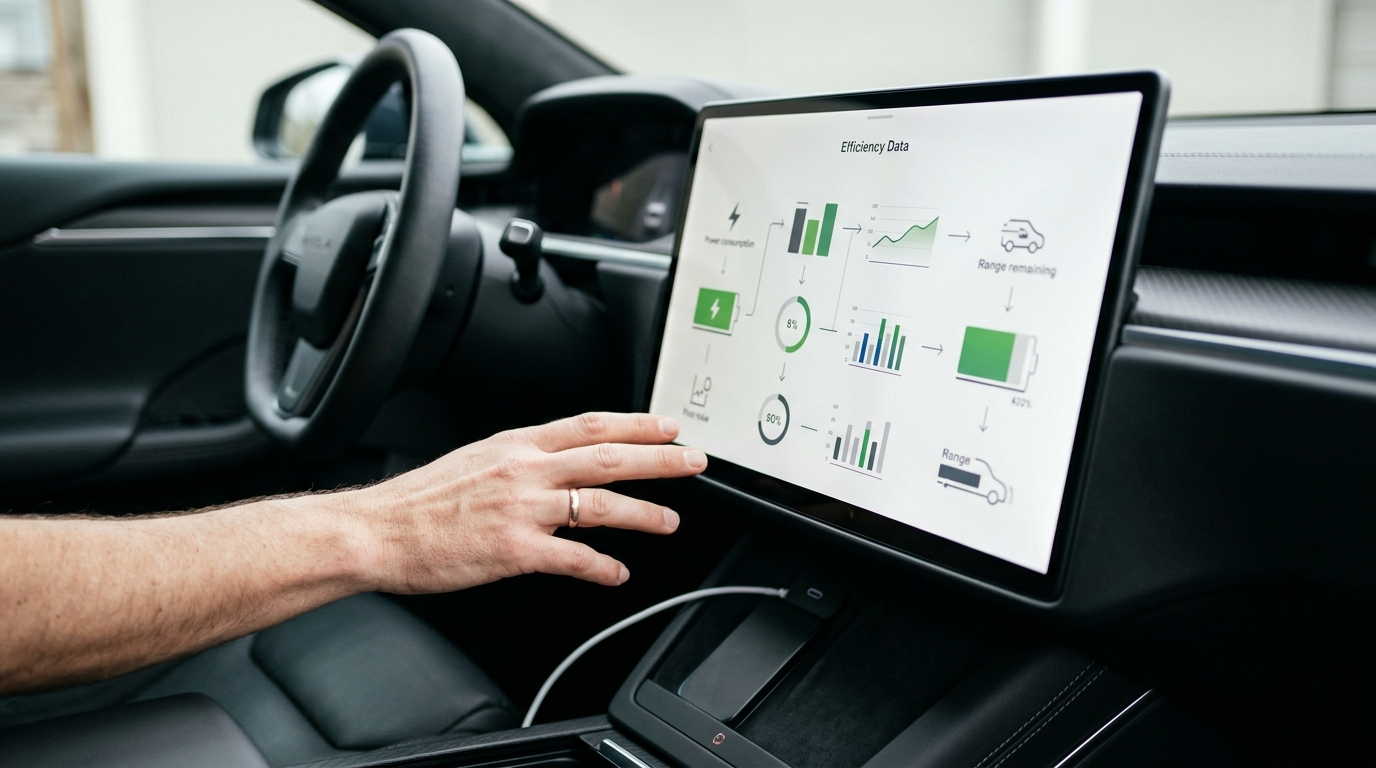
Every electric vehicle comes with a quoted range figure, and almost every EV owner quickly discovers that the real-world range rarely matches it. The number that actually tells you how far your car will go, and how much it costs to drive, is efficiency. Understanding your EV’s efficiency data is the single most useful skill an electric car owner can develop, and it is simpler than you might think.
What Efficiency Means and How It Is Measured
EV efficiency measures how much energy the car uses to travel a given distance. In the UK, the two common metrics are miles per kilowatt-hour (mi/kWh) and kilowatt-hours per 100 miles (kWh/100mi). They tell you the same thing in opposite directions.
Miles per kWh works like miles per gallon: higher is better. A typical modern EV achieves between 3.0 and 4.5 mi/kWh in mixed driving. A very efficient car like the Tesla Model 3 might average 4.0 mi/kWh, while a larger SUV like the BMW iX might average 2.8 mi/kWh. If your car has a 60 kWh usable battery and you are averaging 4.0 mi/kWh, your real-world range is roughly 240 miles. If you are averaging 3.0 mi/kWh, that same battery gives you 180 miles.
kWh/100mi is the inverse: lower is better. A car averaging 4.0 mi/kWh uses 25 kWh per 100 miles. A car averaging 3.0 mi/kWh uses 33.3 kWh per 100 miles. Some European cars display this as kWh/100km, which produces smaller numbers (roughly 15-20 kWh/100km for an efficient car).
Where to Find Your Efficiency Data
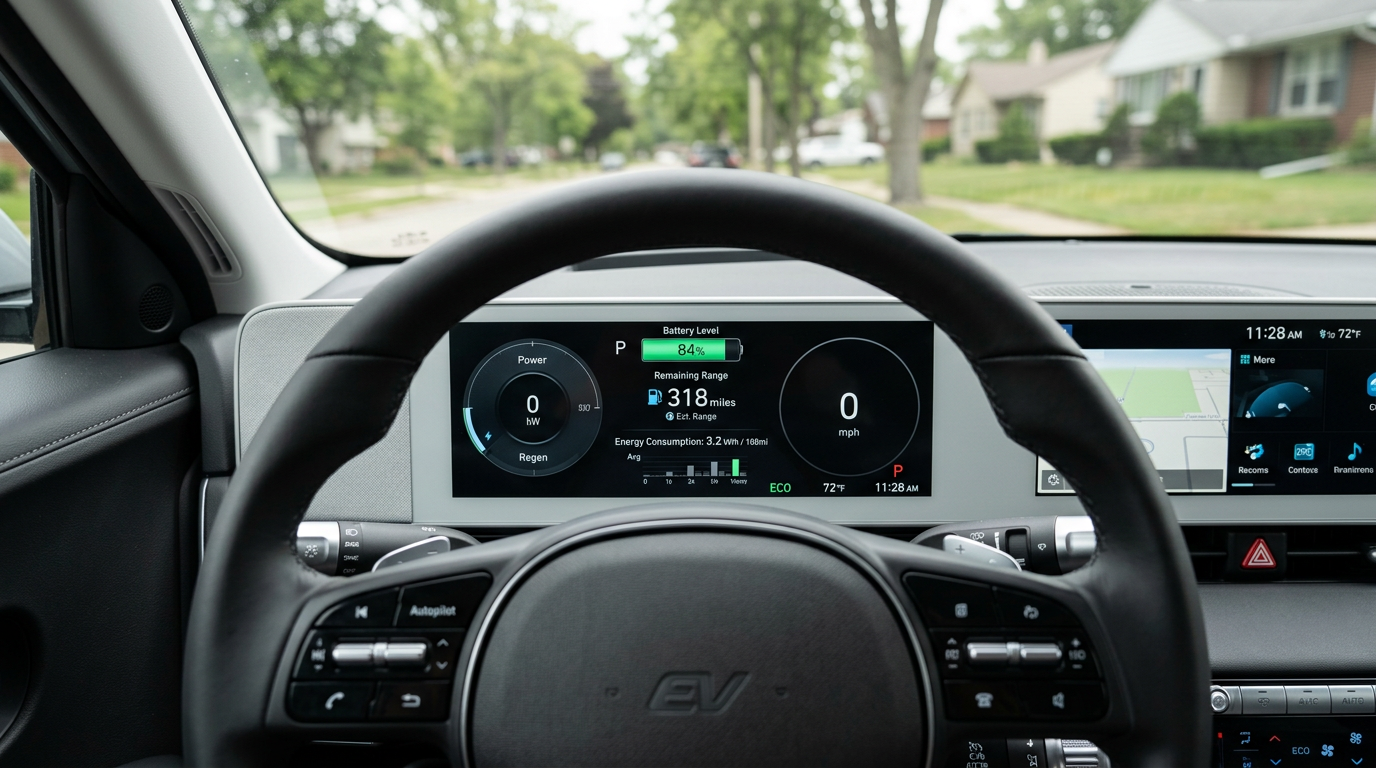
Most modern EVs display efficiency data in several places. The dashboard or infotainment screen typically shows current trip efficiency, which resets each time you start a drive or manually reset it. This tells you how efficient your current journey is but can be misleading if you have just started from cold.

More useful is the lifetime or long-term average, which most cars track automatically. This gives you a realistic picture of your driving patterns over weeks or months. On Tesla, this appears in the Energy app. On Hyundai and Kia EVs, it is in the EV settings menu. On VW Group vehicles (ID.3, ID.4), it is in the trip computer section.
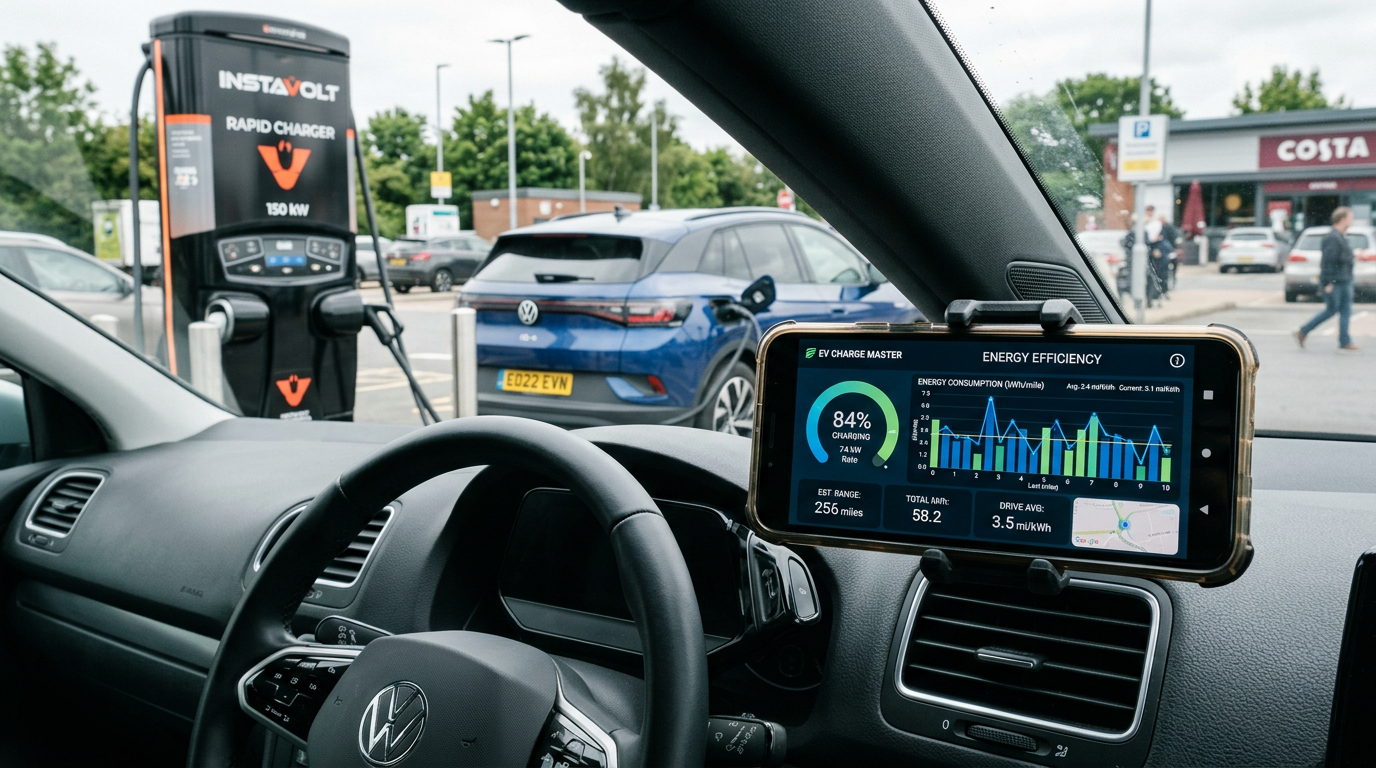
The manufacturer’s companion app often provides the best efficiency overview. The Tesla app, MyHyundai, Kia Connect, and similar apps show trip-by-trip efficiency data, lifetime averages, and sometimes a breakdown of where energy is going (driving, heating, cooling, battery conditioning). These apps are worth checking regularly, as they reveal patterns you might not notice from the dashboard alone. For apps that help with charging logistics, see our best EV charging apps guide.
What Affects Your Efficiency
Speed is the single biggest factor. At motorway speeds (70 mph), air resistance increases dramatically, and most EVs use 30 to 50 per cent more energy than they do at 30 mph. If you regularly see lower efficiency figures than expected, motorway driving is almost certainly the reason. Reducing your motorway speed from 70 mph to 60 mph can improve efficiency by 15 to 20 per cent, which translates directly to extra range.
Temperature has a major impact, particularly in cold weather. Batteries are less efficient in the cold, and heating the cabin uses significant energy. In winter, many EV owners see a 20 to 30 per cent drop in efficiency compared to summer. Using the heated seats and steering wheel instead of the cabin heater can reduce this impact, as seat heaters use far less energy. Pre-conditioning the car while it is still plugged in (warming the battery and cabin before you unplug) is the most effective strategy. Our guide to preconditioning your EV battery explains this in detail.
Tyre pressure matters more than you might expect. Under-inflated tyres increase rolling resistance, which directly reduces efficiency. Check your tyre pressures monthly and keep them at the manufacturer’s recommended levels. Some owners run slightly above the recommended pressure (1-2 PSI) for maximum efficiency, though this marginally reduces ride comfort.
Terrain obviously plays a role. Hilly routes use more energy climbing than you recover going downhill, due to energy losses in the regenerative braking system. Route planning apps like A Better Route Planner account for elevation changes in their range estimates, which is valuable for longer journeys.
HVAC usage (heating, ventilation, and air conditioning) is the most controllable energy draw after speed. Air conditioning in summer uses less energy than heating in winter, but both reduce range. If you are monitoring efficiency closely, note how much your average changes with and without climate control.
Using Efficiency to Predict Real Range
Here is where efficiency data becomes genuinely practical. Instead of trusting your car’s estimated range display (which uses algorithms that may not reflect your current driving conditions), you can calculate your own estimate.
The formula is simple: remaining battery (kWh) multiplied by your current efficiency (mi/kWh) equals predicted range. If your car shows 40 kWh remaining and your recent efficiency is 3.5 mi/kWh, your realistic range is 140 miles. This is almost always more accurate than the car’s own estimate, which often assumes ideal conditions.
Most EVs show the remaining battery capacity in kWh somewhere in the settings or energy display. If yours does not, you can estimate it by multiplying the usable battery capacity by the displayed state of charge percentage. A 64 kWh battery at 60 per cent has roughly 38.4 kWh remaining.
Practical Tips to Improve Efficiency
Beyond the factors above, a few habits make a measurable difference. Use regenerative braking effectively. Most EVs let you adjust the regeneration level. Stronger regeneration recovers more energy during deceleration and reduces brake wear. One-pedal driving, where lifting off the accelerator slows the car sufficiently to stop, is the most efficient driving style once you adapt to it.
Accelerate smoothly. EVs deliver instant torque, which makes rapid acceleration tempting, but gentle acceleration uses significantly less energy. You do not need to drive slowly; just avoid launching from every traffic light.
Plan your journeys with efficiency in mind. For longer trips, use A Better Route Planner, which factors in your car’s real efficiency, weather, elevation, and charging stop locations to give you a realistic journey plan. It is far more accurate than built-in navigation for EV trip planning.
Understanding your EV’s efficiency data transforms the ownership experience from anxiety about range to confidence about what your car can actually do. Once you know your typical mi/kWh figure, quoted range numbers become irrelevant, and you can plan journeys based on reality rather than manufacturer optimism. For more on the broader EV ownership experience, see our piece on whether range anxiety is still a real problem.
Related reading on MTW
Buyer action
Where to buy or check next
Use this as the final check before ordering a phone, changing network or trusting a headline monthly price.













Reader discussion
Leave a comment
Comments are moderated. Keep it useful, accurate, and on topic.