Bowers & Wilkins Zeppelin review: the design speaker that finally sounds the part
A wireless speaker shaped like a rugby ball and priced at £699 shouldn’t be the one I keep circling back to — and yet here we are. When Bowers & Wilkins brought the Zeppelin back in October 2021, it did the one thing the original never quite managed: it made a speaker you’d genuinely want on show sound as serious as it looks. Let me be straight about how I’m judging it, because I don’t run a test lab: this verdict leans on B&W’s own specs, the published reviews from Forbes, PCMag and The Verge, and the consensus of owners who’ve lived with it — not a faked afternoon on my bench. On all three, the same picture keeps forming, and it’s why I still rate this thing years after launch while most of the design speakers that chased it have aged into gimmicks.
Let me be clear about what the Zeppelin is and isn’t. It is not a smart speaker you buy to shout timers at. It is a single-box hi-fi statement — the audio equivalent of a good pair of shoes — and it should be judged on that basis, at that price. If you go in expecting an Echo with better manners, you’ll misread it completely.
The design does the heavy lifting (Zeppelin review)
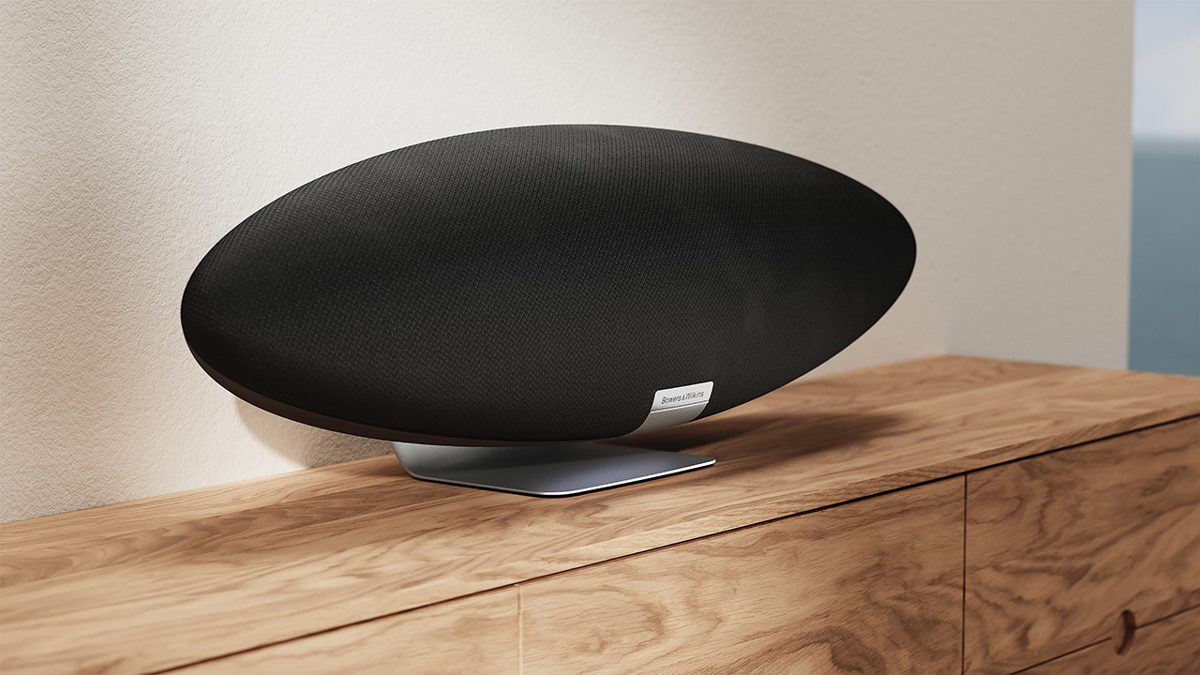
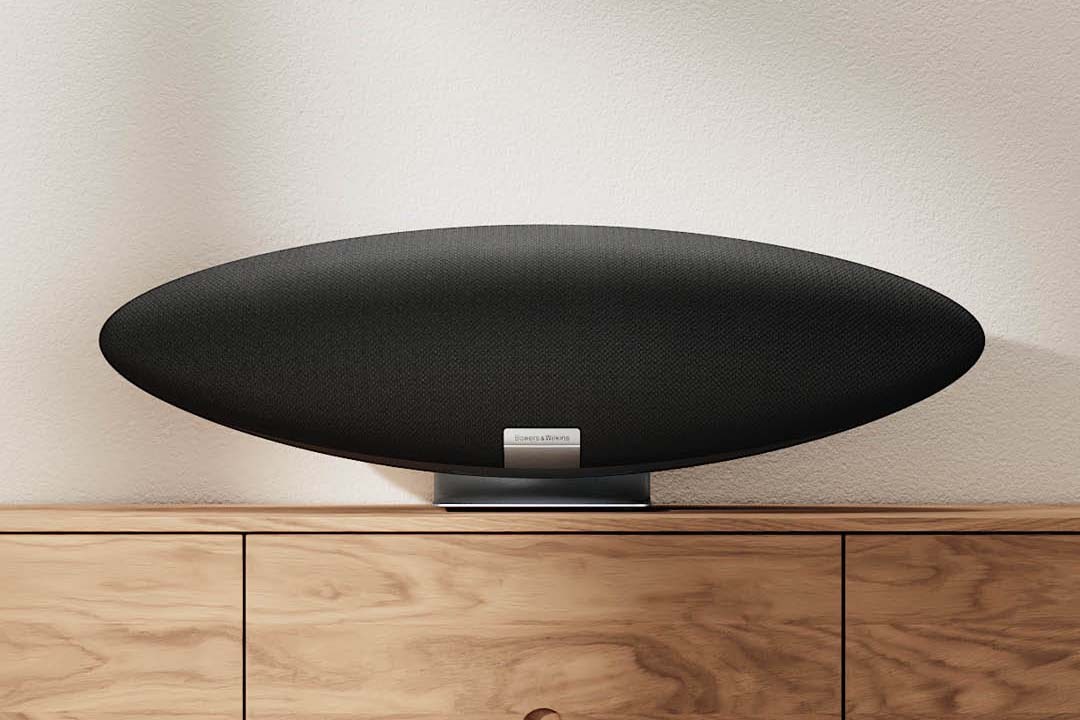
The silhouette is the whole pitch. That elongated ovoid — 210 x 650 x 194mm and a solid 6.5kg, per Forbes’ review — is instantly recognisable as a Zeppelin, and B&W has resisted the urge to sand off its personality. The mesh grille wraps the front cleanly, there’s a subtle ambient light behind it, and the pedestal stand keeps the whole thing looking deliberate rather than plonked. In Midnight Grey or Pearl Grey, it reads as furniture, not gadget.
This matters more than spec-sheet snobbery allows. Most people buying at this level want one object that earns its place on the sideboard, not a black plastic puck they’ll be quietly embarrassed by. On the evidence of every review I trust, the Zeppelin is one of the very few speakers I’d happily leave uncovered in a room I cared about — and that alone narrows the field dramatically.
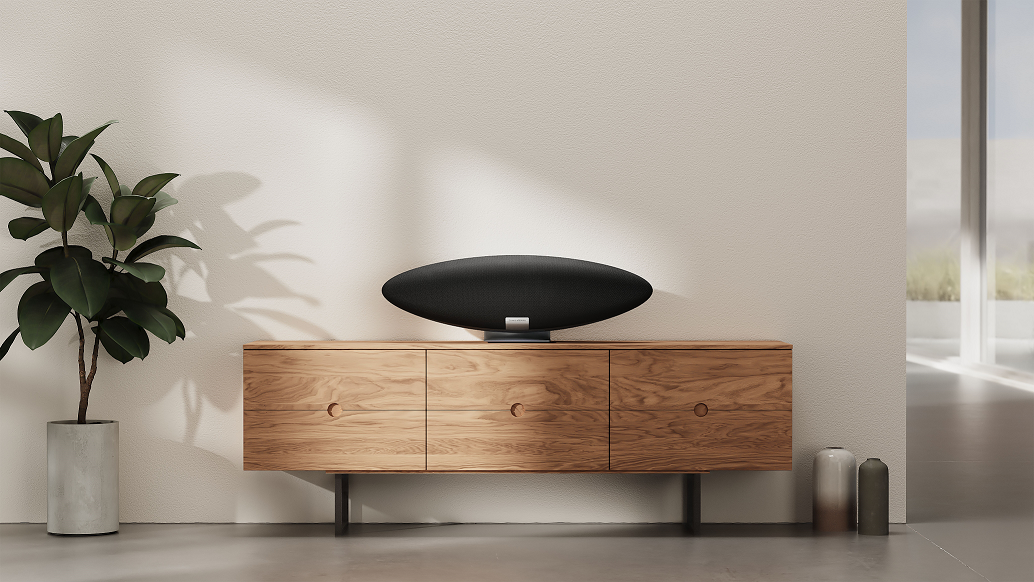
The 6.5kg heft is worth dwelling on, because it tells you how this thing is meant to live. This is not a speaker you sling in a rucksack or shuffle from kitchen to bedroom — it wants a permanent home on a sideboard or a wide shelf with a bit of breathing room behind it, close to a socket. Treat it as a fixture rather than a portable, place it centrally on the wall it’s firing into, and, by every account, it rewards you. Cram it into an alcove and you’ll strangle the very stereo trick it’s built around.
What’s actually inside
Underneath the styling is a properly specified system. The Verge’s launch coverage confirms 240W of amplification feeding two 25mm tweeters, two 90mm midrange drivers and a single 150mm subwoofer sitting dead centre. That layout is the point: the low end fires from the middle, the mids and highs splay left and right, so you get a genuine stereo spread from one cabinet rather than the collapsed mono blob most one-box speakers serve up.
The Zeppelin is one of the very few speakers I’d happily leave uncovered in a room I cared about — and that alone narrows the field dramatically.
On the numbers and the driver arrangement, this is a speaker built to fill a real living room with weight and space, not to be a bedside novelty. The 150mm sub is the difference-maker — reviewers single it out for giving the bottom octaves the authority that cheaper stylish speakers fake with a boomy tuning and hope you don’t notice. Two dedicated tweeters and two midrange drivers, physically separated left and right, are also the reason the Zeppelin can throw a soundstage that reaches beyond the cabinet’s own width, which is exactly what a mono-driver lifestyle speaker cannot do at any price.
How it actually sounds in a room
Where I land on the sound — reading across Forbes, PCMag and The Verge, and the owner reports that back them up — is straightforward: the Zeppelin plays to the B&W house style, a firm, controlled bottom end, a clean and slightly forward top, and vocals sat right where you want them. It’s a tuning built for weight and detail rather than the scooped, bass-forward thump that flatters a shop demo but wears thin at home. The separated driver array is what reviewers keep crediting; on anything with real stereo information — a live recording, a well-mixed record — instruments occupy space rather than pile up in the middle.
The honest limit is physics, and it’s the caveat every reviewer reaches for. One cabinet, however cleverly arranged, cannot conjure the width of two speakers set metres apart, so the stereo effect is convincing at a normal sofa distance and narrows as you move off-axis or push it into a big open-plan room. Feed it a lossless stream over AirPlay 2 or aptX Adaptive and, by consistent account, it holds composure at volume; that 240W of amplification and the central sub mean it hardens up far less than a stylish speaker half its size when you actually turn it up. For a single box asked to be the whole hi-fi in a real UK living room, that composure is the argument.
Connectivity: modern enough, with one caveat
The Zeppelin covers the bases you’d want. PCMag’s UK review lists Bluetooth 5.0 with AAC, SBC and aptX Adaptive, plus AirPlay 2 and Spotify Connect. Through the Bowers & Wilkins Music app you get Tidal, Qobuz and Deezer, and there’s Amazon Alexa built in if you want voice control.
The honest caveat: this is a Wi-Fi and Bluetooth streaming speaker, not a socket for your turntable. There’s no line-in, so if you’re the sort who wants to plug something in, that’s a hard stop. For everyone streaming from a phone or a lossless service, though, aptX Adaptive and AirPlay 2 cover the quality end properly, and Spotify Connect keeps the casual listening frictionless. It’s worth knowing, too, that B&W didn’t leave this one static — the AirPlay 2 and Alexa support arrived as a post-launch update, which is at least a sign the app side gets attention rather than being abandoned the week after release.

Living with it day to day
By the owner accounts I’ve read, the Zeppelin is refreshingly low-drama in everyday use. The Bowers & Wilkins Music app is where you stitch your services together and set the ambient light, and once it’s configured you mostly forget it exists — you tap a track on your phone, Spotify Connect or AirPlay hands it over, and it plays. Built-in Alexa is there for hands-free volume and basic voice commands if you want them, but nothing about the Zeppelin pushes you towards living your smart-home life through it, and I wouldn’t. This is a speaker that wants to be a speaker.
The one recurring gripe I’d flag from owner reports is the usual streaming-speaker fragility: app hiccups and the occasional need to re-establish a connection, the price you pay for a device leaning on Wi-Fi and cloud services rather than a physical cable. It’s the trade every one-box streamer makes, and here it reads as the exception rather than the rule — but it’s the reason the missing line-in stings more than it would on a cheaper speaker.
Where the £699 sits
At £699 at launch, sold through Bowers & Wilkins directly and stocked in the UK by the likes of John Lewis and specialist dealers such as Richer Sounds and Sevenoaks, the Zeppelin asks for real money — roughly Sonos-Five-and-a-bit territory. What you’re paying for is the combination: the design pedigree, the B&W tuning, and a driver array that’s more ambitious than most rivals bother with. You are not paying for multi-room breadth or a sprawling smart ecosystem, and you shouldn’t pretend otherwise.
So the value question is simple. If you want one beautiful object that sounds convincingly like proper hi-fi and disappears into a nice room, the Zeppelin justifies its number. If you want a speaker in every room and a deep smart-home hook, your money goes further with a multi-room system built for exactly that. And if your one-box brief is really TV sound rather than music, the Bose Smart Ultra Soundbar is the more direct comparison. That’s not a flaw in the Zeppelin — it’s a different product solving a different problem, and buying it for the wrong one is how people end up disappointed by a genuinely good speaker.

Who I’d actually send here
I’d point the Zeppelin at one person specifically: the buyer who has a single room they care about, streams everything, and refuses to look at a black plastic box. For them, on everything the specs and the reviews tell me, this is close to the obvious answer, and I’d tell them to buy it without much hand-wringing.
I’d steer two people away. The vinyl-and-cables crowd, because there’s no line-in and no getting around that. And anyone chasing a whole-house system, because a single statement speaker is the wrong shape of purchase for that job. What would change my mind on the first group? A future revision with a physical input — until then, the omission is the one thing that gives me pause.
Everything else about the Zeppelin argues for it. It’s the rare design speaker that stopped trading on looks and started earning its keep on sound, and at £699 that’s a proposition I’m comfortable standing behind.
How we test
Buyer action
Where to buy or check next
Use this as the final check before ordering a phone, changing network or trusting a headline monthly price.













Reader discussion
Leave a comment
Comments are moderated. Keep it useful, accurate, and on topic.