OpenAI Sora is dead, and the manner in which it died tells you everything you need to know about the reckless, burn-the-furniture economics of Silicon Valley’s AI arms race. Just six months after launch, OpenAI pulled the plug on its flagship video generation tool, a product that was haemorrhaging roughly $1 million (around £800,000) per day and had shed half its user base before anyone in San Francisco bothered to wave the white flag.
OpenAI Sora: From “The Future of Video” to a $180 Million (around £144 million) Bonfire
When OpenAI Sora launched in late 2025, the hype was almost comically overblown. Sam Altman himself paraded it as the dawn of a new creative era, a tool that would democratise filmmaking, render stock footage obsolete, and turn every teenager with a ChatGPT subscription into the next Christopher Nolan. The demos were admittedly impressive: photorealistic cityscapes, eerily convincing human motion, and enough visual fidelity to make traditional VFX artists genuinely nervous.
The reality, as usual, was rather less cinematic. Within weeks of launch, users discovered that Sora’s outputs were wildly inconsistent. Hands still looked like melted candles. Temporal coherence, the ability to maintain consistent characters and objects across frames, remained a fundamental unsolved problem. And the compute costs were staggering: each minute of generated video required GPU resources that made OpenAI’s already eye-watering infrastructure bills look positively modest by comparison.
The Numbers That Killed OpenAI Sora
Let’s talk about the figures, because they are genuinely jaw-dropping. According to TechCrunch’s post-mortem, Sora was burning through approximately $1 million (around £800,000) every single day in compute costs alone. That is not a typo. One million dollars. Daily. For a product whose worldwide user count peaked at roughly one million before collapsing to fewer than 500,000 active users.
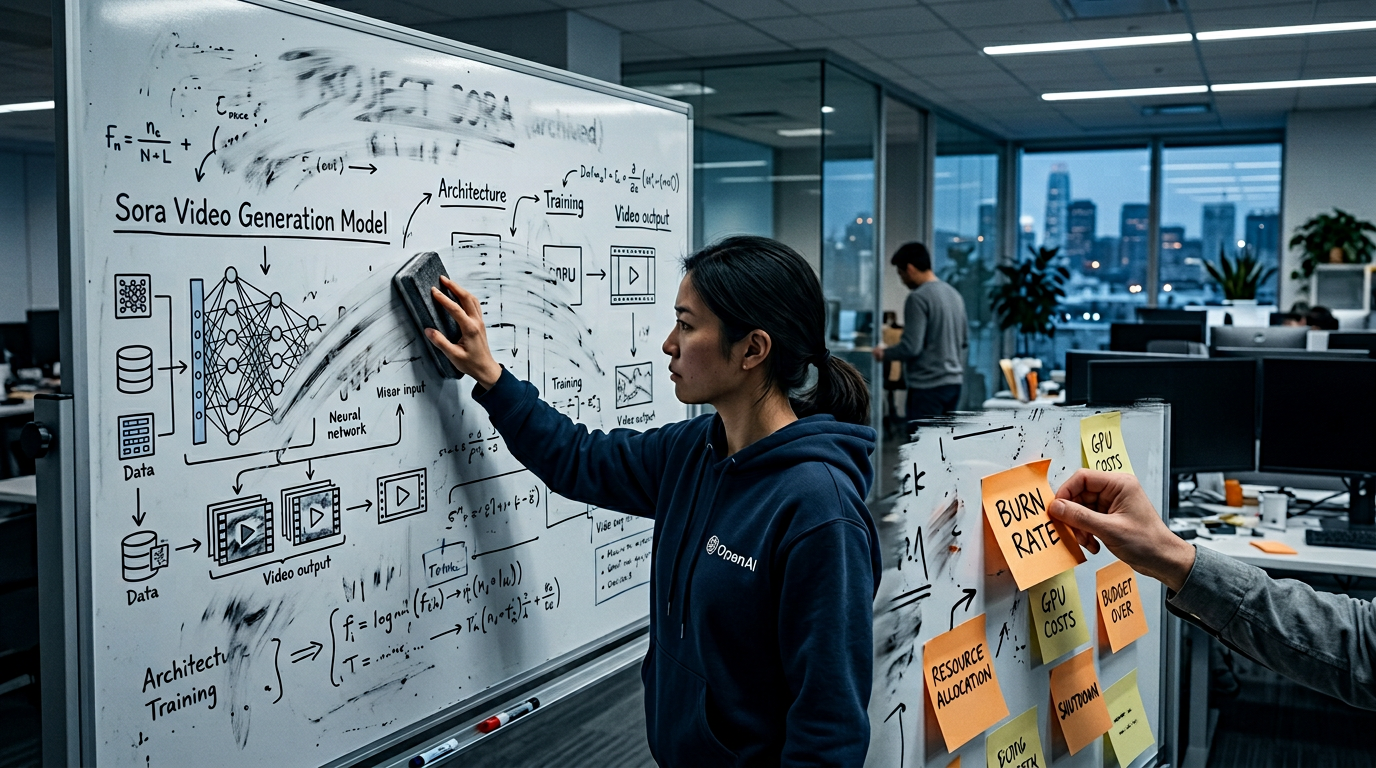
Do the arithmetic: at peak usage, OpenAI was spending roughly a dollar per user per day just to keep the lights on, and that is before you factor in engineering salaries, content moderation, trust and safety teams, and the small army of researchers dedicated to improving the model. Over Sora’s six-month lifespan, the total burn likely exceeded $180 million (around £144 million). For a tool that, by the end, fewer people were using than follow most mid-tier football clubs on Instagram.
The shutdown, announced on 24 March 2026, was not dressed up as a pivot or a strategic realignment. OpenAI simply admitted what everyone already suspected: Sora was a money pit that not enough people were using. The company determined that maintaining it was actively costing them ground in the broader AI competition, resources that could be far better deployed on GPT-5.4, on their superapp ambitions, and on the enterprise contracts that actually generate revenue.
The Disney Debacle: A Billion-Dollar Warning Shot
Perhaps the most damaging element of this entire saga is what happened with Disney. Reports emerged in late 2025 that Disney had agreed a three-year partnership with OpenAI including a planned $1 billion (around £800 million) equity stake, centred on licensing more than 200 Disney, Marvel, Pixar and Star Wars characters to Sora for generated content. It would have been a landmark deal, the kind of Hollywood validation that could have justified Sora’s colossal running costs indefinitely.
Instead, Variety reports, Disney pulled out after OpenAI announced the Sora shutdown, with Disney executives reportedly informed just 30 minutes after a joint meeting about Sora’s future. When the billion-dollar partner walks away because your product has been discontinued without warning, you have a problem that no amount of VC funding can solve.
What makes this worse is that, according to multiple reports, OpenAI did not give Disney adequate advance notice of the shutdown. A partnership of that magnitude, even one that had already shown signs of strain, typically involves months of structured wind-down communications. Instead, Disney apparently learned about Sora’s demise the same way the rest of us did: from a post on X.
Why OpenAI Sora Was Always Doomed to Fail
Here is the uncomfortable truth that Silicon Valley does not want to hear: generative AI video, in its current form, is a solution looking for a problem that most people do not actually have. The average consumer does not need to generate a 30-second clip of a golden retriever riding a skateboard through Tokyo. Content creators who do need video already have tools, Adobe Premiere, DaVinci Resolve, CapCut, that give them actual control over their output.
Sora occupied an awkward middle ground: too expensive and inconsistent for professional use, too limited and novelty-driven for consumer retention. After the initial wow-look-what-AI-can-do phase wore off, and it wore off fast, there was simply no compelling reason for users to keep coming back. The product-market fit was, to put it charitably, non-existent.

A Reality Check for the Entire AI Video Industry
Sora’s collapse is not just an OpenAI problem, it is a canary in the coal mine for every company pouring billions into AI video generation. Google’s Veo, Meta’s Make-A-Video, Runway, Pika, and a dozen well-funded startups are all chasing the same dream. And they are all facing the same brutal economics: the compute required to generate even passable video is orders of magnitude more expensive than text or image generation, while the willingness of users to pay for it remains stubbornly low.
As TechCrunch’s analysis noted, Sora’s shutdown could represent a genuine inflection point, the moment the industry collectively realises that impressive demo and viable product are separated by a chasm of engineering challenges, user behaviour realities, and cold financial mathematics.
What This Tells Us About OpenAI’s Priorities
Strip away the PR language, and the Sora shutdown reveals something telling about where OpenAI is heading. The company has just closed a £96 (about $122) billion funding round at an £675 (about $852) billion valuation and is openly targeting a Q4 2026 IPO at a £1 (about $1) trillion valuation, as CNBC confirms. Dead-weight products that burn a million dollars a day are not what prospective investors want to see on the balance sheet. Every dollar redirected from Sora to GPT-5.4 or to the new superapp strategy is a dollar that makes the IPO pitch deck look marginally less terrifying.
Sam Altman has always been better at selling the future than delivering the present, and Sora was perhaps the purest expression of that tendency. It was a technology demonstration masquerading as a product, a proof of concept that was rushed to market because the AI hype cycle demanded it, not because anyone had figured out how to make it sustainable.
The lesson here is not that AI video will never work. It will, eventually. But Sora’s demise proves that eventually and right now are very different things, and that even OpenAI, with its tens of billions in funding, cannot brute-force its way past the fundamental limitations of current technology. Sometimes, a million dollars a day simply is not enough.
For anyone following the OpenAI Sora story, the key takeaway is that the industry is changing faster than most consumers realise. Our OpenAI Sora analysis will continue as new developments emerge in 2026.
Related reading on MTW
- Cala’s kIQ Plus Is the Wearable That Finally Makes the Consumer Medical Argument Properly
- AGIBOT’s G2 Launch Is the Humanoid Robot Pitch That Actually Sells Into a Factory
- Volkswagen’s ID.3 Neo Refresh Is the Apology Europe’s EV Buyers Actually Needed
MMTW Editorial
Buyer action
Where to buy or check next
Use this as the final check before ordering a phone, changing network or trusting a headline monthly price.











Reader discussion
Leave a comment
Comments are moderated. Keep it useful, accurate, and on topic.