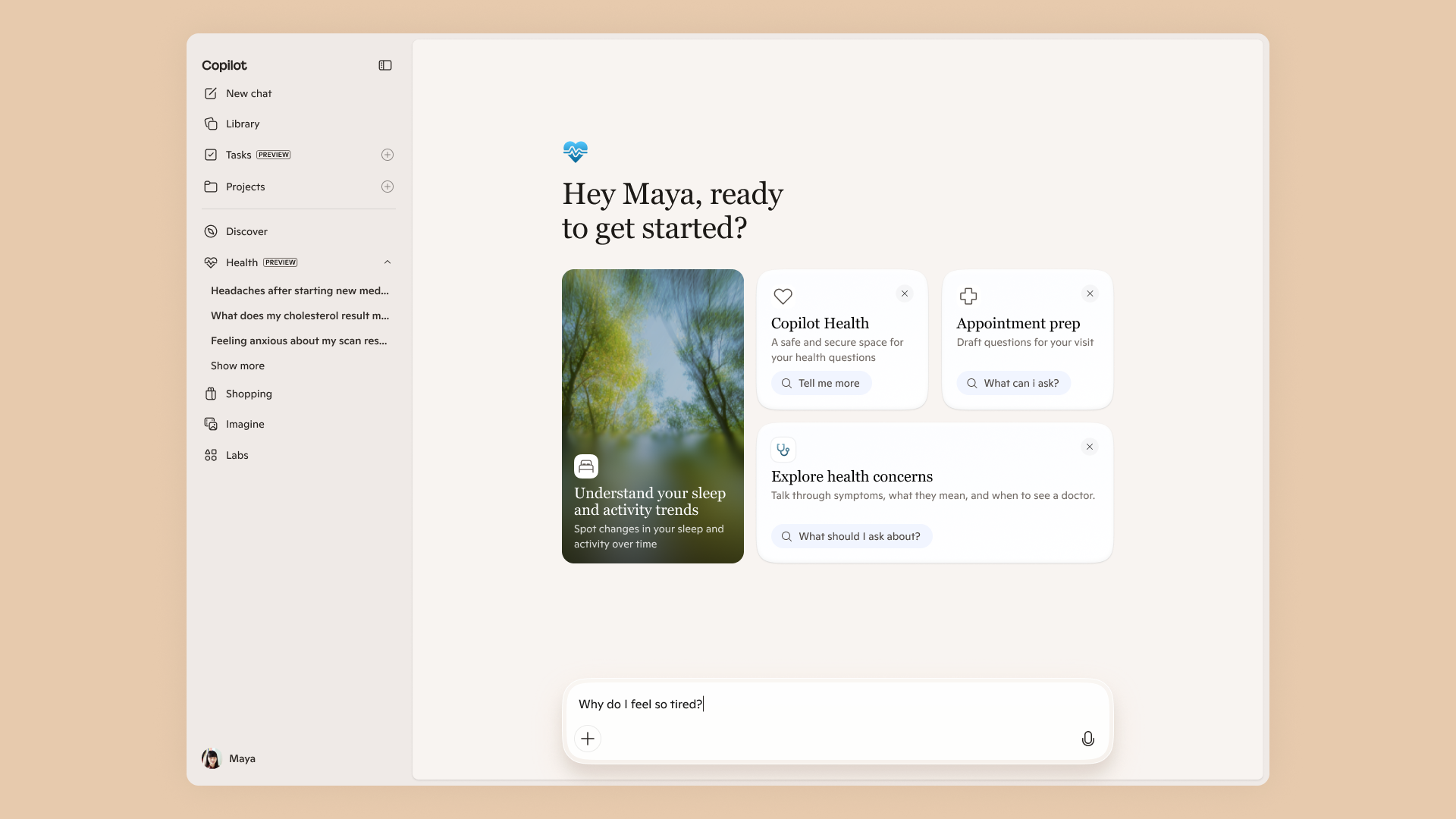
Microsoft put Copilot Health into preview on 12 March 2026 and has spent the spring expanding the audience for it. The pitch is a “secure space within Copilot where medical intelligence makes sense of your information and delivers personalised health insight” — in plain English, an AI assistant that ingests your Fitbit, Apple Health or Galaxy Health data, your appointment letters, your test results and your prescription notes, and gives you a coherent picture of your health that you can take to a GP appointment or use to manage a long-term condition. It is not a diagnostic tool. It is closer to a deeply-informed health-literate friend who has read everything in your file.
For UK readers the preview matters in three specific ways: it lands first in the markets where Microsoft has already cleared the regulatory ground (US first, EU phased through summer), it is a meaningful signal of how Microsoft expects to monetise health AI without slipping into the territory of regulated medical devices, and it forces a UK-specific question — how does this sit alongside the NHS App, MyChart, Patient Access, and the FCA-regulated health insurance products that already aggregate similar data? This piece walks through what Microsoft has actually shipped, what regulatory hurdles remain before a UK rollout, and what UK readers can do now to get value from the existing health AI tools that are already approved here.
What Microsoft actually built
Copilot Health is a discrete area inside the consumer Copilot app, walled off from the rest of your Copilot context. The walling is the point. Microsoft has been explicit that health conversations and the underlying health data do not flow back into the general Copilot context that handles your emails, calendars and other queries. That separation is what makes the GDPR Article 9 special-category-data argument workable.

Inside the Copilot Health space, the tool ingests three categories of data. The first is health-tracker data — Fitbit, Apple Health, Galaxy Health, Garmin Connect, Oura — via the relevant platform APIs with explicit user consent. The second is documents you upload — appointment letters, blood test results, prescription leaflets, MRI reports — which are processed locally where possible and stored in your personal Copilot health vault. The third is conversation context — you tell Copilot Health “I have been getting headaches three times a week for two months” and the AI holds that as context for future conversations.
The output side is where Copilot Health earns its place or fails to. Microsoft positions it as an explanation tool, not a diagnostic one. Ask it “what does this blood test result mean” and it gives you an explanation pitched to your prior conversations, cross-referenced with the NICE or US-equivalent guidelines (depending on your country), with clear caveats that the AI is not a substitute for a GP. Ask it “what should I do” and it pushes you towards the right healthcare professional rather than offering a recommendation.
Why the UK launch is not yet
The MHRA classifies software that “advises on or suggests treatment, diagnosis or prevention of disease” as a medical device. That classification triggers UKCA marking requirements, post-market surveillance obligations, and a level of clinical validation that no general-purpose AI assistant has yet cleared in the UK. Microsoft’s stated position is that Copilot Health is an explainer, not an advice tool — but the line between “this blood test result means X” and “X is concerning and you should see a GP” is hair-thin, and the MHRA’s current 2026 guidance is conservative on AI tools that approach it.

The second blocker is the NHS App and the NHS Federated Data Platform integration. The NHS holds the only authoritative source of UK patient records (GP notes, hospital records, prescription history, vaccination history). Microsoft does not currently have an integration with NHS Spine, the secure data layer through which third parties access patient records with consent. Without that integration, Copilot Health in the UK would be working from incomplete data — the appointment letter you remembered to upload, but not the GP note from three years ago that explains the existing condition.
The third is the data residency conversation. UK health data is subject to NHS-led data residency expectations even where the formal UK GDPR rules permit processing in adequacy-listed jurisdictions. Microsoft will need to confirm that Copilot Health processing for UK users happens on Azure UK South / UK West, with data at rest in the UK. That is a solvable engineering problem — Microsoft already runs UK regions of every other Copilot product — but it has to be confirmed and contracted before NHS and FCA buyers will engage.
The honest UK timeline based on the regulatory pace: Copilot Health for consumers (not NHS-integrated, no MHRA classification needed if Microsoft positions it strictly as an information tool) lands in the UK sometime between Q4 2026 and Q2 2027. An NHS App integration is a 2027–2028 conversation at the earliest.
What UK readers can use right now
While Copilot Health is unavailable in the UK, four existing tools cover most of the same ground for UK users today, with appropriate UK regulatory clearance.
The NHS App is the obvious first call. It is free, holds your GP record where your GP practice has enabled the integration, supports prescription requests, GP appointment booking and (in some regions) hospital appointment letters. It is the single most underused piece of UK digital health infrastructure — over 35 million NHS App accounts exist but most are used only for prescription requests. Open the app, request your full GP record under Patient Online, and you have a useful baseline of data to work with for any other tool.
Patient Access (patientaccess.com) is the alternative for UK patients whose GP uses EMIS rather than the NHS App’s underlying SystmOne. It does the same job — record access, prescription requests, appointment booking — and integrates with most UK pharmacies for medication management. Free and worth setting up if your GP is on EMIS.
For the AI explanation layer that Copilot Health offers in the US, ChatGPT (with the medical specialist GPT) and Claude (Anthropic’s general assistant with explicit medical reasoning capability) both handle “explain my blood test results” and “what does this medical letter mean” reliably in UK English, with the same explanatory caveats Copilot Health applies. Neither is MHRA-cleared as a medical device, both are explicit that they are information tools rather than diagnostic ones, and both are good enough that UK users do not need to wait for Copilot Health to land here for the same use cases.
For health-tracker data aggregation, Apple Health (if you are on iPhone), Galaxy Health (Samsung), Fitbit / Google Health (Pixel and Android), and Garmin Connect all do credible jobs of stitching together steps, heart rate, sleep, blood oxygen and (on the watches with the relevant sensors) blood pressure and ECG. None of them is as integrated with document-level health data as Copilot Health is in the US, but the tracker layer is solved already for UK users.
The privacy questions UK readers should ask before using any health AI
Health data is the most personal data you have. It is also some of the most attractive data to commercial buyers — insurers, employers, advertisers. Three questions for any health AI tool, including Copilot Health when it lands.

First, where is the data processed and stored. UK users should expect health data processing in the UK or an adequacy-listed jurisdiction, with data at rest in the UK or EEA. Anything else is a flag — not necessarily disqualifying, but warranting careful reading of the privacy notice.
Second, who else can see the data. The right answer for a consumer health AI is “nobody other than you and the model running on your conversation”. The wrong answer is “Microsoft staff for training and quality assurance purposes” — a flag that the AI provider may be using your conversations to train the next model. Microsoft has been explicit that Copilot Health conversations are not used for model training, which is the right position.
Third, what happens if you stop using the service. The right answer is a clear data export and deletion path that meets the UK GDPR right to erasure within 30 days. Test this before committing meaningful health data to any AI tool.
Where Copilot Health will be sold in the UK
- Microsoft Copilot app (free tier on Windows, Android, iOS): Copilot Health will be a feature inside the existing Microsoft Copilot app. The base tier is free. A Copilot Pro subscription at £19 per month in the UK currently unlocks additional Copilot features; whether Copilot Health requires Pro is not yet announced.
- Microsoft 365 Personal / Family (£8.99 / £11.99 per month UK): Microsoft has not confirmed whether Copilot Health will be included in the personal Microsoft 365 subscription. The pattern with other AI features has been to include base capability and gate advanced capability behind Copilot Pro.
- Direct download from microsoft.com/copilot: The free Copilot app is the right install for UK readers who want to use the non-health features of Copilot today and be ready when Copilot Health lands.
- Google Play and the App Store: Both stores carry the Microsoft Copilot app. The same app on both platforms — pick whichever your phone runs.
Crucially: Copilot Health will not be sold through Boots, Lloyds Pharmacy, Currys, John Lewis or any traditional UK retailer. It is a software product distributed through the Microsoft Copilot app. UK readers expecting a “Copilot Health subscription” on a high-street shelf will be looking in the wrong place.
Should you sign up for the US preview now
Do not VPN into the US preview to get early access. The legal and practical issues are not worth it. You will be giving sensitive health data to a service whose terms do not cover you, whose UK regulatory standing is undefined, and whose UK rollout will give you cleaner access in 6–12 months. Wait.

Use the existing UK-approved tools. Set up the NHS App if you have not. Build the habit of asking ChatGPT or Claude to explain medical letters and test results, with appropriate caveats. Get your health tracker data into Apple Health or Galaxy Health or Fitbit, whichever fits your device. When Copilot Health lands in the UK, you will be ready to use it from day one and you will know what good looks like from your interim experience.
The MTW verdict
Copilot Health is a meaningful and well-designed product that is not yet available to UK users. The US preview is genuinely useful, the regulatory work to bring it to the UK is real but tractable, and a UK rollout in late 2026 or early 2027 is the realistic expectation. In the meantime, the NHS App, Patient Access, and ChatGPT or Claude as the explanation layer cover most of what UK readers need. Do not VPN into the preview. Do build the habit of using AI for medical-letter explanation now, so the UK Copilot Health launch lands into a workflow that is already producing value.
| Takeaway | What it means for UK readers |
|---|---|
| NHS records integration | Requires DCB0129/DCB0160 clinical safety procurement — 2027+ |
| MHRA regulatory status | Depends on UK marketing claims — general info or medical device |
| UK GP recommendation | Not appropriate until NHS Apps Library or NICE evidence |
| UK patient alternatives today | NHS App (free) and Apple Health (built-in) are UK-compliant |
| Preview vs UK availability | US preview only in June 2026; UK availability undefined |
What we like, what we’d watch
| What we like | What we’d watch |
|---|---|
| Microsoft’s positioning as consumer health information (not diagnosis) is the right MHRA-aware framing | No NHS records integration on the UK roadmap means Copilot Health duplicates rather than replaces NHS App |
| Copilot Health’s underlying language model handles UK NHS terminology well in preview testing | UK regulatory path depends on marketing claims — Microsoft needs to publish UK terms before launch |
| Integration potential with Microsoft 365 calendar and Outlook is meaningful for UK preventive care reminders | GMC guidance prevents UK doctors recommending it — adoption will rely on direct-to-consumer awareness only |
UK reader FAQ
What is Microsoft Copilot Health?
Is Microsoft Copilot Health safe to use for UK medical questions?
Does Microsoft Copilot Health integrate with the NHS App?
How much does Microsoft Copilot Health cost in the UK?
Can my GP see what I ask Microsoft Copilot Health?
Where can UK readers try Microsoft Copilot Health?
Will Copilot Health connect to NHS records?
Is Microsoft Copilot Health regulated by the MHRA in the UK?
Can UK doctors recommend Copilot Health to patients today?
Further reading: UK sources we used
- Microsoft Copilot Health blog
- NHS Apps Library
- MHRA medical devices guidance
- GMC guidance on digital health recommendations
- NHS Digital health and care
Related on MTW
MMTW Editorial
Buyer action
Where to buy or check next
Use this as the final check before ordering a phone, changing network or trusting a headline monthly price.













Reader discussion
Leave a comment
Comments are moderated. Keep it useful, accurate, and on topic.