UPDATED · News · 30 May 2026 · Hannah Foster
Anthropic released Claude Opus 4.8 on 28 May 2026, only 41 days after Opus 4.7. The headline change is an upgrade that costs the same as before: $5 per million input tokens and $25 per million output tokens on the Claude API, exactly the price of 4.7. For UK developers and small teams already paying for Claude Code or Claude.ai Pro, this is a free quality bump on the workflows you are already running.
- Released 28 May 2026; API model ID
claude-opus-4-8; available on Claude API, Amazon Bedrock, Vertex AI and Microsoft Foundry. - Pricing unchanged from Opus 4.7: $5 per million input tokens, $25 per million output tokens. Fast mode runs at 2.5× speed for $10 input / $50 output.
- 1 million token context window; 128k max output (300k via the batch beta header).
- Reliable knowledge cutoff: January 2026. Defaults to
higheffort; users can pickxhighormax. - UK angle: claude.com/pricing still quotes USD only , UK card holders pay the FX spread plus VAT, and there is no £GBP price list.
What actually changed from Opus 4.7
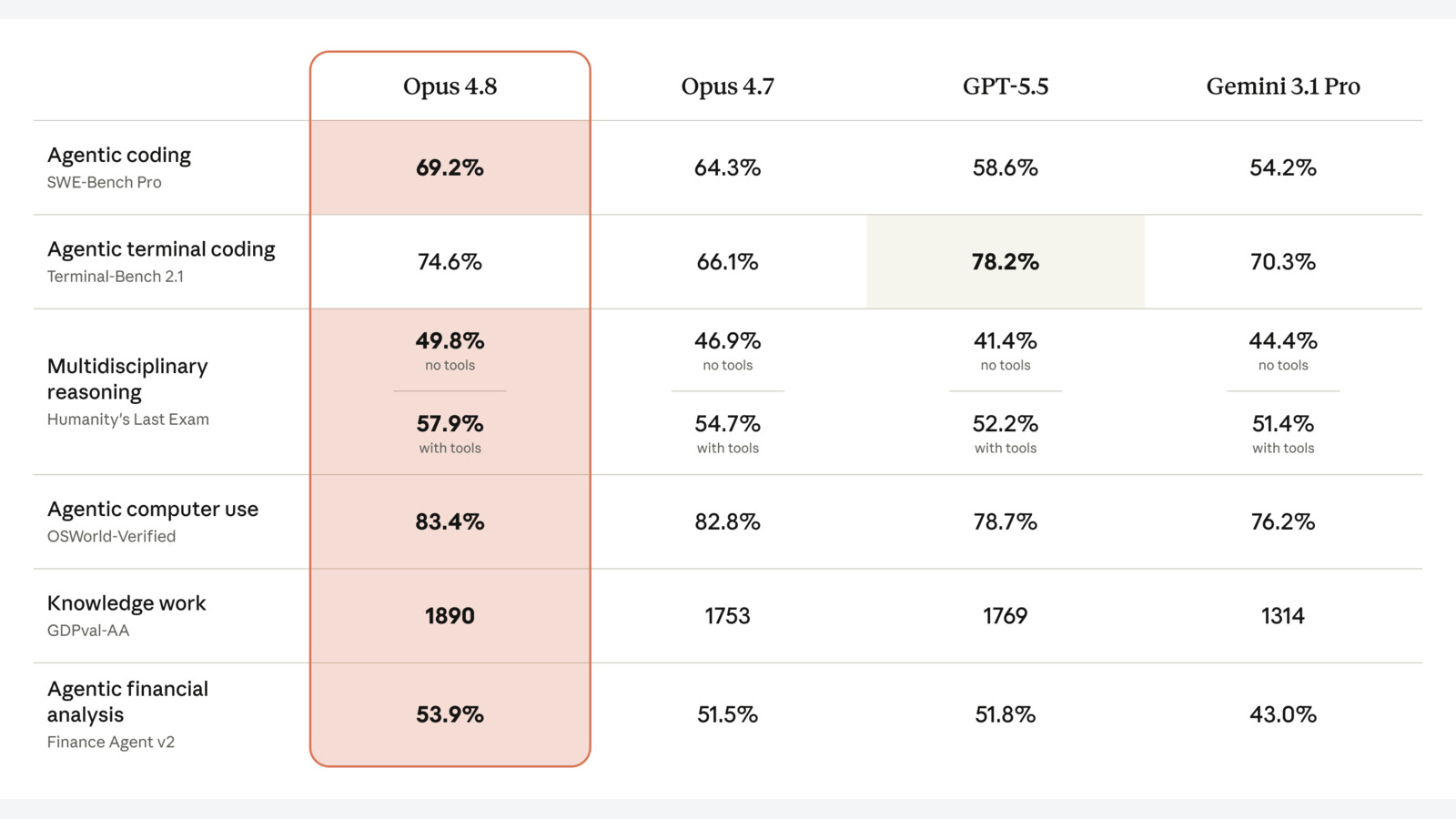
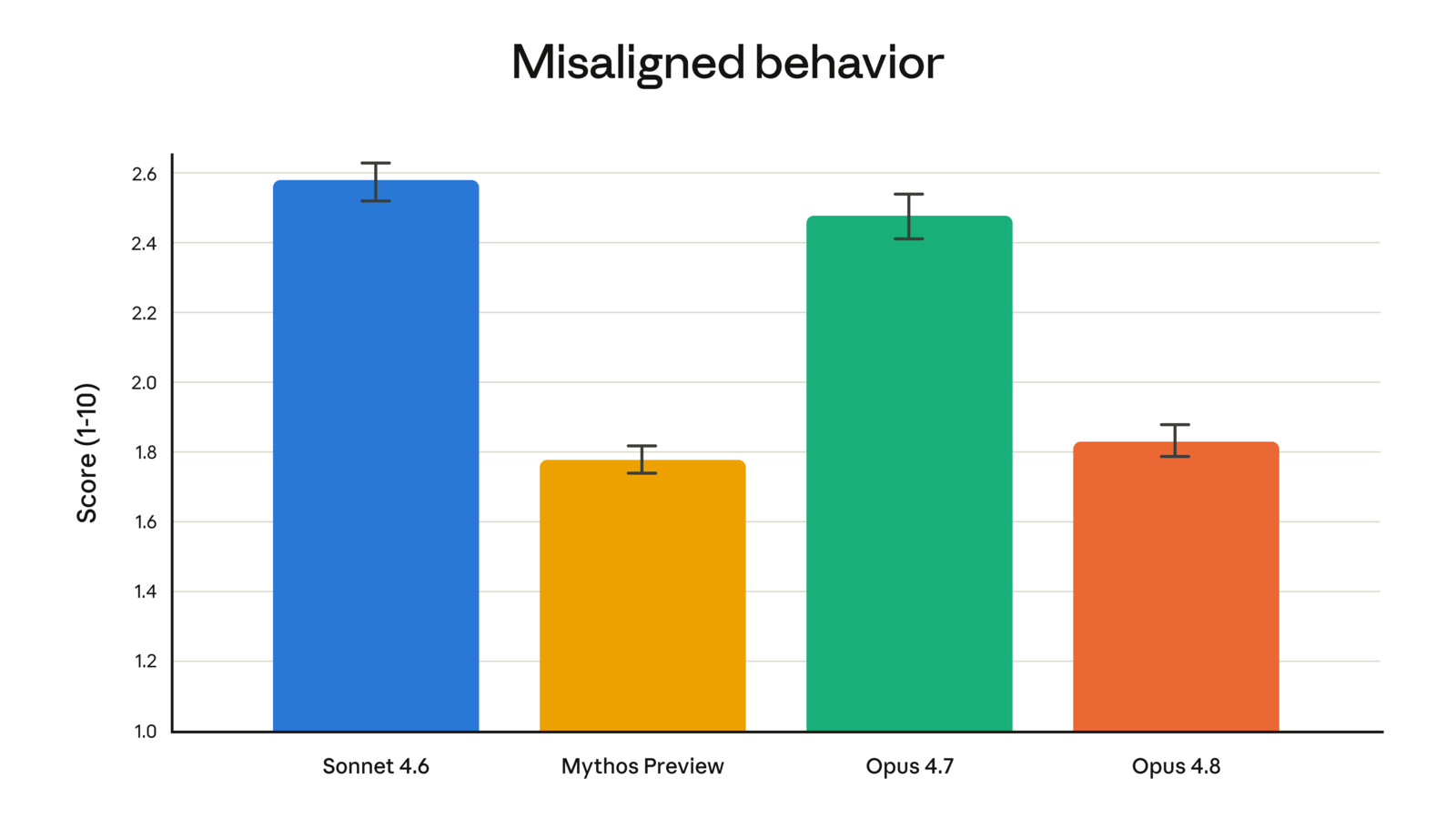
Anthropic’s own framing is that 4.8 is the first model to break 10% overall on the all-pass standard of the Legal Agent Benchmark, scores 84% on Online-Mind2Web, and is “around four times less likely than its predecessor to allow flaws in code…to pass unremarked.” The honesty and self-flagging behaviour was singled out by Bridgewater Associates, who told TechCrunch they value Opus 4.8’s “tendency to proactively flag issues with the inputs and outputs of an analysis.”
The 41-day gap from Opus 4.7 is the other story. Opus 4.7 landed to a chilly reception in mid-April and TechCrunch reports developer pushback was part of the motivation for the quick refresh. 4.8 is, in effect, the corrective release: same price, fewer hallucinated edits, better long-running task behaviour.
What it costs UK developers in practice
There are two ways UK developers get Opus 4.8: the API, and a Claude.ai subscription. On the API the price list is $5 per million input tokens and $25 per million output tokens, with cache reads and Batch API discounts on top (Anthropic quotes up to 90% off with prompt caching and 50% off with Batch). UK businesses get billed in USD against the card on file. There is no published £GBP rate, so the true UK cost is the dollar price plus your bank’s FX spread plus VAT where applicable.
On the subscription side claude.com/pricing lists Claude.ai Pro at $17/month billed annually or $20 monthly, which includes Claude Code access , the cheapest legal route into Opus 4.8 for UK indie developers. Max starts at $100/month for 5× the Pro usage allowance and goes to 20× at the higher tier. Team is $20/seat annually or $25 monthly (standard), $100/seat for the premium seat that includes higher Opus limits. Enterprise sits at $20/seat plus usage at API rates. None of these prices are localised for the UK on the pricing page at the time of writing.
For reference, Sonnet 4.6 is $3 input / $15 output , three-fifths the price of Opus 4.8 across the board. If your workload doesn’t need Opus-tier reasoning, Sonnet 4.6 is the obvious cost-down. Where Opus 4.8 earns its keep is long-horizon coding work, agentic loops and the new Dynamic Workflows feature.
Dynamic Workflows is the headline developer feature
Dynamic Workflows is in research preview on Enterprise, Team and Max plans inside Claude Code. Anthropic’s pitch is that the model can “carry out codebase-scale migrations across hundreds of thousands of lines of code from kickoff to merge, with the existing test suite as its bar.” Under the hood it dispatches hundreds of parallel subagents. If you have ever paid an external contractor to do a framework migration on a UK codebase, that is the price comparison you should be running, not the per-token one.
For solo UK developers on Pro, the most useful 4.8 change is the smaller one: an effort control that lets you trade latency for quality, plus default high effort. You can dial it back to save Pro usage on cheap tasks, or push it to max on the hard ones.
UK data and governance checks worth making
Before moving UK production workloads to Opus 4.8 on the Claude API, three checks matter more than the launch noise. First, data residency: Anthropic’s default routes API traffic through US infrastructure. UK businesses with data residency obligations should confirm whether Amazon Bedrock or Vertex AI regional endpoints (Bedrock and Vertex now offer regional endpoints from Claude Sonnet 4.5 onwards) meet the requirement. Second, training opt-out: confirm under your contract whether prompts and completions are excluded from training , Team and Enterprise have the explicit guarantee, Pro is governed by the consumer terms. Third, audit logs and SSO: if you are in scope for ICO obligations, Enterprise is the tier that gives you SCIM, audit logs and an IP allowlist; Pro and Max do not.
One technical note that bit early adopters: the Messages API now accepts system entries inside the messages array. If you are upgrading existing UK-built integrations, this is a quiet schema change worth checking before you switch model IDs.
MTW verdict for UK developers
If you already pay for Claude.ai Pro, Max, Team or Enterprise, you have Opus 4.8 today at no extra cost , switch the model selector and move on. If you build against the API, the swap is a one-line change to claude-opus-4-8 with the same price card; the upside is fewer silent code defects on long-horizon edits. If you are still on Opus 4.6 or earlier, Anthropic publishes a migration guide and notes Claude Opus 4 and Claude Sonnet 4 retire on 15 June 2026, so plan the move now, not in two weeks.
The one thing UK developers should push Anthropic on: localised pricing. There is no excuse, in 2026, for a frontier-lab pricing page that ships USD only when its UK customer base is paying VAT on every invoice. Until that changes, treat the headline price as a floor, not a ceiling.
Related reading on MTW
Buyer action
Where to buy or check next
Use this as the final check before ordering a phone, changing network or trusting a headline monthly price.














Reader discussion
Leave a comment
Comments are moderated. Keep it useful, accurate, and on topic.