Garmin Forerunner 970 review: the UK runner’s verdict in 2026
Garmin Forerunner 970 review for UK runners in 2026: the £629.99 flagship's AMOLED, ECG and running-science metrics, who should buy it and who should save.
Garmin Forerunner 970 review: the UK runner’s verdict in 2026
Garmin Forerunner 970 review for UK runners in 2026: the £629.99 flagship's AMOLED, ECG and running-science metrics, who should buy it and who should save.
The Garmin Forerunner 970 is the watch every serious UK runner keeps asking me about, and I understand why: it is Garmin’s flagship running watch, it launched at £629.99 on garmin.com, and it promises a bright AMOLED screen, a built-in LED torch, an on-wrist ECG and a stack of new running-science metrics. Here is where I land on it, drawn from Garmin’s published specifications and the most credible UK reviews and dated owner reports. I have read the spec sheet line by line, weighed it against what named reviewers and long-term owners are saying, and formed a strong opinion about who should buy it and who should keep their money.
Prices and availability last checked: 19 June 2026.
At a glance
Price: £629.99 RRP on the Garmin UK store; widely sold around £590 to £600 at specialist retailers.
Screen: 1.4-inch AMOLED, 454 x 454, sapphire lens over a titanium bezel, 50m water rating.
Headline kit: built-in LED torch, on-wrist ECG, multi-band GPS, full onboard maps.
New metrics: Running Economy, Running Tolerance, Step Speed Loss and a refined Training Readiness score.
Battery: up to 15 days smartwatch mode, around 21 hours in all-systems GPS, far less with the screen always on.
What you are actually paying £629.99 for
Let me set the money straight first, because that is where most of the arguments start. On the official Garmin UK store the Forerunner 970 carries a £629.99 RRP. That is a genuine step up from the Forerunner 965 it replaces, and Garmin has not been shy about it. At specialist running retailers the street price has already settled lower, with several UK shops listing it around £590 to £600. So the honest read is this: you rarely need to pay the full RRP, but you are still buying a watch that sits firmly in premium territory, not a sale-bin bargain.
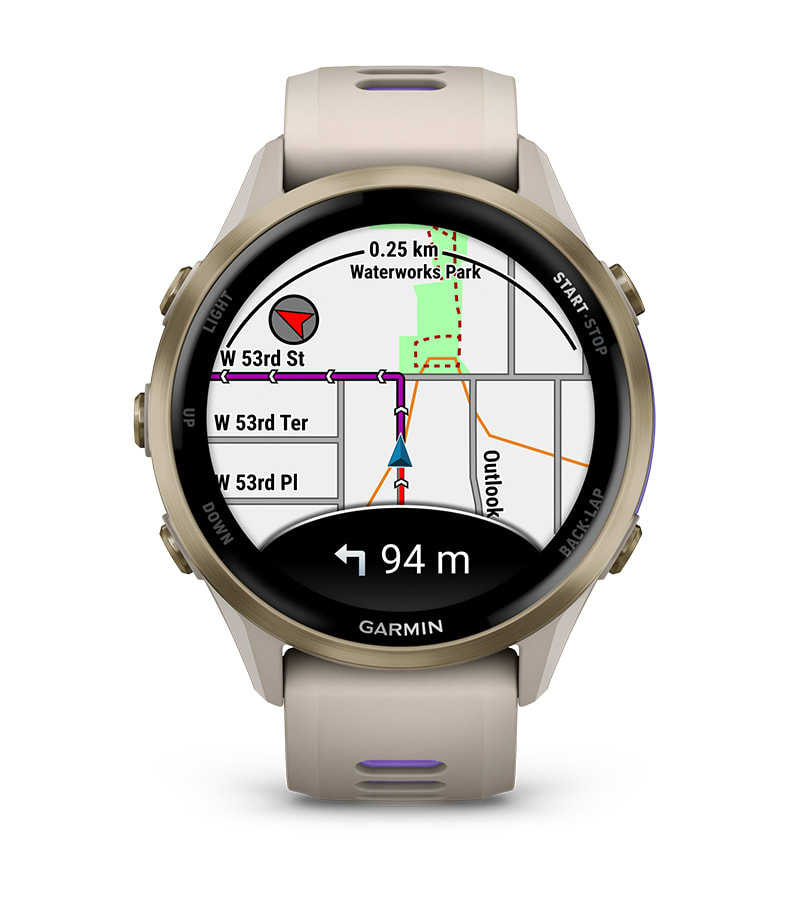
The build is where the premium positioning earns its keep. You get a 1.4-inch AMOLED panel at 454 x 454, protected by a sapphire lens and ringed by a titanium bezel, with a 50-metre water rating. Reviewers have been consistent that this is the brightest screen Garmin has shipped, brighter even than the pricier Fenix 8. If you have squinted at a transflective Forerunner in low winter light, the upgrade is real and immediate, and it is the same premium screen-and-materials story I flagged in the wider case for skipping a smartwatch upgrade this year.
The running-science metrics that justify the badge
This is the part that matters if you actually train rather than just track. The 970 introduces Running Economy, Running Tolerance and Step Speed Loss, and pairs them with a sharpened Training Readiness score that reads your sleep, HRV and recent load to tell you whether to push or back off. Running Tolerance is the one I find most interesting on paper: it tries to flag when your weekly running load is creeping into injury territory, which is exactly the kind of nudge most amateur club runners ignore until something twinges. Garmin pitches these as decision-making tools, not vanity numbers, and that framing is fair.
Image: Garmin
Accuracy is the foundation under all of it, and here the news is good. Writing in his in-depth July 2025 review, the5krunner called the dual-frequency GPS performance genuinely excellent and class-leading, which is the verdict you want before you let a watch tell you to ease off training. The on-wrist ECG and the LED torch round out a feature set that, on raw capability, leaves most mainstream smartwatches behind. If you are weighing this against a lifestyle watch, my Pixel Watch 4 review and the Galaxy Watch 8 versus Apple Watch Series 11 comparison show how differently those platforms prioritise running depth.
Garmin’s own overview walks through the headline features if you want to see the screens in motion before you commit.
That polish on the data side is real, but it is not the whole story, and pretending otherwise would do you a disservice.
The battery question and the bugs owners keep flagging
Here is where I get candid. That gorgeous AMOLED screen comes at a cost, and owners have noticed. Garmin quotes up to 15 days in smartwatch mode, down from 23 days on the Forerunner 965, and around 21 hours in all-systems multi-band GPS. The5krunner’s real-world testing landed closer to 20 to 24 hours with always-on display and SatIQ enabled. Owners on the r/Garmin subreddit through 2025 and into 2026 have been blunter still, with one widely echoed complaint that the battery life is a joke and that dimming the screen to claw it back defeats the point of buying a bright AMOLED in the first place. That is a fair tension, and you should go in knowing it.
This is a watch that wants to be both a beautiful everyday smartwatch and a multi-day ultra tool, and at launch it could not quite be both at once.
Image: Garmin
The5krunner’s July 2025 review also catalogued launch-software rough edges: slow map rendering, sluggish workout saving, the odd unexpected reboot and a fiddly setup. Some of that softens with firmware over time, the usual Garmin pattern, but it is honest to say the 970 did not arrive flawless. It is the same reason I keep telling people not to assume newer always means better, a theme I dug into with the Huawei Watch GT 6.
Forerunner 570 or Apple Watch Ultra: the honest cross-shop
This is the comparison that should decide your purchase. The cheaper Forerunner 570 starts at £459.99 and shares a surprising amount with the 970: the same Elevate Gen 5 heart-rate sensor, the speaker and microphone, skin-temperature tracking and multi-band GNSS. What you give up is the headline stuff. The 570 has no LED torch, no ECG, no onboard maps, no ClimbPro, and crucially it drops the new Running Economy, Running Tolerance and Step Speed Loss metrics. It also swaps the titanium bezel and sapphire lens for aluminium and Gorilla Glass, and storage falls from 32GB to 8GB.
So the £170 gap buys you maps, the new running science, the safety features and the harder-wearing materials. If you are a data-led runner who will genuinely act on Running Tolerance, that is money well spent. If you mostly want accurate pace, a great screen and solid coaching, the 570 is the smarter buy and I would not let anyone shame you out of it. For how differently the wellness crowd weighs cost, my Galaxy Ring long-term review and the Oura subscription breakdown are worth a read.
Against the Apple Watch Ultra family, which starts at £799 on the Apple UK store, the calculus is simpler than it looks. The Ultra is the better all-round smartwatch if you live inside an iPhone. But for structured run and triathlon training, multi-day battery and the depth of Garmin’s metrics, the Forerunner 970 is the specialist tool, and it costs meaningfully less. If you flip between health watches, the fainting-detection coverage is a useful primer on where that wider category is heading.
Where to buy in the UK
Stock is plentiful as of 19 June 2026. The official Garmin UK store lists it at £629.99 RRP, which is the safe baseline for warranty and the full colour range. Specialist running and cycling retailers have generally undercut that: Tredz, Sigma Sports and Start Fitness have all listed the titanium model in the £590 to £600 region, and price-comparison trackers were showing a low of around £592 at the time of writing. Amazon UK has carried it at varying prices, so it pays to check the live figure rather than assume a deal. My advice: treat anything near or below £600 as the going rate and do not pay the full RRP unless you specifically want a colour only Garmin stocks.
Image: Garmin
The Garmin Forerunner 970 verdict: who I would tell to buy it
So here is my decisive call. The Garmin Forerunner 970 is the running watch I would point a committed club runner or triathlete towards without hesitation. The screen is the best Garmin makes, the GPS is class-leading, the new running-science metrics are genuinely useful if you act on them, and the maps, torch and ECG are real advantages over almost everything else at the price. The catch is equally real: the battery is thirsty with the screen on, and the launch software needed patience. If you are a once-a-week parkrunner who just wants accurate pace and a lovely screen, save your money and buy the Forerunner 570, because you will not touch most of what the 970 charges you extra for.
Buy the 970 if you train with intent and will use Running Tolerance to stay healthy. Buy the 570 if you mostly want a brilliant screen and accurate runs. Either way, you are not buying a budget watch, and neither pretends to be one.
We use cookies to make this site work, measure how it is used, and (with your consent) personalise advertising. Strictly necessary cookies always run. Analytics and advertising cookies run only if you accept. See our Cookie Policy and Privacy Policy.
MobileTechWorld Ltd — Companies House registration 16224011. Independent UK technology publisher since 2009.









Reader discussion
Leave a comment
Comments are moderated. Keep it useful, accurate, and on topic.