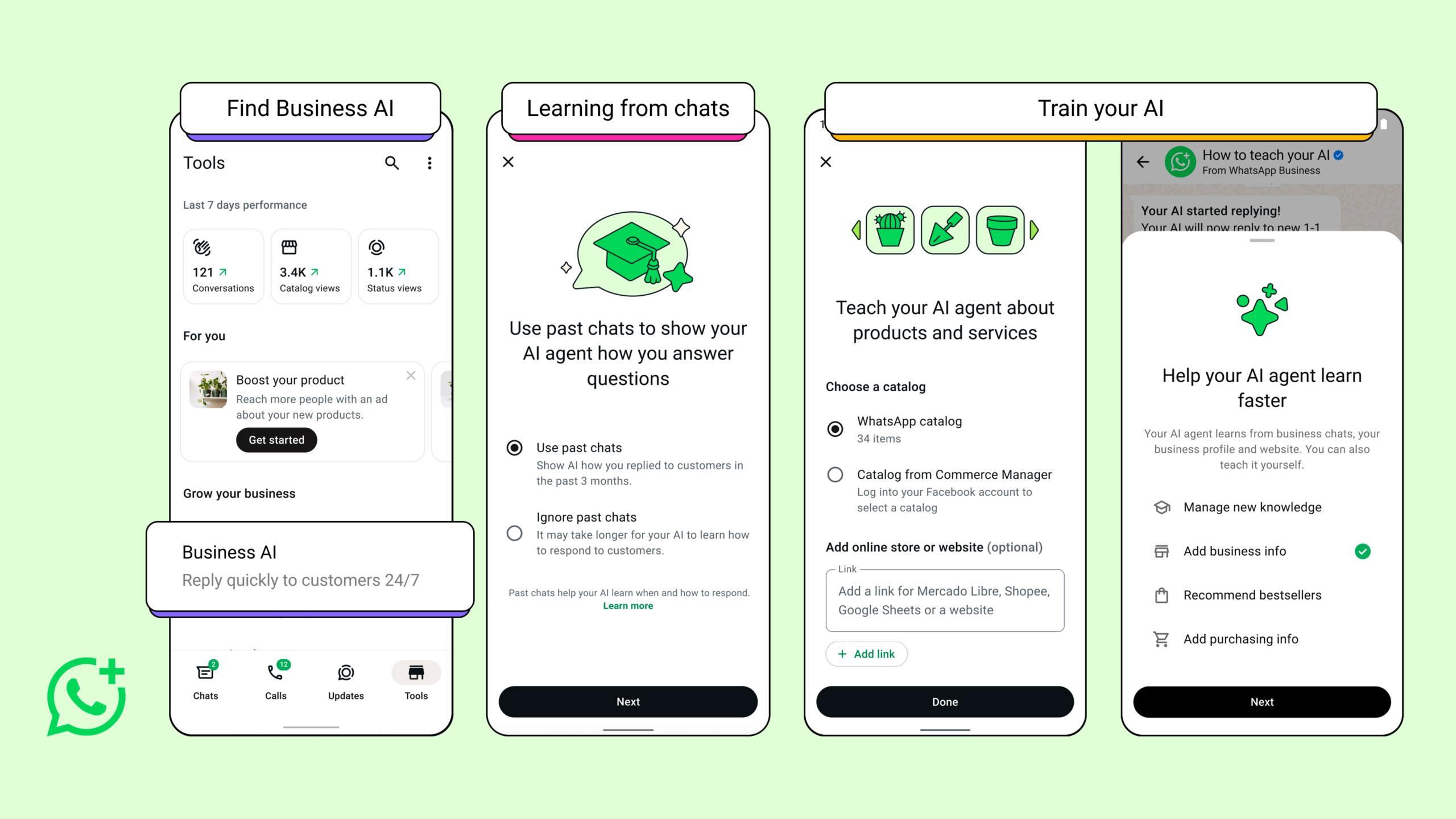
Meta launched Business AI on WhatsApp for small businesses in India on 14 May 2026. The pitch is exactly what every UK small business owner who runs a side hustle on WhatsApp has been quietly hoping for: an always-on customer service agent built into WhatsApp Business that answers FAQs, captures leads, books appointments and — soon — handles payments. Soil Concept, a plant-based personal care startup that piloted the tool, claims an 80–90 percent conversion rate and a customer base now over 15,000. India got the feature first. The UK has not been given a launch date.
That last sentence is the news for British readers. Business AI on WhatsApp is a meaningful shift in how small businesses sell on a platform where 33 million UK adults already have an account. Whether it arrives here in summer 2026, late 2026 or 2027, every UK small business that uses WhatsApp Business — solicitors, hairdressers, dog walkers, MOT garages, independent retailers — should be reading the India playbook now and getting ready. This piece breaks down what Meta actually shipped, what UK regulation will require Meta to change before launching here, which UK businesses have most to gain, and what you can do today to be ready when it lands.
What Meta actually shipped in India
Business AI on WhatsApp is bolted into the existing WhatsApp Business app — the free version that around 20 million Indian micro-businesses already use. It is not a separate app, not a paid add-on, and not the WhatsApp Business Platform that enterprise customers use via the cloud API. That distinction matters: Meta is targeting the same micro-merchant market that buys plants in pots, sells home-cooked food, takes appointments for nail salons, and is too small to integrate a third-party CRM or chatbot.
The setup process Meta describes works like this. A business owner trains Business AI by pasting in product descriptions, prices, delivery information, opening hours, FAQs and any other context they want it to handle. The AI then responds in the business’s tone to customer queries about products, prices, discounts, shipping and stock, in any of the major Indian languages — Hindi, Tamil, Telugu, Kannada, Bengali, Marathi and more. It can also capture leads (name, requirement, contact), book appointments into a calendar, and pass the conversation back to a human when the customer asks for one or when the AI is uncertain.
The roadmap, per Meta, includes UPI payments inside the chat — the customer asks the AI for a product, agrees the price, and pays directly via UPI without ever leaving WhatsApp. That payments piece is what separates Business AI on WhatsApp from every other WhatsApp chatbot tool already on the market. Meta is closing the loop between conversation and conversion inside its own app, with no third-party plug-in fees, no payment gateway integration, and no checkout abandonment.
Why this is harder to ship in the UK
The India launch works partly because the regulatory landscape there for AI customer service is lighter than the UK’s. Meta needs to clear at least four hurdles before Business AI lands cleanly in Britain.

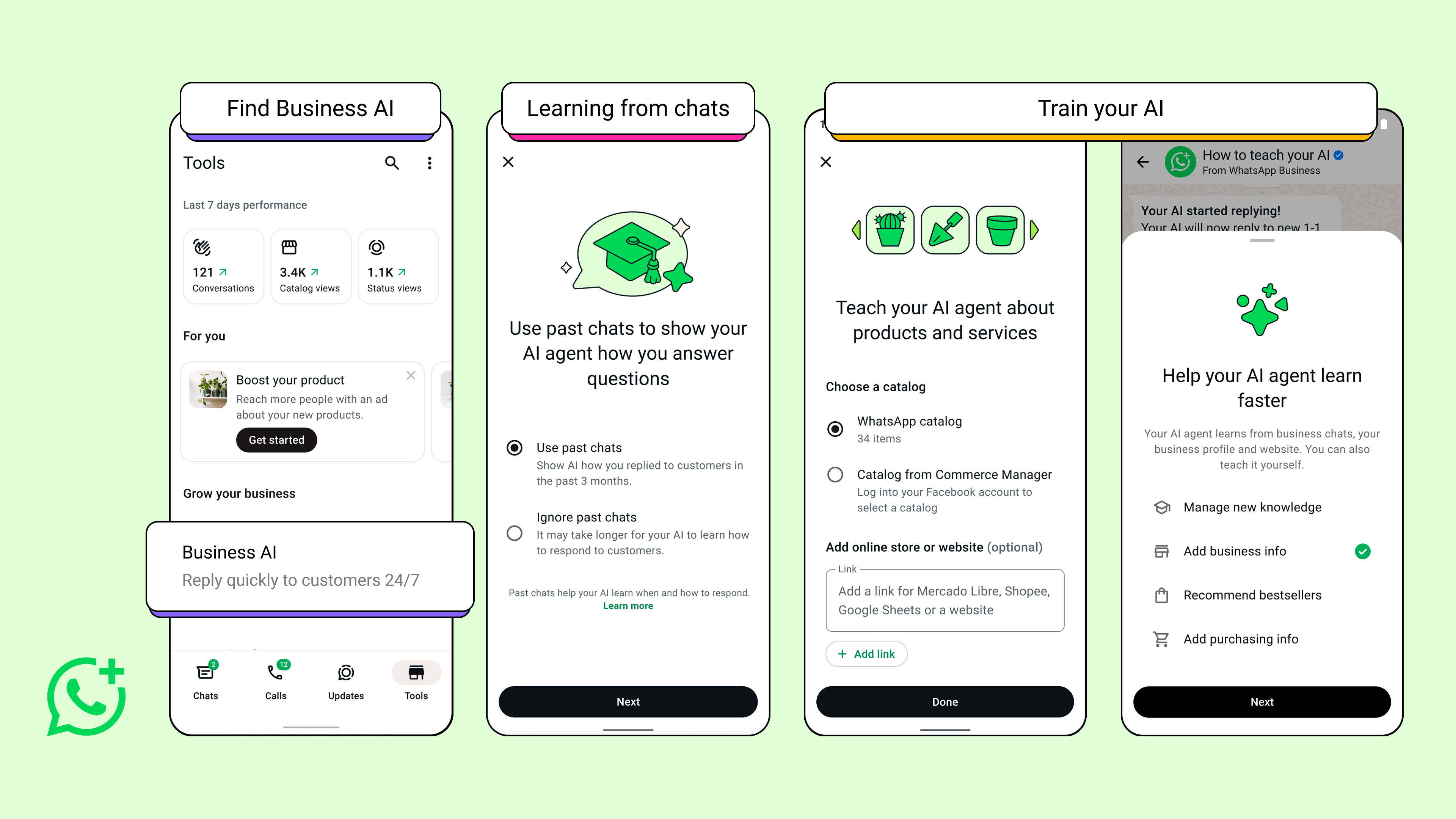
The first is GDPR. The AI is trained on the business’s data and operates over conversations that include personal data — phone numbers, names, addresses, payment intent. Under UK GDPR Article 22, an automated decision-making system that has a “legal or similarly significant” effect on someone requires the business to inform the customer and offer a route to a human. Meta will need to bake an explicit disclosure (“You are chatting with an AI agent. Type ‘agent’ to speak to a person”) into the UK version — and the ICO has been clear in 2026 guidance that burying that in a 200-word T&C is not enough.
The second is the EU AI Act, which applies in Northern Ireland under the Windsor Framework and is being mirrored in proposed Westminster legislation expected to clear the Lords by autumn 2026. Conversational AI used for customer service is currently classified as limited-risk under the Act, which means a transparency obligation (customers must be told they are talking to AI) and a logging obligation (the business must keep records of significant decisions taken by the AI). Meta will need to give UK small businesses a one-click log export to meet that.
The third is FCA territory for any UK business handling regulated financial services — a sole trader insurance broker, a mortgage adviser, a small payments firm. The FCA’s 2026 guidance on AI in financial services explicitly prohibits unsupervised AI from giving regulated advice without a senior manager (SMF24 or equivalent) accountable for the output. Meta will need to ringfence FCA-regulated business categories from the AI advice flow, the same way Stripe currently restricts merchant categories.
The fourth is payments. UPI does not exist in the UK. Meta will need to plumb Business AI into UK payment rails — almost certainly Open Banking via PayPal, Stripe or a direct Faster Payments integration. That is a deeper engineering job than the India launch and is the most likely reason the UK rollout will lag India by 6–18 months.
Which UK small businesses have most to gain
The UK businesses that will benefit fastest when Business AI lands are the ones already losing leads to time zones. A solo solicitor who runs conveyancing enquiries on WhatsApp Business gets messages at 9pm Sunday from people about to make an offer on a house Monday morning. They cannot reply until Monday. The customer goes elsewhere. An AI that handles the initial fact-find, schedules a Monday morning call, and confirms the firm’s typical fee range, captures a lead that is otherwise lost.
Independent retailers in the £100,000 to £1.5 million turnover band — the typical UK independent boutique, gift shop or specialist food business — are the second clear winner. WhatsApp Business is already the second-largest customer-service channel for this segment after email. Adding an AI that answers “do you have this in green, size 14” without a human present unlocks Sunday and Monday morning sales the shop never sees.
Tradespeople — plumbers, electricians, gardeners — are the third. The current pain point is the same: the homeowner texts at 7pm Saturday after the boiler dies, the tradesperson is in the pub, the message gets missed, the homeowner has already called someone else by Sunday morning. An AI that triages “is it urgent, do you need a same-day call-out, here is our weekend rate” and books the slot keeps the work in-house.
The categories where Business AI is a poor fit are anything FCA-regulated, anything involving health advice (CQC and ASA both will object), and anything where the cost of getting the answer wrong is high (legal advice on contentious matters, immigration advice, debt counselling). UK businesses in those categories should plan to use Business AI strictly for top-of-funnel triage — “tell me your situation, when can you come in” — and never for substantive advice.
What you can do today to be ready
The single most useful preparation right now is a documented FAQ. Open WhatsApp Business, look at the last 200 messages, and tally the questions. Most UK small businesses answer the same eight to fifteen questions over and over — price, lead time, delivery area, opening hours, parking, vegan option, do you take card, what is the deposit. Write the answers in plain English, in your business’s voice, in a single shared document. When Business AI lands, you will paste that document in and be live in 20 minutes. Without it, you will be back at the same blocker.
The second is a clean WhatsApp Business catalogue. Meta’s catalogue feature lets you list products with prices and photos, which the AI will pull from to answer “do you have X”. Most UK small businesses have ignored the catalogue. Fill it. Photograph everything you sell, set a price, add a stock note. Even if Business AI never arrives, a catalogue makes the existing app dramatically more useful.
The third is a quick GDPR review. If you collect customer phone numbers via WhatsApp, you should already have a privacy notice. When AI joins the conversation, that notice will need to add: “We use an AI assistant to respond to initial enquiries. Your messages are processed by Meta and used to generate replies. Reply ‘AGENT’ at any time to speak to a person.” Draft that line now and add it to your existing notice on next update.
Where Meta will sell Business AI in the UK
Business AI will not be sold through retailers. It will be a feature inside the free WhatsApp Business app, which UK small businesses can already download. Here is how the UK rollout is likely to land based on Meta’s pattern with previous features:
- WhatsApp Business app (free, via Google Play and the App Store): This is where the feature will appear when Meta switches it on for UK accounts. No purchase, no subscription tier announced. Pricing has not been disclosed for paid tiers — Meta’s prior behaviour suggests a free tier with usage caps and a paid tier above a message threshold, likely tied to a UK pricing structure of £15–£50/month.
- WhatsApp Business Platform (Cloud API): The enterprise tier already exists with per-conversation pricing. Meta currently charges UK businesses £0.029–£0.123 per conversation depending on category (service vs marketing). Business AI in the Platform tier will likely arrive alongside or before the SMB feature lands.
- BT Business, Vodafone Business, EE Business: All three currently bundle WhatsApp Business onboarding into their SME packages. When Business AI lands, expect bundled training and setup support from the carriers’ digital teams, especially BT Business which has been pushing AI-enabled small business tools through 2026.
- Local Enterprise Hubs and Growth Hubs: The 38 UK Growth Hubs offer free digital skills support and will run sessions on Business AI within weeks of launch. If you want hand-holding without paying a consultant, this is the right door.
The strong recommendation if you are a UK small business owner reading this: download the free WhatsApp Business app today if you do not already have it, run your business through it for a month, get the FAQ and catalogue clean, and you will be ready the day Meta turns the feature on for the UK.
Should you wait for it
Do not wait. The UK already has perfectly serviceable WhatsApp chatbot tools — Wati, Trengo, Respond.io and a half-dozen others — that integrate with WhatsApp Business Platform and offer AI-assisted replies today. Pricing starts around £29/month. If you are losing leads outside business hours right now, the answer is to fix that this month, not wait six months for Meta’s free version.
Meta’s offering, when it arrives, will be free, native and probably easier to set up than any third-party tool. It will also be less powerful than the paid alternatives on day one — Meta tends to ship lean and add features. The play for most UK small businesses is to use a paid third-party tool now, get the workflow right, and migrate to Meta’s native option when it lands if pricing and features make sense.
The MTW verdict
The India launch of Business AI on WhatsApp is a meaningful signal that Meta is serious about the small business segment in messaging. The UK rollout is coming — the regulatory work and the payments integration take time, not commitment. UK small businesses that prepare now (FAQ document, catalogue, GDPR notice) will be live in an afternoon when the switch flips. Those that wait will spend three weeks scrambling after launch. Build the prep now. Use a third-party WhatsApp chatbot tool in the meantime if you are losing leads. Watch Meta’s UK blog at about.fb.com/news/category/europe/ for the announcement.
| Takeaway | What it means for UK readers |
|---|---|
| UK launch timing | Q4 2026 at the earliest; pending Ofcom OSA guidance |
| First-line automation scope | Bookings, order tracking, FAQ replies |
| Human escalation | Complaints, refunds, complex queries still require staff |
| UK GDPR lawful basis | Legitimate interest with clear customer disclosure |
| UK reach advantage | 87% of UK adults already have a WhatsApp account |
What we like, what we’d watch
| What we like | What we’d watch |
|---|---|
| UK WhatsApp reach (87% of adults) makes business AI a real friction win for UK SMEs | Online Safety Act implementation timing is the gating factor for UK launch — Ofcom still working through guidance |
| First-line FAQ automation genuinely reduces UK SME staff load on repetitive queries | UK GDPR lawful basis is unsettled for AI-mediated business messaging — ICO position pending |
| Meta’s ad reach inside WhatsApp gives UK SMEs a cheaper customer acquisition channel than Google or Facebook | Customer complaint escalation still needs human staff — automation savings will be smaller than India case studies |
UK reader FAQ
What is WhatsApp Business AI?
How much does WhatsApp Business AI cost in the UK?
Is WhatsApp Business AI GDPR-compliant for UK businesses?
Can I use WhatsApp Business AI for appointment booking?
Where can UK small businesses sign up for WhatsApp Business AI?
How does WhatsApp Business AI compare with Instagram DMs for UK SMEs?
When does WhatsApp Business AI launch in the UK?
Will WhatsApp Business AI replace UK small business customer service agents?
Is WhatsApp Business AI compliant with UK GDPR?
Further reading: UK sources we used
- Meta for Business UK
- Ofcom Online Safety Act
- ICO AI and data protection guidance
- HMRC self-employment guidance
- Meta WhatsApp Business Platform
- UK Government Online Safety Act guidance
Related on MTW
MMTW Editorial
Buyer action
Where to buy or check next
Use this as the final check before ordering a phone, changing network or trusting a headline monthly price.












Reader discussion
Leave a comment
Comments are moderated. Keep it useful, accurate, and on topic.