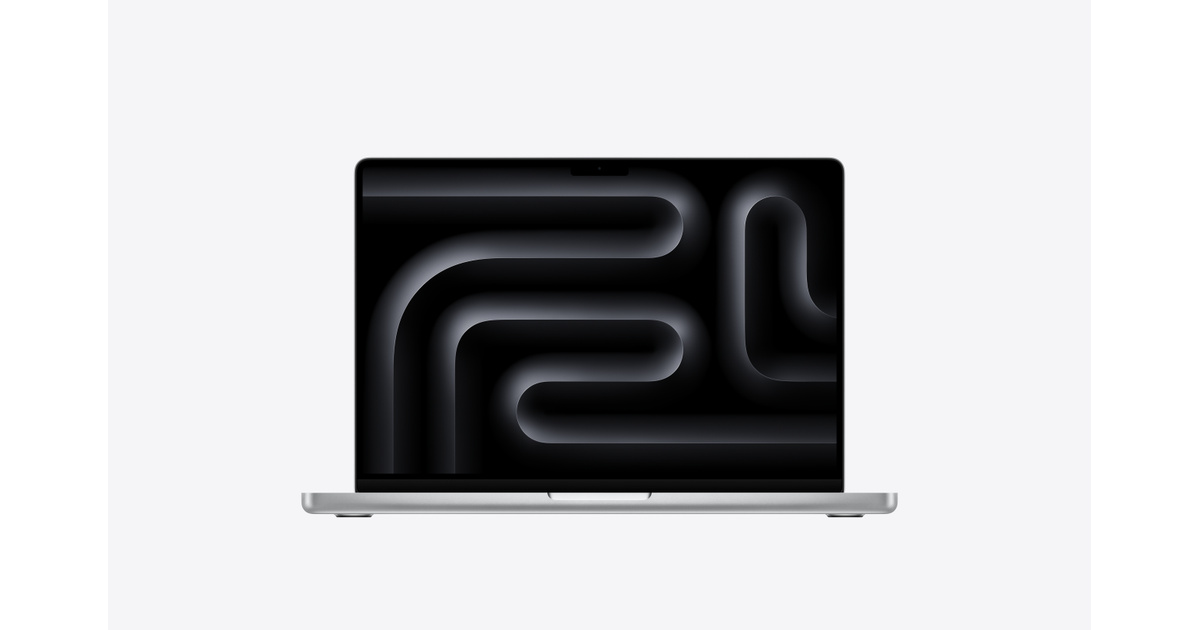
For once, the most interesting line on an Apple spec sheet isn’t the chip, it’s the storage. When Apple introduced the M5 Pro and M5 Max MacBook Pro on 3 March 2026, the 14-inch M5 Pro quietly doubled its starting SSD to 1TB. The base price held at £2,199. That single swap reframes the whole machine for the people Apple actually built it for, and it’s the change I keep coming back to.
Let me deal with the calendar first, because it’s tidy. Pre-orders opened in the UK on 4 March 2026, with deliveries and in-store stock from 11 March. If you’re reading this trying to work out whether to wait, you’re not waiting for anything: it’s on shelves now.
What £2,199 actually buys you (MacBook Pro 14)
The entry 14-inch M5 Pro lands at £2,199 with 24GB of unified memory, that new 1TB SSD, and a choice of space black or silver. Apple’s own base configuration pairs a 15-core CPU with a 16-core GPU. On paper that’s an unremarkable Apple opening price, the same £2,199 the 14-inch Pro tier has sat at for a while now. The difference is what’s underneath it, and it is worth weighing against the cheaper base M5 in the MacBook Air M5 versus Pro M5 decision.

Last generation, £2,199 bought you 512GB. To get to 1TB you paid Apple’s notorious storage tax, roughly £200 to double a part that costs the trade a fraction of that. So while the headline number hasn’t moved, the machine behind it is materially better value than the one it replaces. You’re getting the upgrade most buyers used to grudgingly tick at checkout, baked in for free. That free doubling lands at a useful moment, too, because as I covered in the 2026 memory price squeeze, storage and RAM have been climbing hard everywhere else.
The performance numbers, with the asterisk they deserve
Apple’s launch figures claim the M5 Pro is up to 30% faster on CPU and 50% faster on GPU than the M4. For AI workloads it quotes 4x the performance of M3 and 8x of the M1.
Read those comparisons carefully. The eye-catching multiples are measured against M3 and M1, chips two and four years old. If you’re on an M4 machine, the honest delta is the 30/50% generational step, and that’s the number I’d hold Apple to. It’s a real gain, but it’s an upgrade-every-few-years gain, not a drop-everything one. If your interest is in the heavier end of the range instead, the M5 Max versus M4 Max comparison is the one to read next.
If you’re coming off an M1 Pro the jump is genuinely dramatic; if you’re on an M4, you’re buying a faster machine, not a different one.
Where the multiples do matter is local AI. The GPU’s neural acceleration is doing the heavy lifting for on-device generative tools, upscaling and the kind of machine-learning passes that have crept into editing suites. If your work has tipped into that territory in the last year, the 4x-over-M3 claim is the line that should make you sit up: that’s the workload Apple is chasing.
Apple has stopped selling speed and started selling storage you no longer have to argue yourself into. For working creators, that is the more honest pitch.
Why this one’s aimed squarely at creators
The 1TB floor is the tell. Video editors, photographers and music producers are the buyers who hit a 512GB ceiling within weeks: a single ProRes project or a sample library swallows it. Making 1TB standard is Apple admitting the entry Pro was always slightly under-specced for its own target audience. It also reads as a quiet answer to the rise of capable Windows creator laptops like the Asus ProArt P16.
Go further up the stack and the ceilings climb fast. The M5 Pro configures up to 4TB of SSD; the M5 Max stretches to 8TB and 128GB of unified memory. That 128GB number is the one for anyone running large local models, multi-stream 8K timelines or heavy 3D: it’s headroom you simply can’t buy in a laptop of this footprint elsewhere. If your day is spent in a colour grade or an edit, the panel and the silicon also raise the stakes in the perennial Final Cut versus DaVinci Resolve question.
There’s a connectivity upgrade worth a line too. The new N1 chip brings Wi-Fi 7 and Bluetooth 6. For most people that’s a future-proofing footnote, but if you offload terabytes of footage over the network at the end of a shoot, Wi-Fi 7 is the kind of quiet quality-of-life gain you only notice when it’s gone.
The bit that would give me pause
At £2,199 the base machine is the sweet spot, but Apple’s pricing ladder still punishes ambition. Climb toward 4TB on the M5 Pro, or step up to an M5 Max with serious memory, and you’re into the kind of money where the spec sheet stops feeling generous and starts feeling like leverage. The free storage bump giveth at the bottom of the range; the upgrade pricing taketh away further up. If you genuinely need that ceiling, weigh whether a tablet-led setup like an iPad Pro as a laptop replacement covers part of the load instead.
And the 30/50% generational claim cuts both ways. It’s enough to justify replacing an ageing machine. It is not, on its own, enough to justify trading in a perfectly good M4 Pro after a year, no matter how the 8x-over-M1 headline is framed.
What I’d actually do at £2,199
If you’re a creator on an M1 or M2 Pro, this is an easy call: the base 14-inch M5 Pro at £2,199 is the most coherent that entry configuration has ever been, and the free jump to 1TB is the closest Apple comes to a discount. Buy it and don’t look back.
If you’re already on M4, sit tight: you’re being sold a generational step dressed up as a generational leap, and your machine will hold its own for another cycle. And if you’re eyeing the M5 Max with 128GB and 8TB because your timelines or your models genuinely demand it, go in clear-eyed: the silicon is extraordinary, but you’ll pay Apple handsomely for every extra terabyte. The one thing that would change my mind on holding off is independent benchmarks showing that local-AI multiplier holds up in real editing software rather than Apple’s own slides. Until then, the 1TB base is the story, and it’s a good one.
Buyer action
Where to buy or check next
Use this as the final check before ordering a phone, changing network or trusting a headline monthly price.














Reader discussion
Leave a comment
Comments are moderated. Keep it useful, accurate, and on topic.