
Apple Studio Display (2026) review: does it still make sense for UK creators?
Apple Studio Display 2026 keeps the same 5K panel at £1,499, so does this modest refresh, or the £2,999 XDR, make sense for UK creators?
The Apple Studio Display has been on sale for four years with the exact same 27-inch 5K panel, and the 2026 refresh that landed on 3 March 2026 does not change that one bit. Apple confirmed in its UK Newsroom announcement that the standard model holds at £1,499 (£1,409 for education), keeps the same 5K 60Hz screen at 600 nits, and adds an A19 chip, a 12MP Centre Stage camera, six-speaker spatial audio and Thunderbolt 5 with two extra USB-C ports. So the panel you stare at all day is untouched, which makes this a more interesting decision than the spec sheet first suggests.
What I would tell a creator in a hurry
- Standard Studio Display refresh: £1,499 (edu £1,409), on sale 11 March 2026, same 27-inch 5K 60Hz 600-nit panel as 2022.
- New silicon: A19 chip, 12MP Centre Stage camera, six-speaker spatial audio, Thunderbolt 5 plus two USB-C.
- The headline act is the all-new Studio Display XDR at £2,999: mini-LED, 120Hz adaptive, 2,000-nit peak HDR, 2,304 dimming zones.
- If you already own a 2022 Studio Display, the refresh is not the upgrade. The XDR might be.
| Spec | Studio Display (2026) | Studio Display XDR |
|---|---|---|
| UK price | £1,499 (edu £1,409) | £2,999 |
| Panel | 27-inch 5K, 600 nits | 27-inch 5K mini-LED, 2,000-nit peak HDR |
| Refresh rate | 60Hz | 120Hz adaptive |
| Local dimming | None | 2,304 zones |
| Chip | A19 | A19 |
| Best for | Everyday 5K desk, calls, audio | HDR grading, colour-critical work |
What the £1,499 refresh actually changes
Let me be blunt about the standard model, because Apple’s own marketing will not be. The screen is the same. Same 5,120 by 2,880 resolution, same 60Hz ceiling, same 600 nits of sustained brightness, same matte or nano-texture glass options. If image quality at the desk is your only concern, a 2022 unit and a 2026 unit will look identical side by side. That is not me being cynical, it is what the spec sheet says once you strip out the chip name.
What you are paying the same £1,499 for now is the supporting cast. The A19 chip replaces the ageing A13, which mattered most for the webcam: the new 12MP Centre Stage camera should finally drag the Studio Display’s video calls up to the standard you get on a current MacBook. The six-speaker spatial audio array is a genuine upgrade if you mix or monitor at the desk, and Thunderbolt 5 with two additional USB-C ports turns the panel into a more capable dock for anyone running a MacBook Pro 14 with M5 Pro as their main machine. None of that is nothing. It is just not the screen.
That Thunderbolt 5 port matters more than the marketing lets on, because it is the part of this refresh a working creator will actually feel day to day. One cable to the Mac carries the picture, charges the laptop and hangs an SSD, a card reader and a wired network adapter off the back of the display, which is exactly the tidy single-cable desk Apple keeps selling and the standalone-monitor crowd keeps undercutting on price. If your edits live on fast external storage, the extra bandwidth headroom over the old Thunderbolt 3 panel is the quiet upgrade that justifies buying new rather than second-hand.

One thing I would flag before anyone reaches for a card: £1,499 is the floor, not the ceiling. Apple still charges extra for the nano-texture glass and again for the tilt-and-height-adjustable stand, and on a unit you will keep on a desk for years I think the height-adjustable stand is the option most UK buyers regret skipping. Configure the display you actually want, then compare that real total against a third-party 5K panel, not the headline £1,499.
Apple charged the same £1,499 and changed everything except the part you look at. For most desks, the camera and the speakers are the real story.
For a creator weighing a 5K Apple panel against a sharp third-party alternative, the calculus is unchanged from last year. If you want HDR and high refresh for less money, the OLED route I covered in my 4K 240Hz OLED MSI vs Gigabyte comparison still gets you more raw spectacle per pound. What the Studio Display sells is the tidy single-cable Mac experience and that 5K pixel density, and the 2026 refresh keeps both intact while quietly fixing the webcam everyone complained about.

The XDR is the upgrade Apple actually wanted to sell
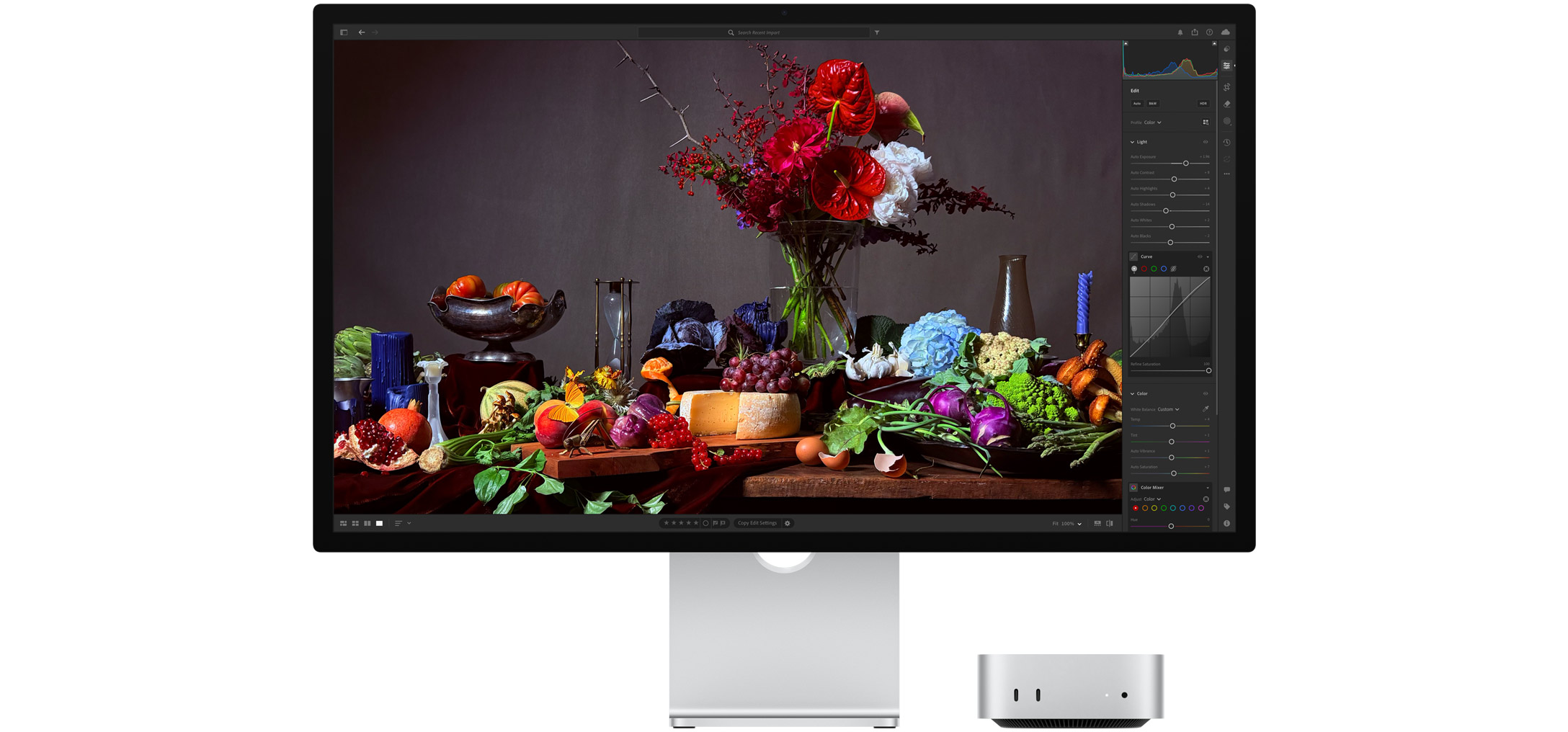
The all-new Studio Display XDR is where the engineering went, and at £2,999 it is exactly double the standard model. For that you get a mini-LED backlight with 2,304 individually controlled dimming zones, a 120Hz adaptive refresh rate and 2,000 nits of peak HDR brightness. In plain terms, this is a 27-inch 5K version of the panel technology that previously lived only in Apple’s pricier Pro Display XDR and the high-end MacBook Pro screens. If you grade HDR video or work to a reference standard, that jump from 600 to 2,000 nits and from zero dimming zones to 2,304 is the whole point.
What makes the XDR interesting is where it sits in Apple’s own line-up. It brings 5K pixel density and a modern mini-LED backlight to a price well under the long-in-the-tooth Pro Display XDR, which means the colour-critical creator no longer has to step up to Apple’s most expensive screen to get reference-grade HDR at desk resolution. For a UK studio that bills HDR deliverables, that is a real shift in what a calibrated Apple panel costs to put on the desk.
Whether £2,999 is sane depends entirely on what feeds it. If you are editing in Final Cut Pro or DaVinci Resolve and your client deliverables are HDR, the XDR earns its keep because it is one of the few desktop panels that can actually display what you are exporting. Pair it with an M5 Max MacBook Pro and you have a colour pipeline that holds together from camera to timeline to screen. For everyone else, a 120Hz mini-LED panel is a lovely luxury that your work will never need.
Should a 2022 Studio Display owner move on
Here is the question I keep getting from people who bought in 2022, and my answer is mostly no. Selling a perfectly good £1,499 5K panel to buy the same 5K panel with a better webcam is not a trade I would make. The camera and speaker fixes are welcome, but they do not justify the depreciation hit and the hassle. If your 2022 unit works, keep it, and put the money toward the machine driving it.
If the old webcam genuinely grates on you, a £100-ish external camera clipped to the top fixes it for a fraction of the cost of a new display, and you keep the panel you already paid for. That is the maths I would do before trading in, because the resale value of a four-year-old Studio Display will not be kind once a visibly newer model is on the shelf next to it.
The one exception is the creator who genuinely needs HDR and high refresh and has been making do with the flat 600-nit panel. That person should not buy the refresh at all, they should jump to the XDR. For the rest, the Studio Display still slots neatly into the same Apple ecosystem reasoning that makes an iPad Pro a credible laptop replacement or pushes people from a MacBook Air M5 to the Pro: it is bought for how cleanly it fits, not for any single headline number.

Where I land after living with the numbers
Reading Apple’s UK Newsroom release and the UK product page back to back, my view is simple. The £1,499 refresh is a quietly sensible buy for a new Mac creator who wants a clean 5K desk with a webcam and speakers that no longer embarrass it, and the camera fix alone closes the gap that made the original feel dated. But it is a modest update, not a reason to upgrade, and anyone chasing HDR or 120Hz should walk straight past it to the £2,999 XDR. The honest takeaway: pick by the panel you need, not the chip Apple put behind it. My score: 7/10 for the standard refresh, with the XDR a more exciting machine for the narrow group who can use it.
Sources: Apple UK Newsroom announcement (3 March 2026) and the Apple UK Studio Display product page.
How we test
Buyer action
Where to buy or check next
Use this as the final check before ordering a phone, changing network or trusting a headline monthly price.










Reader discussion
Leave a comment
Comments are moderated. Keep it useful, accurate, and on topic.