
Meta Business AI has moved from a quiet India trial to a global rollout, and that shift matters for any UK small business that already lives inside WhatsApp. The idea is simple: an automated assistant that can answer customer questions, recommend products and capture leads inside a chat, around the clock, without you hiring an overnight support team. Meta first launched its “Business AI on WhatsApp” for small businesses in India in May 2026, then opened a broader version, the Meta Business Agent, to businesses globally at its Conversations 2026 event in London on 3 June 2026. This guide explains what these agents actually do, what UK firms can switch on today, and the data-protection questions you need to settle before you let software talk to your customers.
Key facts
- Meta launched Business AI on WhatsApp for small businesses in India on 14 May 2026, its first market for the feature.
- On 3 June 2026, at Conversations 2026 in London, Meta made the Meta Business Agent available to businesses globally across WhatsApp, Instagram and Messenger.
- Getting started is free; Meta says paid subscription tiers will follow in the coming months, and large businesses will be billed by usage.
- The agent answers questions, recommends products, books appointments, qualifies leads and hands the chat to a human when needed.
- Any UK firm using AI on customer chats remains subject to UK GDPR, and the ICO publishes specific guidance on AI and data protection.
What Meta Business AI actually does in a chat
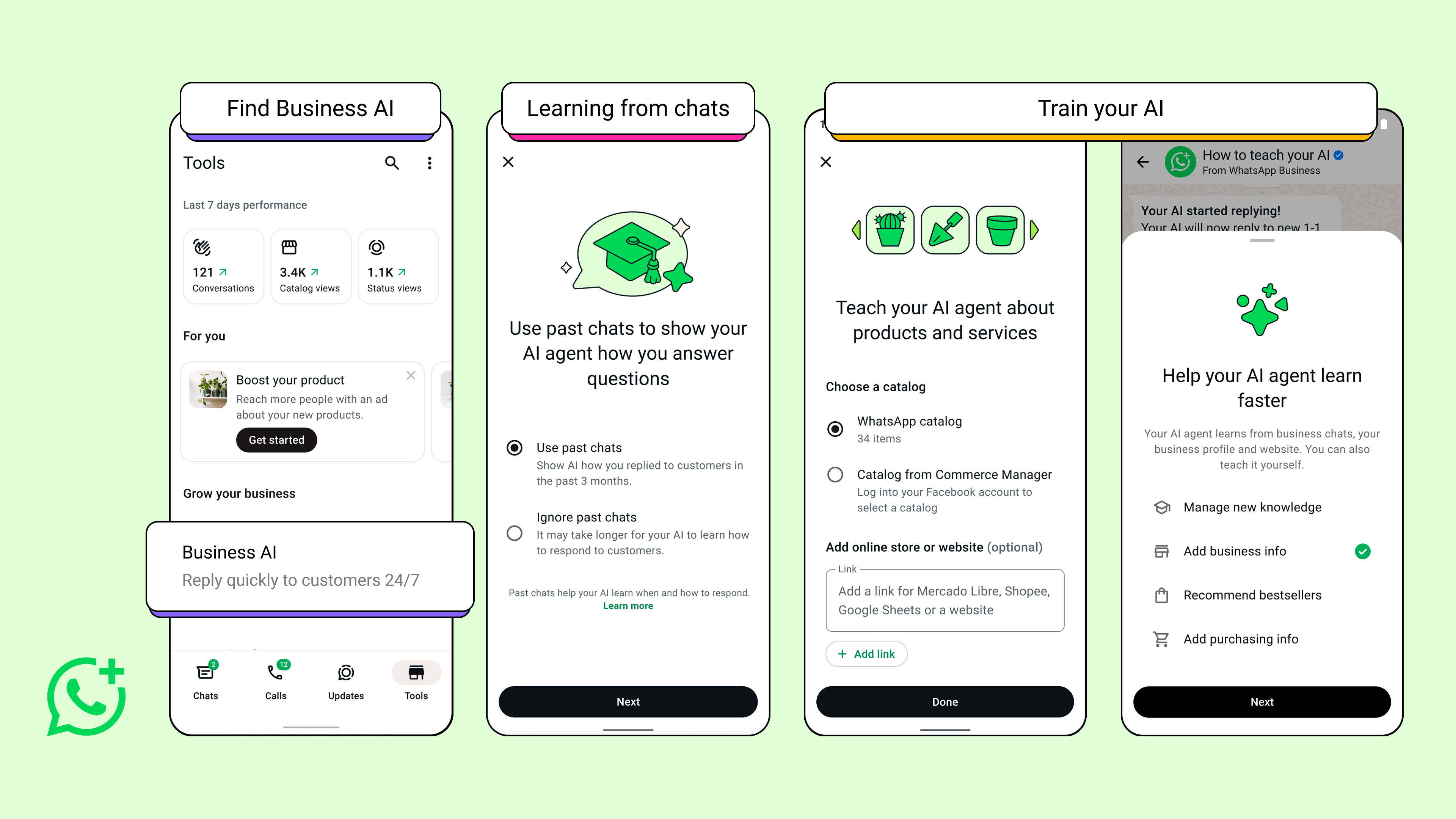
Strip away the marketing and a business agent is a configured assistant that sits on your WhatsApp Business number and replies to customers in your name. Meta’s India announcement describes a tool that responds to queries 24/7, recommends products, captures leads and helps with orders, all inside the WhatsApp Business app and without any coding. You feed it your own material: a product catalogue, an FAQ list, your opening hours, your returns policy and your website link. It then drafts replies that match that information, rather than inventing answers from the open internet.
The newer Meta Business Agent extends that pattern across Messenger and Instagram direct messages as well, and adds touches aimed at owners who cannot watch a phone all day. It can qualify a sales lead, book an appointment, push a recommended item from your catalogue and then hand the conversation to a team member when a person needs to step in. Meta also says owners get briefings on missed chats and summaries of what customers have been asking, which turns a pile of unread messages into something closer to a shift report. Crucially, the business stays in charge: you can jump into any chat, change how the assistant behaves or switch it off entirely.
Why Meta started in India before going worldwide
India was not a random choice. WhatsApp is woven into Indian commerce in a way it is not yet in Britain, with shoppers routinely browsing, asking and buying through chat. Ravi Garg, Director of Business Messaging at Meta India, framed the launch around that reality, saying: “Small businesses are the backbone of India’s economy, and we deeply understand the value of every customer conversation for them.” Meta built the India version in every native Indian language and signalled that payments through UPI inside a chat would follow, which tells you the company sees the agent as a full storefront, not just a help desk.
Running the feature in one high-volume market first let Meta test the awkward bits in public: how the assistant learns from past chats, how it picks the right catalogue item, and how owners react when an algorithm answers a customer for them. By the time of Conversations 2026, Meta said it had spent close to two years testing agents in markets such as India and Mexico, with more than a million businesses using earlier versions of the tools. The London launch then flipped the switch from limited trial to open access, so the lessons from India now ship to firms in Manchester and Cardiff as much as Mumbai.
The honest UK position right now
Here is the part the headlines blur. The Meta Business Agent announced in London on 3 June 2026 was billed as a global rollout, and Meta confirmed that getting started is free while paid tiers are prepared. The India-specific “Business AI on WhatsApp” experience, complete with native Indian languages and UPI payments, is a separate, country-tuned build and should not be read as the exact product a UK cafe or plumber will see. So the accurate framing is this: the broad agent is reaching UK businesses, but the polished, payments-in-chat version that made headlines from India is not the same thing, and Meta has not published a UK feature-by-feature breakdown.
That nuance protects you from two mistakes. The first is assuming nothing has arrived in Britain, when the agent has in fact been opened to businesses worldwide. The second is assuming the full India toolkit, including in-chat UPI payments, works here, when UPI is an Indian payments system with no UK equivalent baked into WhatsApp. Treat the announcement as a strong signal that AI customer chat is now mainstream on Meta’s platforms, then check exactly which controls appear in your own WhatsApp Business app before you promise customers anything. For the wider context on these tools landing with British firms, our coverage of WhatsApp business AI for UK SMEs is a useful companion read.
WhatsApp tools a UK firm can use today
You do not need to wait for any agent to get value from WhatsApp. The free WhatsApp Business app has been available to UK sole traders and small shops for years, and it already carries the boring-but-useful features that win customers: a business profile with your address and hours, a product catalogue, quick replies for common questions, greeting and away messages, and labels to organise chats. For most micro-businesses, switching these on is a faster win than any AI, because they set expectations and cut the time you spend retyping the same answer.
Firms that need more volume or more than one agent step up to the WhatsApp Business Platform, the paid, API-based tier built for higher message counts and integration with a customer system. This is where automated agents, ticketing tools and third-party chatbots have plugged in for some time, long before Meta’s own agent arrived. If you already run a Microsoft or Google stack, it is worth comparing how an assistant fits your existing software rather than bolting on something new; our look at Microsoft Copilot versus Google Gemini for UK business and our guide to Copilot for UK small business both help you place WhatsApp’s agent in a wider toolkit. For a balanced view of the rival assistants, see our Claude, Copilot and Gemini comparison for the UK.
UK data protection: what the ICO expects
The moment software reads and replies to a customer message, you are processing personal data, and UK GDPR applies in full. The Information Commissioner’s Office publishes detailed guidance on AI and data protection that maps the usual principles onto AI systems: you still need a lawful basis, you must minimise the data you collect, you must keep it accurate, and you must be transparent about what the system is doing. Letting an agent handle chats does not move that responsibility to Meta; as the business deciding to use it, you remain the data controller for your customer conversations.
The ICO has shown it will act when firms get this wrong. Its investigation into Snap’s “My AI” chatbot, opened in 2023 over concerns the company had not properly assessed the risks of a generative assistant used by millions of UK people including teenagers, was described by the regulator as a warning to the whole industry to assess data-protection risks from the outset. The practical lesson for a small business is to complete a data-protection impact assessment for high-risk processing, tell customers plainly when they are talking to an automated agent, and keep a human route open. If your customer base includes under-18s, the bar is higher again. Our explainer on UK GDPR and AI assistants walks through the same obligations in more depth.
Getting set up without losing the personal touch
If you decide to try an agent, treat the setup like training a new junior member of staff rather than flicking a switch. Start by writing down the twenty questions you answer most, with the exact replies you would give, then load those into the assistant alongside your catalogue and policies. Test it with a friend posing as an awkward customer, watch how it handles a refund request or a complaint, and decide where it must always defer to a person. A good rule for a UK firm: let the agent take routine, factual queries off your hands, but route anything involving money disputes, vulnerable customers or legal promises straight to a human.
Keep the tone yours, too. Customers forgive a slower human reply far more readily than a fast robotic one that misreads the question, so set a clear greeting that names the assistant and tells people how to reach a person. Review the missed-chat briefings Meta provides, because they surface the questions your agent could not answer, which is exactly the list you should be improving each week. If wearables are part of how you work on the move, our piece on Meta AI glasses for UK business looks at where hands-free Meta AI fits the day-to-day, and our note-taking roundup covers the best AI note-taking apps for UK small businesses.
Where UK businesses can check or start next
There are three places worth visiting before you commit. First, the WhatsApp Business app on your phone: open it, look under your business tools, and see whether an AI or agent option appears for your account, since rollout reaches accounts in waves. Second, Meta Business Suite on the web, which is where you manage Facebook, Instagram and WhatsApp together and where agent settings for those surfaces are likely to live. Third, the WhatsApp Business Platform if you need higher volumes or want to connect an agent to your own systems through a partner.
On the compliance side, read the ICO’s artificial intelligence hub before you switch anything on, complete a short impact assessment, and update your privacy notice to mention automated chat handling. Before you change any privacy-sensitive setting, our guide to the WhatsApp and Meta AI privacy settings UK users should check is the quickest way to see what is on by default. Do those three checks and you will know, concretely, what is available to your business rather than relying on a global headline.
For UK small businesses, the sensible move is to adopt the boring WhatsApp Business features now and approach the AI agent with measured curiosity. If you run a high-volume, chat-led operation, a takeaway, a salon, an online shop drowning in repeat questions, an agent that handles routine queries 24/7 is worth a careful trial, because the time it saves is real and the free starting tier lowers the risk. Set it up properly, supervise it for a few weeks, and keep a human escalation path that customers can always find.
If you are a sole trader handling a handful of messages a day, or your customers expect a personal relationship, wait. The personal touch is your advantage, and an automated reply can erode it faster than any feature can win it back. Either way, do not let an agent loose without a data-protection impact assessment and a clear privacy notice; the ICO’s Snap case is a reminder that “the platform built it” is not a defence. Meta Business AI is a genuinely useful tool arriving at the right moment, but in Britain it rewards the firms that switch it on deliberately, not the ones chasing a headline.
Buyer action
Where to buy or check next
Use this as the final check before ordering a phone, changing network or trusting a headline monthly price.













Reader discussion
Leave a comment
Comments are moderated. Keep it useful, accurate, and on topic.