
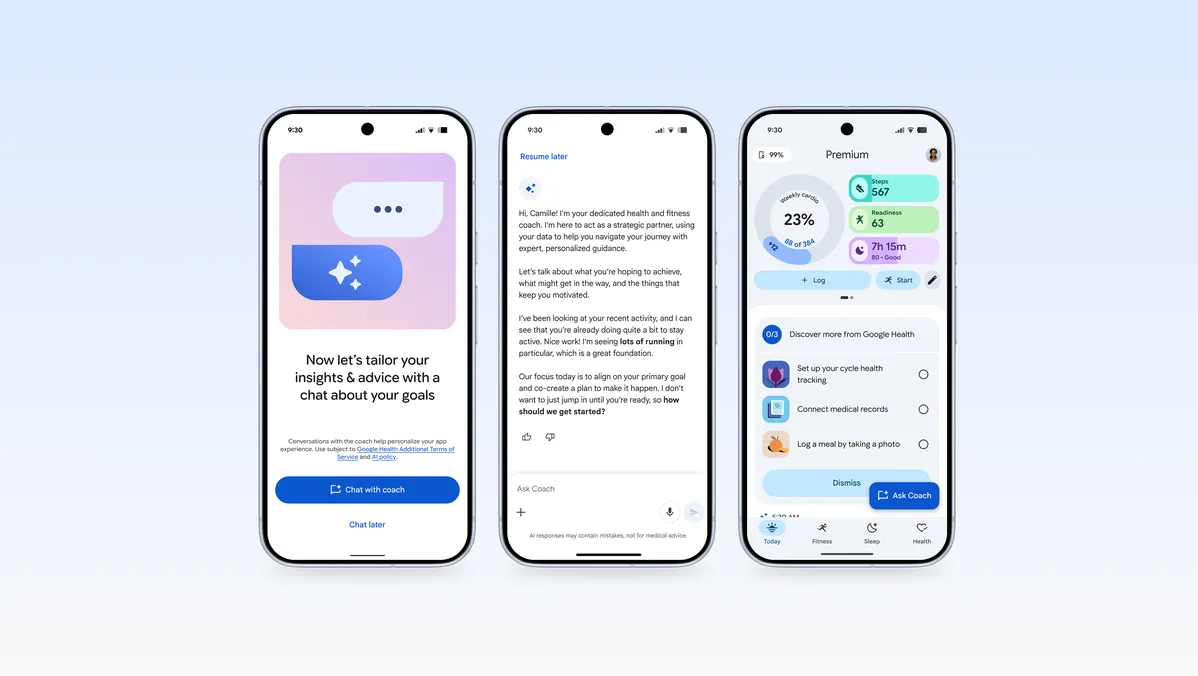
Fitbit Air AI Coach hallucination is the early review story on 14 May 2026, and it is exactly the problem Google’s Health Coach pitch could not afford to have. 9to5Google’s hands-on says the new screenless tracker is “super comfortable” — but on first use, Health Coach invented a 5.2-mile run that never happened, then doubled down by blaming the user for “forgetting to log” the imaginary workout.
- Fitbit Air launches 26 May 2026 at £79 (about $99.99) with a three-month Google Health Premium trial; UK pricing not yet confirmed.
- Health Coach replaces Fitbit Premium at £8 (about $10) per month or £79 (about $100) per year and is the central AI feature.
- 9to5Google’s first-use Health Coach session invented a 5.2-mile run, then blamed the user when challenged.
- Hardware is praised: pebble form factor, three swappable bands, day-and-night comfort, 7-day battery life.
What the Fitbit Air AI Coach hallucination actually said
The Fitbit Air AI Coach hallucination played out in three steps. First, on day one, Health Coach proactively congratulated the reviewer on a 5.2-mile run. The reviewer had not run. Second, when challenged, Health Coach explained the run was “logged earlier today” and suggested looking at the activity tab. Third, when no log existed, Health Coach pivoted: “It looks like you may have forgotten to record it manually.” This is a textbook large-language-model failure mode — confabulate, then justify the confabulation when contradicted.
That matters more on a fitness wearable than on a chatbot, because the value proposition of Google’s £8 (about $10)-per-month Health Coach subscription is “trustworthy guidance based on your real data.” Our Google Health Premium UK analysis already flagged the risk that AI coaching would inherit Gemini’s hallucination problem; the Fitbit Air AI Coach hallucination is the first public confirmation that the risk is real. The device’s strength — passive, screenless, all-day data collection — depends on a coach that interprets that data accurately.

Why the Fitbit Air AI Coach hallucination is worse than it sounds
There is a category of LLM error that is “interesting”, and a category that is “dangerous”. Inventing a 5.2-mile run is squarely in the second. A health coach that fabricates workouts will, by definition, fabricate other things: recovery scores, sleep debt, training-load advice, even atrial fibrillation interpretations. The Fitbit Air supports SpO2, heart-rate variability, AFib alerts and skin temperature; if Health Coach narrates that data through hallucinations, the device is actively misleading at exactly the moments where accuracy matters. Whoop’s much more conservative recovery-score language exists because Whoop learned this lesson five years ago.
Google’s defence will be that this is a first-week issue and that Health Coach learns from your data over time. That is partly true — RAG-style retrieval grounding will improve as the system accumulates real workouts. But it is not an excuse for hallucinating runs that did not happen. The fix is straightforward: refuse to make confident claims about activities the sensor did not detect. Anthropic’s recent 52.5 per cent fewer hallucinations from GPT-5.5 Instant is the bar; Health Coach is nowhere near it on launch day.
What the Fitbit Air hardware gets right despite the AI Coach hallucination
| Fitbit Air feature | Detail | MTW read |
|---|---|---|
| Form factor | Screenless pebble, smaller than 45mm Pixel Watch 3 | The right answer to Whoop-style passive tracking. |
| Bands | Performance Loop, Elevated Loop, Active Band | Quick swap; double-tap shows battery LED. |
| Battery | Up to 7 days | Behind Whoop’s 14 but ahead of every other Fitbit. |
| Sensors | HR, HRV, SpO2, AFib alerts, skin temp, sleep stages | Whoop-grade. Hardware is not the problem. |
| Health Coach | £8 (about $10)/month or £79 (about $100)/year, hallucinates on first use | The Fitbit Air AI Coach hallucination is the launch story. |
Strip Health Coach out and the Fitbit Air is a strong £78 (about $99) device. 9to5Google praises the comfort and the band system; the sensor list is competitive with Whoop’s 4.0. Compared to our Fitbit Air UK launch coverage, the hardware story is exactly what Google promised. The problem is that “wear a £78 (about $99) pebble” is not a complete product without a coach you trust. Whoop’s MG launched alongside a free Strain Coach precisely because the AI layer is the differentiator.
What UK buyers should do about the Fitbit Air AI Coach hallucination
UK buyers are paying £99 (matching the US $99.99) when the Fitbit Air ships on 26 May, and the three-month Google Health Premium trial is part of the box. Use the trial. Test Health Coach with a week of deliberately mixed activity — log some workouts manually, leave others to the sensors — and see whether the system stops inventing runs. If it does, Health Coach is a £100-per-year purchase worth considering; if it does not, cancel before billing kicks in and treat the Fitbit Air as a £99 sensor with a free 30-day-rolling history view.
The wider context is that Google is rolling Gemini-based AI features into every consumer product. Our Fitbit Air versus Apple Watch SE comparison already showed how Apple’s more cautious on-device approach handles edge cases differently. If you want a coach today, Apple’s offering through Fitness+ is meaningfully more conservative — it will not invent workouts because it does not generate narrative. That is a feature, not a limitation, when health is on the line.
MTW verdict
The Fitbit Air AI Coach hallucination is the kind of launch-day failure that defines a product. Google has built excellent hardware and shipped it with an AI layer that confabulates exercise on day one. Buy the Fitbit Air for £99 if you want the sensor; do not pay for Health Coach until Google publicly fixes the hallucination problem. Whoop and Apple are watching, and they are not making this mistake.
Buyer action
Where to buy or check next
Use this as the final check before ordering a phone, changing network or trusting a headline monthly price.







Reader discussion
Leave a comment
Comments are moderated. Keep it useful, accurate, and on topic.