
UPDATED · News · 29 Apr 2026 · Hannah Foster
Firestorm xCell is one of the stranger drone stories of April 29, and that is why it deserves attention. TechCrunch reported that Firestorm Labs closed an £65 (about $82) million Series B led by Washington Harbour Partners to scale a containerised manufacturing platform that can produce drone systems closer to where they are needed.
- Firestorm xCell is a containerised, expeditionary manufacturing system for drones and parts.
- The April 29 Series B raised £65 (about $82) million, bringing total capital raised to £120 (about $153) million.
- Firestorm holds a five-year global exclusive agreement with HP for industrial 3D printing inside xCell units.
- Firestorm says a Tempest-class airframe can be printed, assembled, tested and flown in 9-24 hours.
Why Firestorm xCell makes the factory part of the drone story
Consumer drone coverage usually focuses on camera sensors, flight time and obstacle avoidance. Defence drone coverage has a different problem: supply. A drone that takes months to replace is not useful in a fast-changing environment. Firestorm xCell’s pitch is that production needs to move closer to the point of use — and the £65 (about $82) million Series B suggests serious investors agree.
That makes xCell less like a drone model and more like a manufacturing layer. Firestorm describes it as a rugged factory in a box, housed in expandable 20-foot ISO containers, with off-grid operation and HP industrial 3D printing at the centre. The idea is to print airframes, parts and mission-specific components in 9-24 hours per Tempest-class drone, without waiting on a distant factory or transatlantic logistics chain. It is a fundamentally different supply model from the consumer side that DJI now dominates in the civilian drone market.
The mobile-tech angle on Firestorm xCell
This looks like a defence startup story, but the wider mobile-tech angle is obvious. Drones are becoming distributed computing devices: cameras, radios, sensors, autonomy software, batteries and modular payloads wrapped in an airframe. Once the airframe can be produced locally, the software and payload stack become the part that changes fastest. The same principle is already showing up elsewhere — see how China’s 10,000-a-year humanoid robot factory reframes robotics as a manufacturing-capacity story before it is a software story.
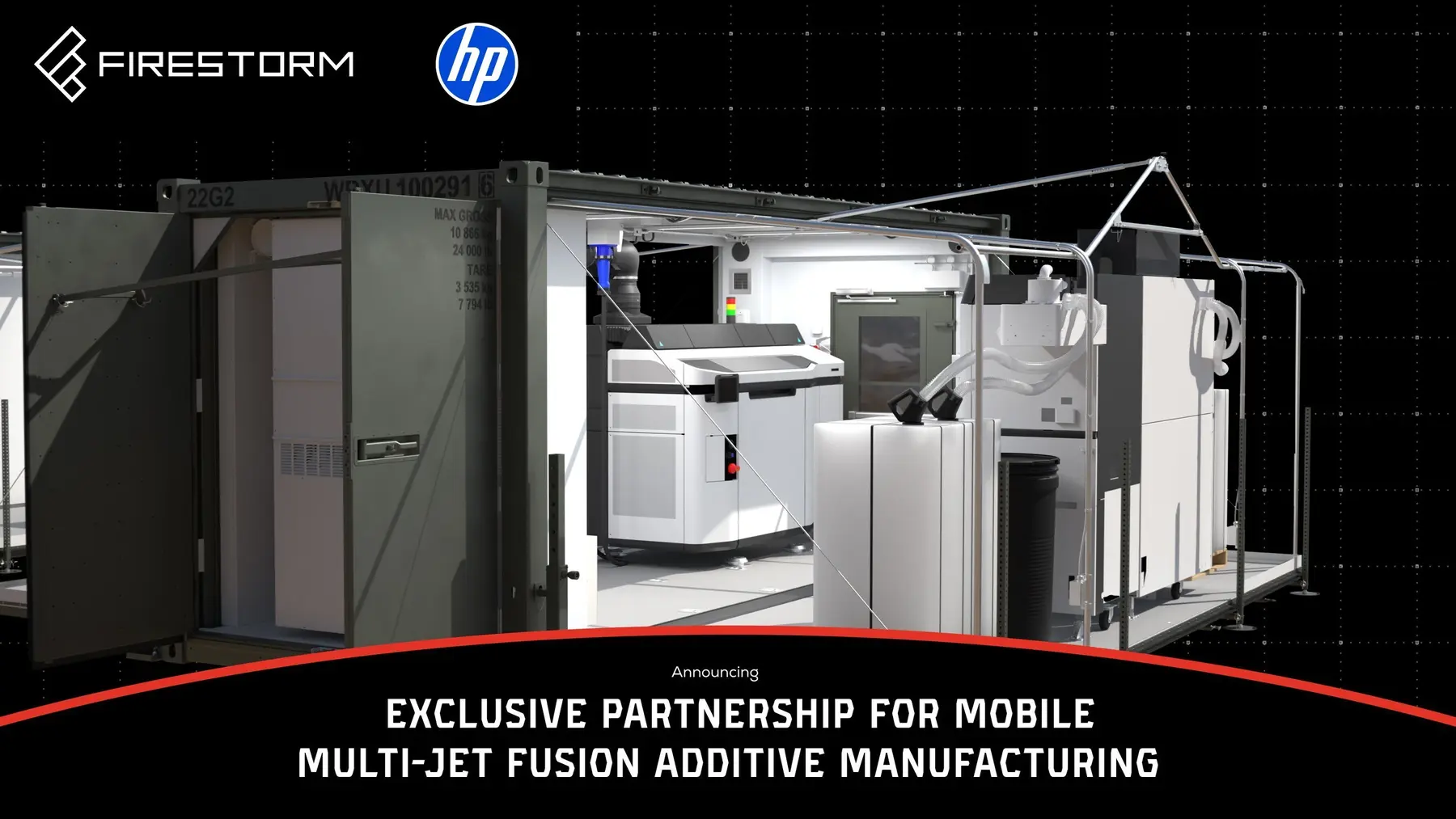
That is why Firestorm xCell matters. It suggests drone companies are no longer competing only on the finished aircraft. They are competing on how quickly they can adapt, manufacture and redeploy hardware. In consumer-tech terms, it is the difference between selling a phone and controlling the factory that can change the phone overnight.
What to watch as Firestorm xCell scales
- Whether xCell scales beyond pilots and specialist deployments now that Firestorm has £120 (about $153) million in total funding.
- How much of a drone can realistically be produced inside an ISO container rather than assembled from shipped components.
- Whether other drone makers and primes such as Lockheed Martin (a Series B participant) build for xCell-style distributed production.
- How regulators, procurement teams and allied governments handle rapid local iteration of weapons-adjacent systems.
The investor list itself is telling: Washington Harbour Partners led, with NEA, Ondas, In-Q-Tel, Lockheed Martin, Booz Allen Ventures, Geodesic and Motley Fool Ventures participating. That is a defence-meets-deeptech syndicate, not a pure venture round. It maps to the broader pattern picked up in our coverage of NVIDIA’s physical AI push: serious capital is flowing into hardware that operates in the real world, not just AI models that live in the cloud.
The Firestorm xCell context: where this fits in the 2026 drone economy
Two xCell units are already deployed inside the United States — one with the Air Force Research Laboratory in Rome, New York, and one with Air Force Special Operations Command in Florida — alongside operational units in the Indo-Pacific. That early footprint is what made the Series B credible: investors are not buying a pitch deck, they are buying a system that has already been delivered to government customers. Firestorm’s founders include CEO Dan Magy, special-operations veteran Chad McCoy and CTO Ian Muceus, a holder of 3D printing patents — a team that maps to the hard edges of additive manufacturing and defence acquisition.
The wider point is that drone-making is bifurcating. Consumer drones are commoditising around DJI-grade camera kits, while defence and industrial drones are increasingly built and rebuilt as software-defined, mission-specific airframes. Firestorm xCell sits firmly on the second side of that line, and it is the kind of infrastructure story that will keep showing up as nations rethink supply chains. The Series B headline of £65 (about $82) million is also worth reading alongside the prior round: Firestorm raised £37 (about $47) million in 2025, which means total funding has more than tripled in under a year. That growth curve is what attracted the new investor mix.

MTW take
The Firestorm xCell story is not about a drone you can buy in a shop. It is about the next pressure point in drone technology: manufacturing speed. If drones are becoming disposable, adaptable and mission-specific, then the factory becomes part of the product — and Firestorm just raised £65 (about $82) million to prove that point.
That is why this belongs in MTW’s drone coverage. The most important drone trend of 2026 may not be a better camera. It may be the ability to build the right aircraft, in the right place, fast enough for the situation in front of you. Firestorm xCell is the clearest sign yet that the drone industry has worked that out — and that the line between consumer hardware, defence procurement and supply-chain technology is going to keep blurring through the rest of the decade. Buyers and observers should expect more containerised manufacturing announcements before the year is out, because the playbook now has investor proof.
MTW verdict
Firestorm xCell is not a consumer product, but it is the most consequential drone story of April 29. The shift from “buy the drone” to “build the drone where you need it” is going to reshape both defence and, eventually, commercial drone economics.
Buyer action
Where to buy or check next
Use this as the final check before ordering a phone, changing network or trusting a headline monthly price.














Reader discussion
Leave a comment
Comments are moderated. Keep it useful, accurate, and on topic.