
There is no polite way to say this: DJI owns the consumer drone market. Not in the way Apple dominates premium smartphones or Google dominates search. Those are strong positions in competitive fields. DJI’s grip is closer to a quiet monopoly, with an estimated 70 per cent or more of the global civilian drone market according to industry analyst Berg Insight. And the most remarkable thing about this dominance is how few people outside the drone community seem to notice or care.
Consumer Drone: Contents
- How DJI Got Here
- The Competition: Brave but Outgunned
- The Regulatory Wildcard
- Is DJI’s Dominance Good or Bad for Buyers?
- What Happens Next
How DJI Got Here
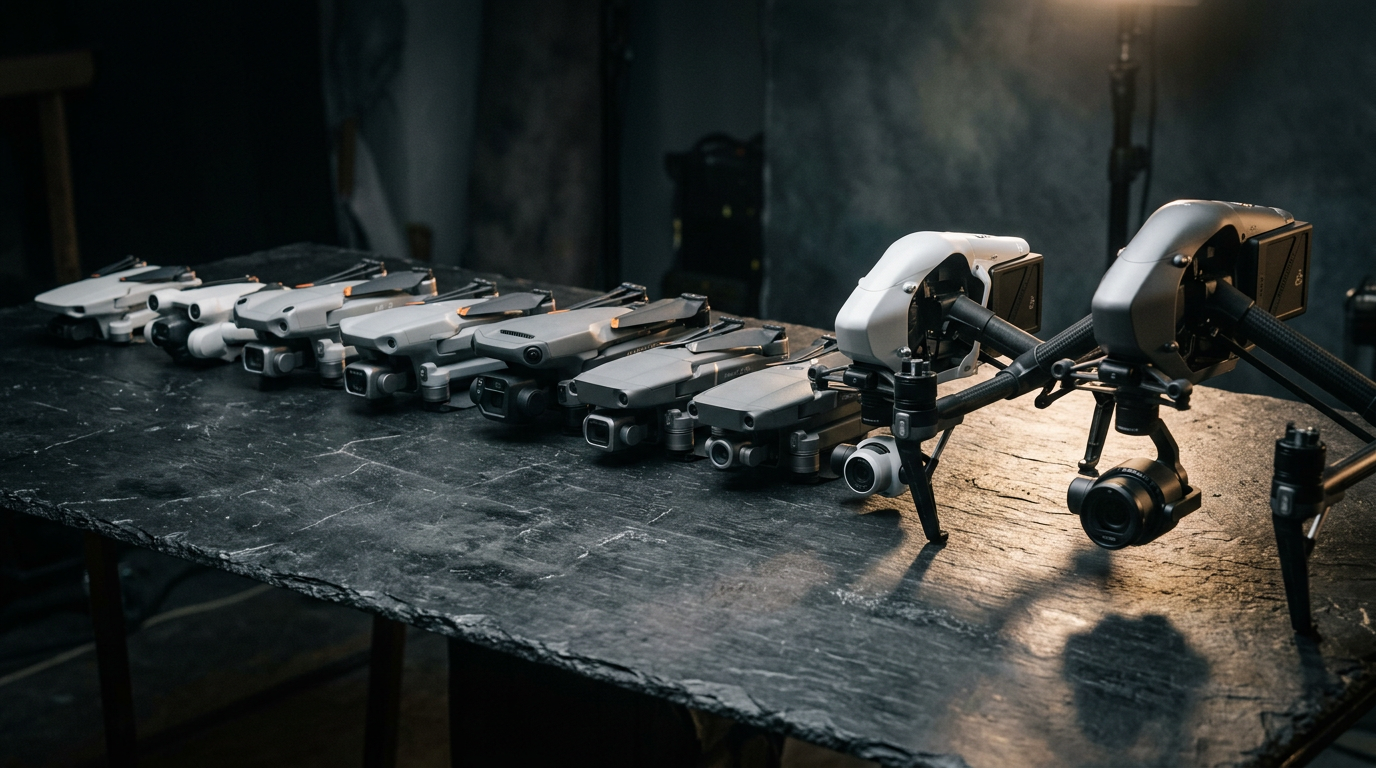
DJI’s dominance was not inevitable. Founded in 2006 by Frank Wang in a dormitory at the Hong Kong University of Science and Technology, the company started by making flight controllers for hobbyist helicopters. The pivot to consumer drones came with the Phantom series in 2013, and what followed was a masterclass in vertical integration.
DJI manufactures its own motors, propellers, gimbals, cameras, sensors, batteries, and flight controllers. It writes its own flight software, obstacle avoidance algorithms, and video processing firmware. This vertical integration means DJI can optimise every component to work with every other component, producing a coherence of performance that competitors building from third-party parts cannot match.


The result is products that simply work better. The DJI Mini 4 Pro weighs under 249 grams, shoots 4K HDR video with three-axis gimbal stabilisation, avoids obstacles in every direction, and flies for 34 minutes on a single charge. No competitor offers anything close at the same weight and price point. The DJI Avata line similarly dominates FPV drones, and the Mavic series has been the default prosumer choice for years.

The Competition: Brave but Outgunned
Skydio is the most promising American competitor. Its drones feature genuinely excellent autonomous tracking and obstacle avoidance, arguably better than DJI in specific scenarios. However, Skydio has largely pivoted to enterprise and military markets, where US government concerns about DJI’s Chinese origins create a captive customer base. Its consumer products are fewer, more expensive, and less refined than DJI’s.
Autel Robotics is the closest direct competitor in the consumer space. The Autel EVO Lite+ and EVO Nano+ are competent drones with good cameras and reasonable prices. But “competent” and “good” are not enough when you are competing against “best-in-class” and “industry-leading.” Autel lacks DJI’s scale advantages, which means fewer accessories, less extensive dealer networks, and a smaller user community for support and content creation.
Parrot, once a significant consumer drone manufacturer, has effectively abandoned the consumer market to focus on military and enterprise applications. Its ANAFI series was well-regarded but could not compete commercially against DJI’s pricing and marketing.
The Regulatory Wildcard
The single biggest threat to DJI’s dominance is not a competitor, it is Washington. The 2025 National Defence Authorisation Act gave a US national security agency one year to clear DJI. When no agency completed that review, the FCC added DJI to its Covered List in late December 2025, blocking new equipment authorisations. DJI filed a petition with the US Court of Appeals for the Ninth Circuit challenging the decision in early 2026, as Bloomberg reported. The Pentagon has publicly backed the FCC’s stance, citing intelligence concerns. Drones already in the wild remain flyable, but the tap on newly certified DJI radios and accessories in the US has been turned off. The underlying concern is that a company headquartered in Shenzhen could in theory be compelled to share user data, flight logs or location metadata with the Chinese government under China’s national intelligence laws.
Is DJI’s Dominance Good or Bad for Buyers?
The benefits are tangible. DJI’s scale enables it to invest heavily in research and development, producing innovations, like sub-250g drones with enterprise-level cameras, that would not exist in a more fragmented market. Prices have decreased consistently relative to capability. A drone that matches the original 1,000-pound Mavic Pro’s camera quality now costs under 350 pounds. The accessories ecosystem is enormous, third-party support is excellent, and community resources for learning to fly and editing drone footage overwhelmingly cater to DJI products.
There is also the innovation question. Competition drives innovation. Without meaningful rivals in the consumer space, DJI’s incentive to push boundaries diminishes. Some argue this is already visible, recent DJI releases have been iterative improvements rather than revolutionary leaps. Whether that reflects market maturity or reduced competitive pressure is debatable.
What Happens Next
Three scenarios could reshape the market in the coming years. First, a US ban on DJI could create a vacuum that Skydio, Autel, or a new entrant fills with American-made alternatives, though likely at higher prices and initially lower quality. Second, DJI could face antitrust scrutiny in Europe or Asia that forces licensing of key technologies, lowering barriers for competitors. Third, and perhaps most likely, the status quo continues: DJI dominates, competitors scrape by in niches, and consumers benefit from excellent products while accepting the risks of a near-monopoly.
For buyers today, the practical advice is straightforward. DJI makes the best consumer drones, and pretending otherwise serves nobody. Buy DJI if you want the best hardware and the largest support ecosystem. But keep an eye on Autel and Skydio if you prefer to support competition, and stay aware that the regulatory landscape could change the equation faster than any technology could.
DJI’s dominance is a fascinating case study in how a company can win so thoroughly that competition becomes almost theoretical. Whether that is a triumph of engineering or a cautionary tale about market concentration depends on which side of the disruption you are standing on.
MMTW Editorial
Buyer action
Where to buy or check next
Use this as the final check before ordering a phone, changing network or trusting a headline monthly price.









Reader discussion
Leave a comment
Comments are moderated. Keep it useful, accurate, and on topic.