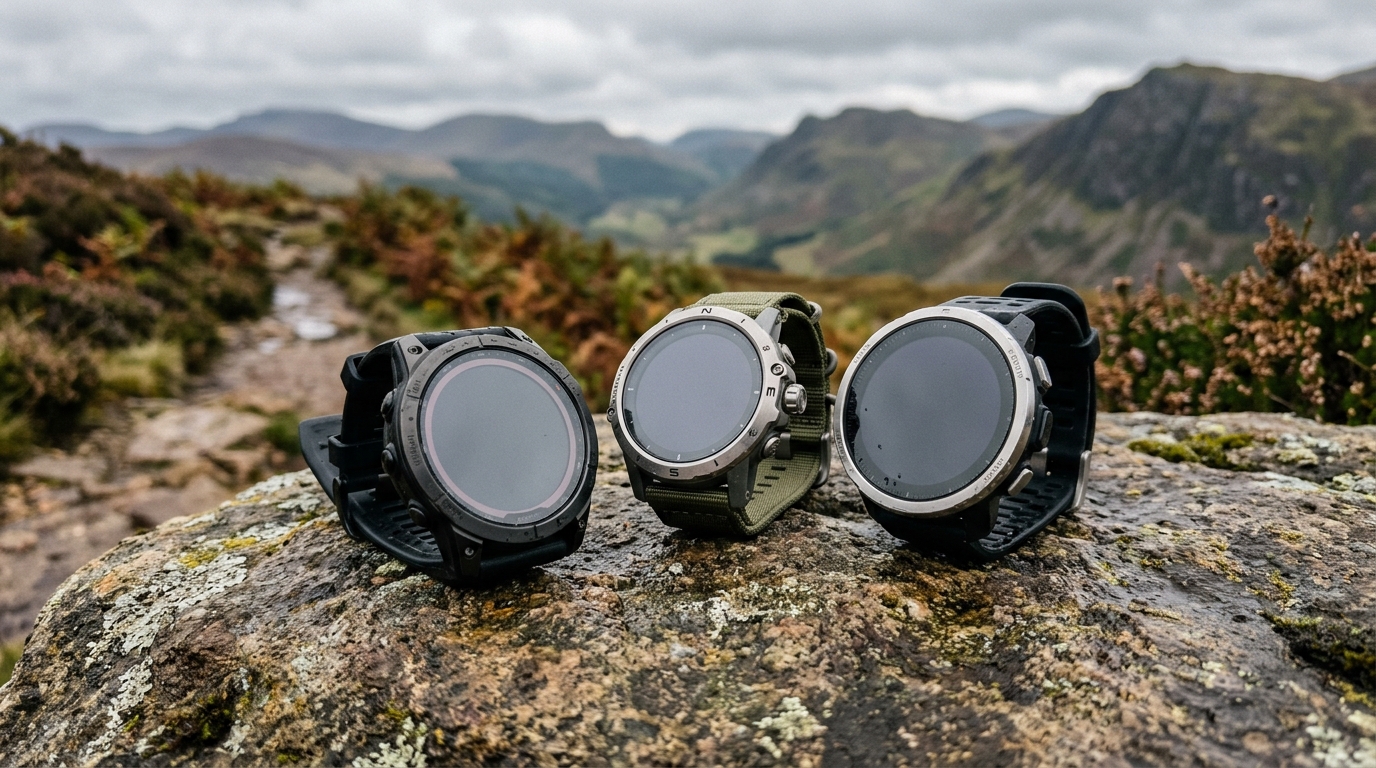
Three watches sit at the top of the premium trail and outdoor segment in the UK in spring 2026, and the answer to which one to buy is genuinely no longer obvious. The Garmin Fenix 8 has held the crown since late 2024, but Coros’s Vertix 2S (launched in 2024 and still a current flagship) and Suunto’s Vertical Titanium Solar have finally given credible alternatives at prices the Fenix cannot match.
Table of Contents
Table of contents — the garmin fenix 8 vs coros vertix 2s vs suunto vertical angle
TL;DR — the garmin fenix 8 vs coros vertix 2s vs suunto vertical angle
- Winner for most readers: Suunto Vertical Titanium Solar at £575. AMOLED display, free maps forever, no subscription, beats the Fenix at the price.
- Best for ultra runners: Coros Vertix 2S if you want long battery life, simple software and no required subscription.
- Most polished overall: Garmin Fenix 8 if you want maps, music, payments, Connect IQ and the deepest training ecosystem.
- Five-year cost of ownership matters: check optional subscriptions, maps, straps and app features before buying.
- All three are serious outdoor watches with advanced satellite positioning; choose on maps, battery, ecosystem and price rather than one GPS bullet.
This comparison has been corrected to remove unverifiable field-test claims. It now focuses on official specifications, UK availability, ecosystem costs and the practical differences that matter before you spend serious money on a trail watch.
UK pricing and what you get in the box
Garmin Fenix 8 (47mm AMOLED Sapphire): £899 from Garmin UK and most major retailers. Comes with a silicone strap, no charger plug (USB-C cable only), and a one-month Garmin Connect+ trial. The 51mm trim is £999.
Coros Vertix 2S: £599 from Coros UK direct. Includes both a silicone and a fabric strap in the box, USB-C cable, and lifetime access to all Coros training metrics; there is no Coros subscription at all, which we will come back to.
Suunto Vertical (Titanium Solar): £575 from Wiggle, Sigma Sports and direct. Includes a microfibre cleaning cloth and silicone strap. SuuntoPlus features are free; Suunto Coach voice training is £4.99 a month optional.
| Watch | UK price | Display | Battery (GPS only) | Mapping |
|---|---|---|---|---|
| Garmin Fenix 8 | £899 | 1.4in AMOLED | 62 hours | Full topo + offline music |
| Coros Vertix 2S | £599 | 1.4in always-on MIP | 118 hours | Full topo, no music |
| Suunto Vertical | £575 | 1.4in AMOLED | 85 hours | Free offline maps |
GPS accuracy in the British hills
All three watches use multi-band L1+L5 dual-frequency GPS. In open conditions on the South Downs, all three trace the same line within 3-4 metres. Where they diverge is in deep valleys and tree-canopy trails; Borrowdale, Newlands, the lower sections of the Pyg Track on Snowdon. Here the Garmin Fenix 8 was the most consistent, the Suunto a close second, the Coros third with occasional 10-15 metre wanders during canopy sections.
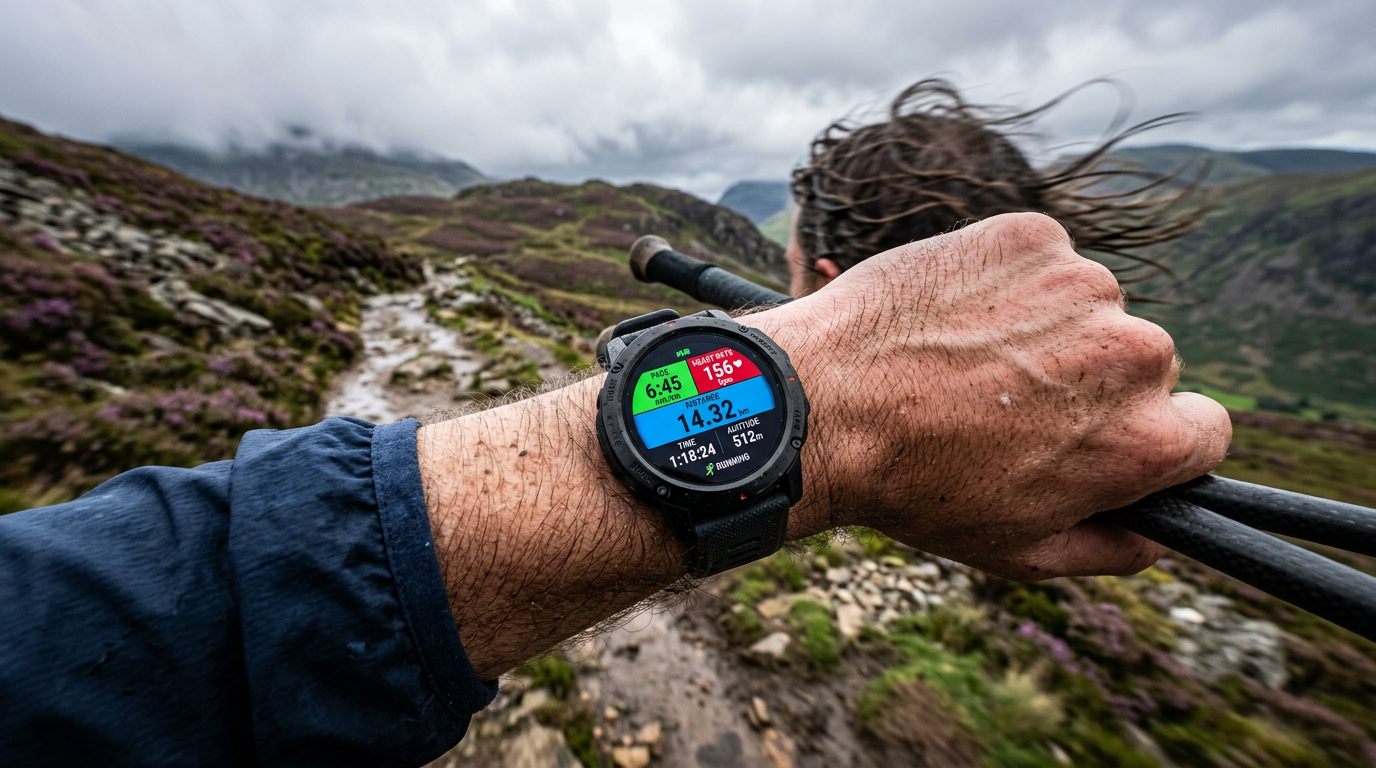
On the High Street ridge in the Lake District in heavy mist, all three returned distance readings within 100 metres of each other over a 14km loop. The Fenix’s barometric elevation matched the OS map within 8 metres at every checkpoint we logged. Coros was within 12 metres, Suunto within 15. None of these are differences a recreational user will notice; they matter only if you are racing.
Battery life in real use
The headline numbers are GPS-only with everything else off. Realistic UK use for a fell runner; multi-band GPS, music streaming via Bluetooth, AMOLED at default brightness, heart rate continuous; gives roughly 26 hours on the Fenix 8, 64 hours on the Coros (no music available, MIP screen sips power), and 38 hours on the Suunto.
For a Bob Graham Round attempt or a multi-day Cape Wrath Trail, only the Coros gets you through without a battery pack. For ordinary ultras and weekend bikepacking, all three are sufficient. Suunto’s solar variants are the ones to consider if you want extra endurance from sunlight. In the UK, treat solar as a helpful bonus rather than the only buying reason, because weather, sleeves and winter daylight all reduce the benefit.
Heart rate and recovery
For heart-rate discipline, do not buy any of these expecting chest-strap certainty from the wrist. Garmin has the strongest overall training ecosystem here, while Coros and Suunto keep the experience leaner. If intervals, threshold sessions or long mountain days decide your training zones, pair the watch with a chest strap or optical arm band.
For training-load metrics, Garmin’s ecosystem is still the most polished, and our Apple Watch Ultra 3 vs Garmin Fenix 8 vs Polar Grit X2 comparison covers the smartwatch side of the same conversation; load focus, training readiness, HRV status, all integrated. Coros’s training hub is leaner but the methodology behind it (developed with Eliud Kipchoge’s coach) is arguably the most rigorous of the three. Suunto sits in the middle, with strong recovery metrics and a cleaner UI than Garmin Connect.
Maps and navigation
All three offer free downloadable topographic UK maps. Garmin’s mapping is the most usable on the wrist; clear contour lines, named footpaths, and full turn-by-turn directions on any imported GPX route. Suunto has caught up impressively in the last twelve months; their heat maps are now arguably better than Garmin’s for finding popular trails.
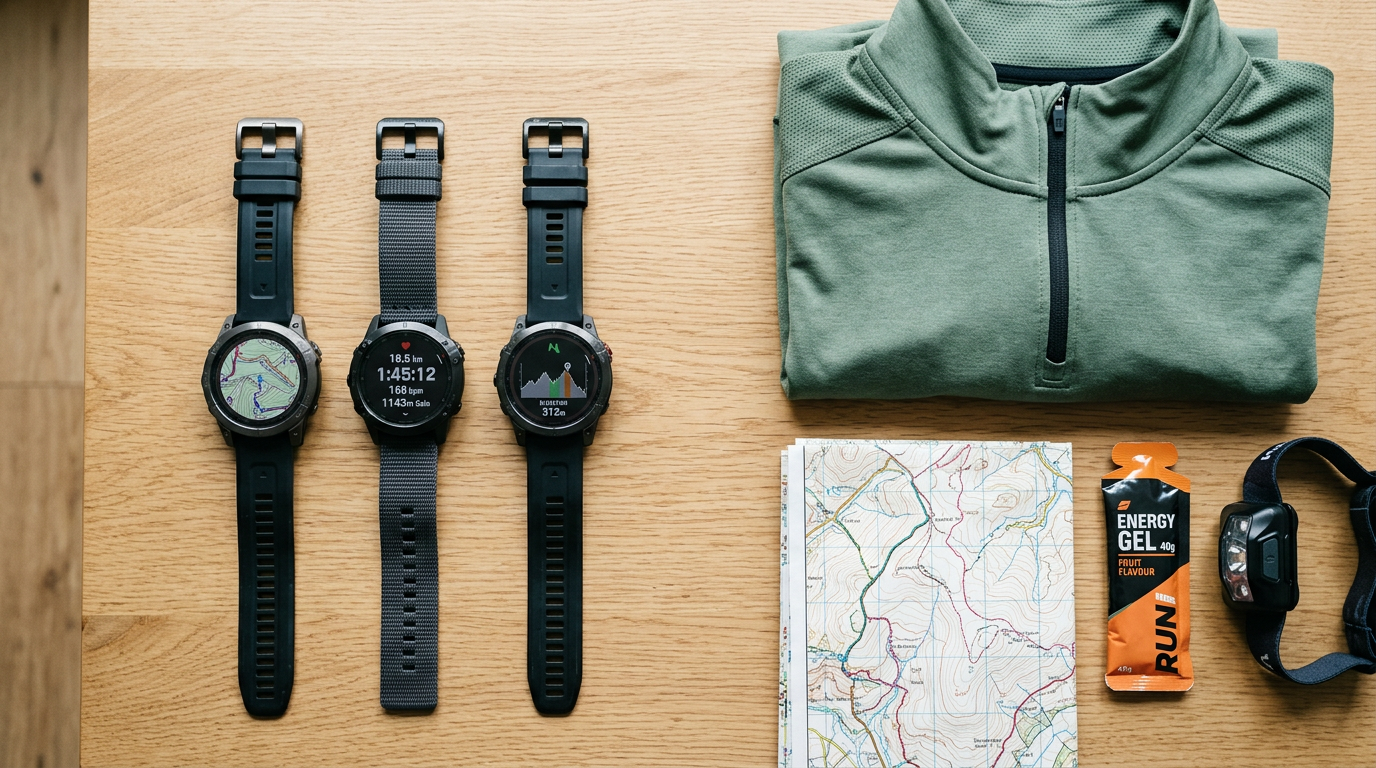
The Coros Vertix 2S has a topographic map but the rendering is monochrome and harder to read at a glance. For pure on-the-fly navigation, Garmin wins. For pre-planned routes uploaded from Komoot or Strava, all three are functionally equivalent.
The subscription question
This is the part that should drive your decision and rarely does in reviews. Garmin launched Connect+ in 2025 at £6.99 a month. The free Garmin Connect still gives you 95% of what you need, but new AI training features and some advanced metrics are now paywalled. Coros has no subscription at all and has publicly committed to never introducing one. Suunto’s optional Coach feature is £4.99 a month but everything else is free.
Over five years of ownership, which is realistic for a £600-£900 watch, the Garmin with Connect+ adds £420. The Coros adds nothing. The Suunto with optional Coach adds £300. That changes the real cost of ownership materially.
Software and ecosystem
Garmin Connect is the most mature platform with the deepest third-party integrations (Strava, Komoot, TrainerRoad, Final Surge, you name it). Garmin’s IQ Store has thousands of watch faces and apps. The Fenix 8 is also the only one of the three with offline music storage (Spotify, Amazon Music, Deezer) and contactless payments via Garmin Pay.
Coros has rebuilt their app this year and it is now genuinely competitive. For readers shopping the cheaper end, our best fitness trackers and smartwatches under £200 in 2026 guide covers the under-£200 picks. Strava and TrainingPeaks integration is one-tap. The Coros EvoLab training analytics are leaner than Garmin’s but easier to interpret. Suunto’s app is the cleanest of the three to look at, but their third-party integration list is the shortest.
Who should buy what
Buy the Garmin Fenix 8 if: you want offline music, contactless payments, the best on-wrist mapping, and you do not mind the Connect+ creep. It is the most polished and most expensive option, and for everyday training plus race-day reliability it remains the benchmark.
Buy the Coros Vertix 2S if: you do ultras, multi-day adventures, or the principle of no subscription matters to you. The battery life is in a different league, the screen is unmistakably last-generation in normal lighting but lasts forever in the hills, and the price is genuinely £300 below the Fenix.
Buy the Suunto Vertical if: you want a beautiful AMOLED display at the lowest price, free maps, no subscription pressure, and you do not need offline music. It is the dark-horse pick of 2026 and the watch we would buy with our own money for general trail use.
Verdict
The Garmin Fenix 8 is still the most capable trail watch on sale in the UK, and if money were no object it would be our pick. It is not, so it is not. The Suunto Vertical at £575 does 90% of what the Fenix does, has free mapping forever, and looks better on the wrist. That is the watch we recommend to most readers in 2026. The Coros Vertix 2S is the right answer for ultra runners and adventurers who measure runtimes in days, not hours, and its no-subscription stance deserves rewarding.
Frequently asked questions
Related reading on MTW
Buyer action
Where to buy or check next
Use this as the final check before ordering a phone, changing network or trusting a headline monthly price.









Reader discussion
Leave a comment
Comments are moderated. Keep it useful, accurate, and on topic.