
Here’s the number that matters: £168. That’s what Ubiquiti’s own UK store lists the UniFi Express 7 for, including VAT, as of 23 June 2026 — not the £199 figure that’s been doing the rounds. For a tri-band Wi-Fi 7 gateway with a 10G port, that price is the whole story, and it’s why I’d think hard before buying almost any consumer “mesh” system this side of £200.
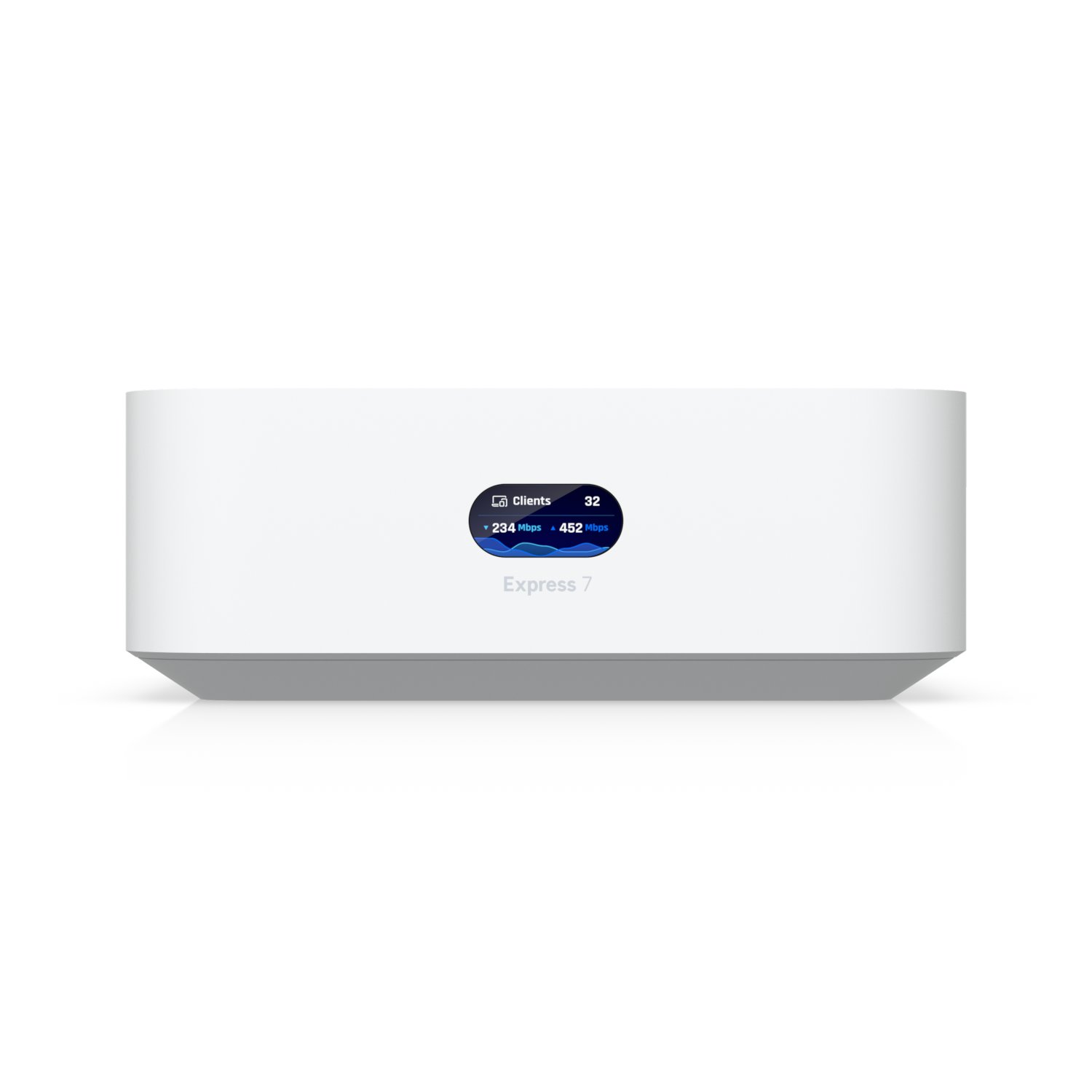
The UX7 is the smaller, cheaper end of Ubiquiti’s cloud-gateway line — a single box that runs the UniFi controller, routes your traffic, and throws out its own Wi-Fi 7 signal rather than asking you to bolt on a separate access point. The pitch is simple: prosumer networking gear at a price that’s crept down into ordinary-router territory. It’s a small thing, too — Ubiquiti’s tech-specs page puts it at 104 × 104 × 30mm and 198g, a palm-sized puck that draws a maximum of 18W. This is not a box you hide in a cupboard; it’s one you sit on a shelf, partly because it has a little front display and partly because, like every UniFi device, it wants airflow.
What £168 actually buys you (UniFi Express 7)
The headline spec is the radio. Ubiquiti’s own techspecs sheet rates the built-in tri-band Wi-Fi 7 access point at up to 688 Mbps on 2.4 GHz, 4,300 Mbps on 5 GHz and 5,700 Mbps on 6 GHz — an aggregate figure of roughly 10,688 Mbps. Those are theoretical ceilings, as every throughput number on every spec sheet always is, but they put the UX7 firmly in current-generation territory rather than among the Wi-Fi 6 stragglers still clogging up the shelves. Ubiquiti quotes coverage of around 140 m² from the single unit — fine for a flat or a modest two-up-two-down, optimistic for a thick-walled Victorian terrace.
The 6 GHz band is the part I’d actually care about. That’s the lane Wi-Fi 7 opens up properly, and it’s where a clean, modern client — a recent laptop, a flagship phone — can stretch its legs without fighting every neighbour’s network for airtime. If your devices can’t reach 6 GHz, you’re buying this for the routing and the controller, not the radio.
The catch nobody puts on the box: routed throughput
This is the bit a spec sheet won’t lead with, and it’s the single most important number if you have, or are about to get, a fast line. That 10G WAN port does not mean the UX7 routes at 10 gigabits. The radios are fast; the little ARM processor doing the actual routing and NAT is the real ceiling. On a box this size and power budget, I’d expect plain routed throughput to land in the low-multi-gigabit range — a few gigabits with no security inspection running, and a further hit the moment you switch on UniFi’s IDS/IPS deep-packet inspection. That’s a judgement from the hardware class, not a Ubiquiti figure, so treat it as indicative rather than a guarantee — but the gap between the 10G port on the label and what the router can actually push is real, and it’s the thing to plan around.
The 10G port is for headroom and link speed, not line rate. If you’re on a 1 Gbps or 1.6 Gbps full-fibre package, the UX7 routes it without breaking sweat. If you’ve splashed out on a 2.5 Gbps or faster line and you want IDS running, you’re at the edge of what this box was built to do.
For the overwhelming majority of UK homes — where even “full fibre” tops out at 900 Mbps to 1.6 Gbps on the common Openreach and CityFibre tiers — this is a non-issue, and the headroom is genuinely useful. But if you’re the sort of person who pays for a 2 Gbps or 8 Gbps symmetrical line, know what you’re buying: a gateway whose radios outrun its router, and budget for a beefier Cloud Gateway if line-rate routing with full security is the point.
The price gap is the interesting bit
This is where it gets worth a closer look. The official store sits at £168 inc VAT, but the UK reseller channel doesn’t undercut it — it sits above it. NetXL lists the UX7 at £157.91 ex-VAT, which is £189.49 including, and quotes 72 units in stock. MS Dist has it at £152.25 ex-VAT, or £182.70 inc.
So the cheapest, in-stock, VAT-paid route to a UX7 right now is Ubiquiti direct. That’s unusual enough to flag, because it inverts the usual logic where you trawl resellers to dodge a manufacturer’s markup. Here, the resellers are the markup — useful if you want a single trade invoice or you’re already buying a rack of UniFi kit from one of them, but a £14–£21 premium over buying direct otherwise.
The ports — and why one of them is a quiet compromise
The connectivity story is short, and it has a sting in the tail. You get one 10 GbE RJ45 WAN port and one 2.5 GbE RJ45 LAN port — and that’s it. There’s no SFP+ cage, so if your incoming fibre terminates in an SFP module you’ll need a media converter or an upstream switch to break it out to copper. And there’s no PoE output, so you can’t power a UniFi access point or camera straight off the gateway; the UX7 itself runs from a bundled DC adapter, not PoE.
That single 2.5G LAN port is the design decision that tells you what the UX7 is for. This is a gateway-and-AP-in-one for a small network, not a switch. The moment you want to wire in more than one device, or feed power to a separate access point, you’re buying a UniFi switch as well — and that’s by design. Ubiquiti wants the UX7 to be the front door, with everything else hanging off a switch behind it.
UX7 vs the cheaper UniFi Express: is Wi-Fi 7 worth the £69?
The obvious cross-shop is Ubiquiti’s own back catalogue. The original UniFi Express — the Wi-Fi 6 model, often sold around £99 in the UK — does the same controller-plus-gateway job for roughly £69 less. The difference is exactly what you’d expect: the older box is dual-band Wi-Fi 6 with gigabit ports, no 6 GHz, no 10G WAN. Here’s how the two line up on the points that actually decide it.
| UniFi Express 7 (UX7) | UniFi Express (original) | |
|---|---|---|
| UK price | £168 inc VAT (Ubiquiti store) | ~£99 |
| Wi-Fi | Tri-band Wi-Fi 7 (2.4/5/6 GHz) | Dual-band Wi-Fi 6 (2.4/5 GHz) |
| 6 GHz band | Yes | No |
| Fastest WAN port | 10 GbE | 1 GbE |
| LAN port | 1× 2.5 GbE | 1× 1 GbE |
| Who wins | Faster-than-gig lines and 6 GHz clients | Sub-gigabit homes with no Wi-Fi 7 kit |
If your broadband is sub-gigabit and none of your devices speak Wi-Fi 7, the cheaper Express is the more honest buy, and I’d not feel short-changed pointing someone at it. The UX7 earns its premium in two specific cases: you have, or are getting, a faster-than-gigabit line and want the 10G WAN headroom; or you own modern 6 GHz clients that will actually light up the Wi-Fi 7 band. Tick neither box and the extra £69 buys you future-proofing you won’t feel for a year or two. Tick either and it’s money well spent. Anyone wanting more wired ports or PoE built in should look up the range at a Dream Router or Cloud Gateway instead — they cost more, but they stop you bolting on a switch on day one.
Who this is for — and who it isn’t
I’d point the UX7 at one reader in particular: the person who wants UniFi’s controller software, dashboards and expandability but doesn’t want to spend a Saturday building a multi-box setup. It’s a sensible first rung — start with the Express 7 doing everything, add access points later as the network grows. The 10G port means you’re not immediately bottlenecked if you later feed it a faster line or a NAS.
Who I’d steer away? Anyone whose clients are still all Wi-Fi 6, because you’re paying for a 6 GHz radio you can’t use — the cheaper Express does that job. Anyone who genuinely wants a fit-and-forget mesh with a polished phone app and zero appetite for network settings — UniFi rewards tinkering, and that’s a feature or a tax depending on who you are. And anyone with a sprawling, thick-walled house: the UX7 is a single unit, so that 140 m² figure will fall short and you’ll be budgeting for extra access points before £168 is the whole bill.
The bit that would make me press buy
On the numbers, the case is straightforward. A tri-band Wi-Fi 7 gateway with a 10G port and Ubiquiti’s controller baked in, at £168 from the maker’s own shop, is the kind of price that quietly makes a lot of £150-plus consumer routers look poor value. If I were standing up a home network today and I could live in UniFi’s world, I’d buy direct from Ubiquiti’s UK store and pocket the difference over the resellers — unless I were already placing a trade order through NetXL or MS Dist, in which case the small premium buys convenience.
What would stop me? Two things, and they’re both about matching the box to the line. If my devices can’t touch 6 GHz, I’d buy the cheaper Wi-Fi 6 Express and save the £69. And if I were paying for a 2 Gbps-plus line and wanted IDS running flat out, I’d accept that the UX7’s router is the limit and step up a tier. Check your clients and check your line speed first. For everyone in between — modern kit, a full-fibre line at or below gigabit, and an appetite for UniFi — the UX7 at £168 is one of the easier recommendations I’ve made this year.
Buyer action
Where to buy or check next
Use this as the final check before ordering a phone, changing network or trusting a headline monthly price.








Reader discussion
Leave a comment
Comments are moderated. Keep it useful, accurate, and on topic.