A ceiling light that won eight “Best of CES” awards and yet still can’t tell you when it’ll actually ship to your house — that, in a sentence, is the strange position the Nanoleaf Skylight has occupied since it first turned heads at CES 2023. Writing for Forbes in March 2024, Anthony Karcz called it “more than just a pretty light fixture,” and he’s right. But the question I keep coming back to isn’t whether the Skylight is clever. It plainly is. It’s whether a modular panel system you bolt to your ceiling yourself is the thing a premium home actually wants — or whether you’d be better off ringing a lighting designer and having the ceiling done properly, once.
What you’re actually buying (Nanoleaf Skylight)
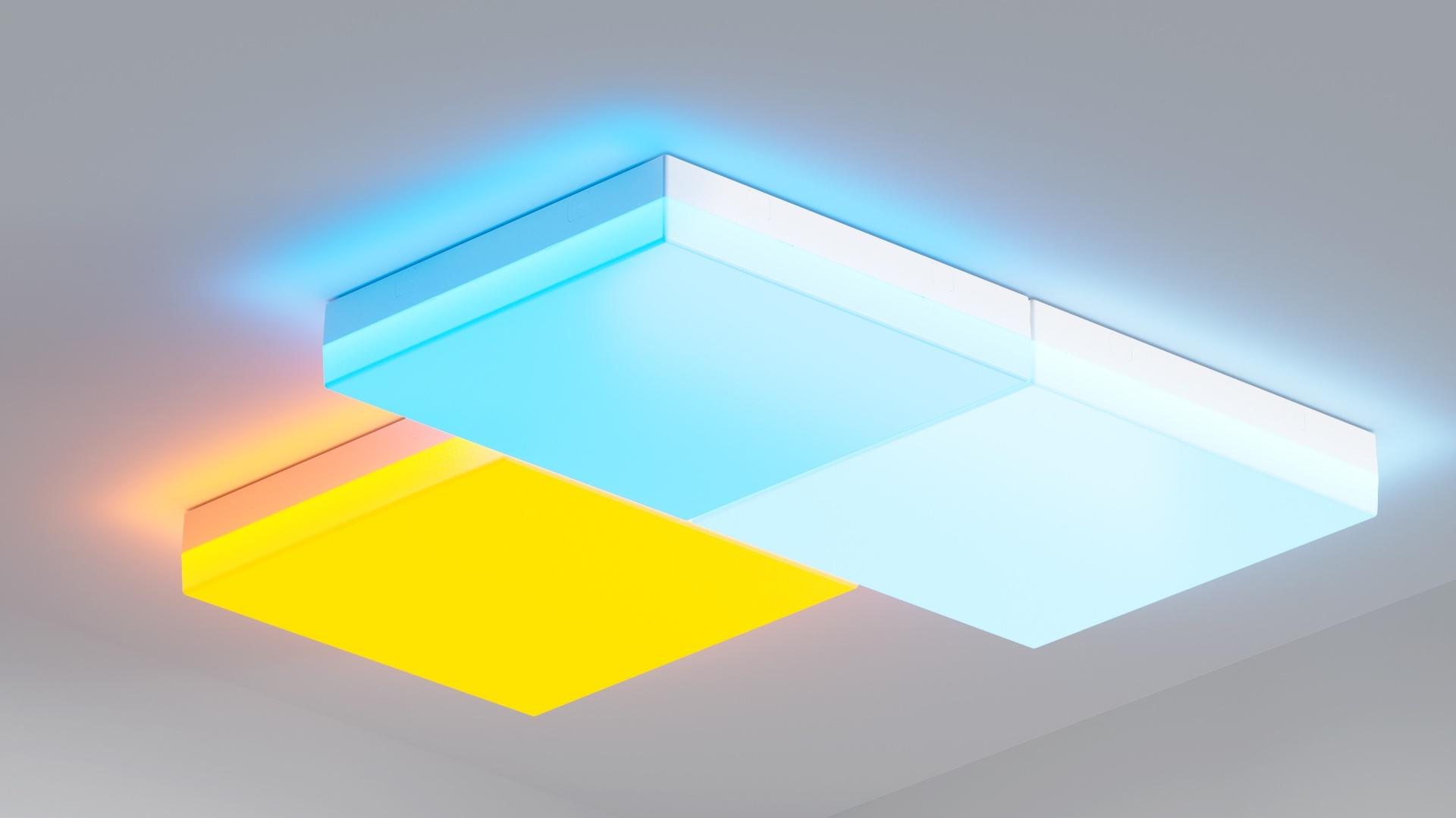
Let’s be precise about the hardware, because the marketing photography does a lot of heavy lifting here. The Skylight is a square, hardwired ceiling panel. Each one pushes out 1,400 lumens and is rated for 25,000 hours, according to the CGMagazine launch coverage and the How-To Geek review. That lifespan works out at well over a decade if you ran it for five hours a night, which is the sort of longevity that makes the upfront cost easier to stomach.
The genuinely interesting part is the architecture. One main panel acts as a controller, and you can chain expansions off it — up to 100 panels in total on a single controller, as MacRumors lays out in its review. So this isn’t a fixed fitting. It’s a system you grow into the shape of your room: a tidy 2×2 over a kitchen island, a long run down a hallway, a sprawling grid across an open-plan ceiling. Sixteen million colours, tunable white, the usual Nanoleaf scene theatrics. On paper it’s a lighting designer’s mood board you can rearrange with an app.
The money, laid out honestly
Here’s where the romance meets the spreadsheet. The Starter Kit of three panels carries a UK RRP of around £169.99, and each additional panel — the Expansion Pack — is £69.99. That £70-a-panel figure is the number that matters, because almost nobody who’s drawn to this product wants just three squares of light.
Run the maths the way you’ll actually buy it. A modest nine-panel array is one Starter Kit plus six expansions: about £170 plus £420, so a shade under £590. Push to a twelve-panel ceiling feature and you’re at the starter plus nine expansions — around £800. Want something that genuinely reads as architecture across a large open-plan space, say twenty-odd panels, and you’re comfortably past £1,400 in panels alone, before a single screw goes into plasterboard.
The Skylight isn’t competing with a chandelier. It’s competing with the ceiling you currently pretend not to look at — and at scale, its price competes with having that ceiling designed properly.
Image: Cgmagonline
That’s the framing I think most buyers miss. At three panels for £170, the Skylight looks like an impulse upgrade. At the scale that actually justifies it, it’s a four-figure commitment — and four figures is the threshold where bespoke architectural lighting stops being a fantasy and starts being a quote.
The installation reality
This is not a bulb you swap in. The Skylight is hardwired, and while Nanoleaf includes plasterboard mounts and pitches it as DIY-friendly, both Forbes and How-To Geek are candid that ceiling work is the hard mode of home improvement. You’re at the top of a ladder, dealing with mains wiring overhead, working against gravity, trying to keep a modular grid dead straight across a span. If your home isn’t already wired for a fitting where you want the array, you’re calling an electrician regardless — which quietly erodes the “I’ll just do it myself” saving that makes the Skylight feel accessible in the first place.
And there’s the aesthetic caveat the reviews keep flagging: brightness uniformity. The panels can show darker centres, and opinions on how even the wash looks are genuinely divided. For a £170 starter that’s a footnote. For an £800 ceiling centrepiece in a room you’ve otherwise spent real money on, it’s the kind of detail that nags every time you walk in.
Versus having it done properly
So here’s the actual decision, because “Skylight or not” is the wrong question. The right one is: Skylight, or a proper architectural lighting scheme designed for your ceiling?
A bespoke commission — a lighting designer, recessed or cove or linear fittings specified for the room, an electrician to install it — runs into four and five figures and gives you something permanent, uniform, and tailored to the architecture. It will never glow magenta for a party. It also never needs a firmware update, never shows a dark centre, and adds to the home in the way buyers and surveyors recognise.
The Skylight gives you the opposite trade. It’s flexible where bespoke is fixed, playful where bespoke is restrained, and reconfigurable in an afternoon where bespoke is set in plaster. The premium isn’t in the lumens — 1,400 per panel is fine, not extraordinary — it’s in the optionality. You’re paying for a ceiling that can be three different rooms before breakfast.
Image: Nanoleaf
There’s a quieter point about permanence, too. A designed scheme is a fixed asset — it stays with the property and reads as part of the fabric of the home. A Skylight array is more like a very good piece of consumer electronics screwed to your ceiling: it has firmware, it has an app, it has a supply chain, and like anything in that category it carries the long-tail risk that the software stops being updated or a panel format gets superseded. Over a fifteen-year horizon that’s a real distinction. The bespoke route ages like joinery; the panel route ages like a gadget. Neither is wrong — but you should know which kind of thing you’re buying before you commit a four-figure sum to it.
So, panels or a proper scheme?
If you own the home, the ceiling is staying, and you want light that simply is the architecture — calm, even, permanent — then the honest answer is to skip the Skylight and put that £800-to-£1,400 toward a designed scheme. You’ll get a result that flatters the room rather than performing in it, and it’ll still be there, uncomplaining, in fifteen years.
But the Skylight earns its place in a specific home: the one that wants its ceiling to be expressive, the renter or the restless owner who values reconfiguring over permanence, the open-plan space where the lighting is part of the entertainment. There, a 25,000-hour rating, the up-to-100-panel headroom and that app-driven theatre are worth the £70-a-panel premium — and a starter kit at £170 is a low-risk way to test whether you’ll love it before you commit to a ceiling’s worth.
What would change my mind in the Skylight’s favour across the board? Genuinely even illumination edge to edge, and a clearer commitment from Nanoleaf on supply, given expansions have a habit of going out of stock just when you’ve decided to scale up. Until then, my line is simple: three panels as a delightful experiment, yes. A whole ceiling of them in lieu of doing the job properly — only if you actively want the flexibility, not because it looked cheaper than the designer. At scale, it usually isn’t.
Buyer action
Where to buy or check next
Use this as the final check before ordering a phone, changing network or trusting a headline monthly price.
We use cookies to make this site work, measure how it is used, and (with your consent) personalise advertising. Strictly necessary cookies always run. Analytics and advertising cookies run only if you accept. See our Cookie Policy and Privacy Policy.
MOBILE TECH WORLD LIMITED — Companies House no. 16224011. Registered office: 15 St. James’s Street, Brighton BN2 1RF.













Reader discussion
Leave a comment
Comments are moderated. Keep it useful, accurate, and on topic.