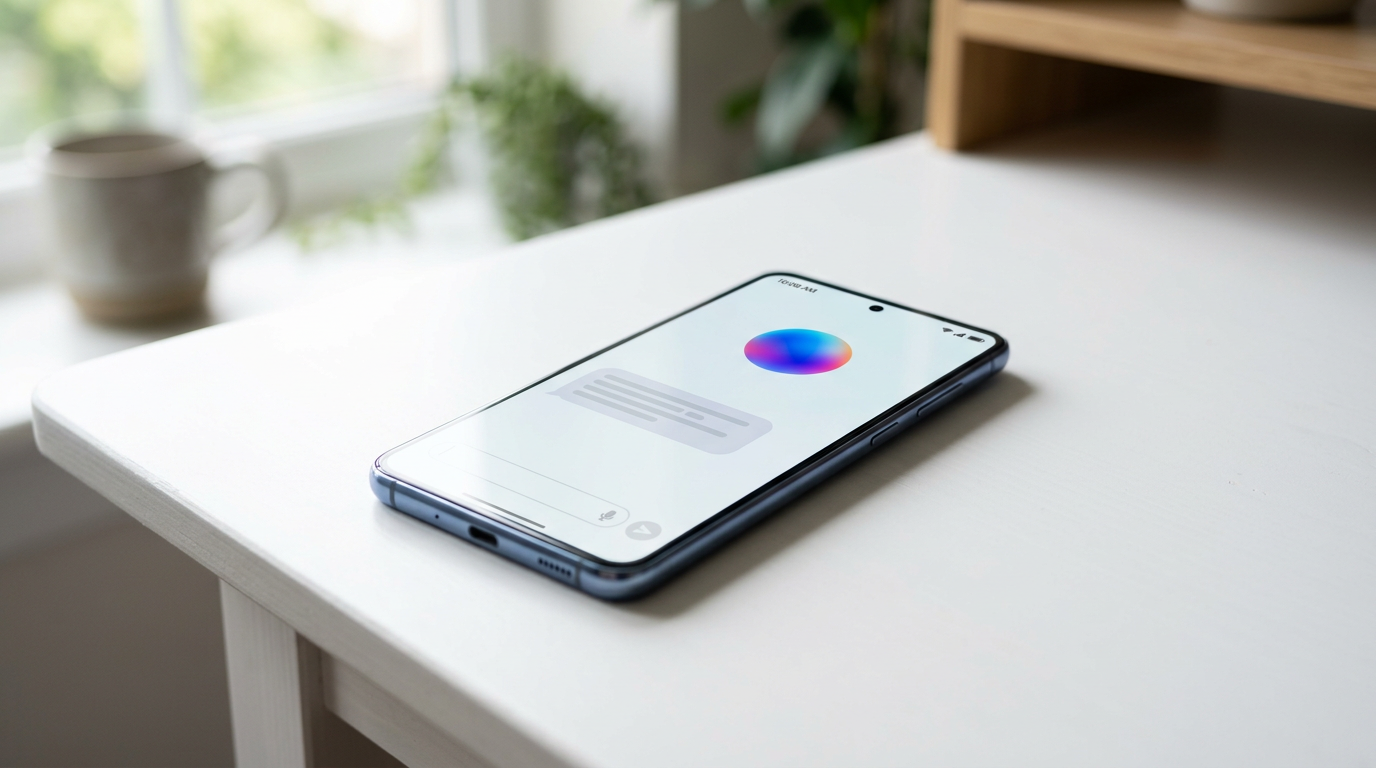
The Google Gemma 4 Android story is the quiet announcement under the noisy Gemini 3.1 launch. Google released the Gemma 4 family on 2 April 2026 under the Apache 2.0 licence, and that single legal detail is what gives every Android phone maker a commercially redistributable on-device model they can ship without a six-month licensing review. Google’s announcement framed it as a developer story. For UK Android buyers, it is the real shift of 2026.
- Gemma 4 released 2 April 2026 in four variants: Effective 2B (E2B), Effective 4B (E4B), 26B Mixture of Experts and 31B Dense.
- Apache 2.0 licence — commercially permissive, no acceptable-use carve-outs.
- Context windows of 128K on edge models and up to 256K on the larger ones.
- Multimodal across vision and variable-resolution images; E2B and E4B add native audio input.
- 140+ language support; the 31B sits at #3 on the Arena leaderboard, the 26B MoE at #6.
Why the Apache 2.0 licence is the whole Google Gemma 4 Android story
The previous generation of ship-capable open-weight models, Meta’s Llama line, carried a licence with acceptable-use carve-outs that made manufacturer lawyers nervous. Apache 2.0 does not. A phone maker can ship a fine-tuned Gemma 4 derivative without worrying about triggering a redistribution clause, paying royalties, or losing commercial rights if Google revises the terms later. That is the precise legal detail that moves a model from research toy into shipping product.
It is also why Google’s framing — “complete developer flexibility and digital sovereignty” — matters past the marketing. For UK Android OEMs and the developer community, sovereignty in this context means independence from the kind of upstream licensing changes that previously turned promising on-device features into legal liabilities overnight.
What UK Android buyers will actually see from Google Gemma 4
The E2B and E4B models are the ones designed to live on a phone. Google quotes them with 128K context, native audio for speech recognition, and image-plus-video understanding at variable resolutions. In practical UK terms, that points at private on-device summarisation of long WhatsApp and SMS threads, offline transcription for Voice Recorder-style apps, and richer image search that does not need a network round-trip. None of those features are exclusive to Google Pixels: the licence is the whole point.
The 26B MoE and 31B dense variants will sit behind OEM cloud endpoints. Expect Samsung, Xiaomi and Honor to evaluate them for the heavier private-processing workloads currently shipped via Awesome Intelligence or Xiaomi HyperAI. None of that is publicly confirmed, but the Arena leaderboard placement makes the case for itself — a 26B MoE that holds its own against 500B-class proprietary models is genuinely cheaper for an OEM to operate at UK scale.
Where Apple sits next to the Google Gemma 4 Android pitch
Apple’s on-device foundation model on iOS 27 remains proprietary and tightly coupled to the OS. The trade-off for UK buyers is the familiar one. Apple’s stack has privacy guarantees the company can credibly enforce. Android with Google Gemma 4 inside will have wider capability surfaces, faster feature updates, and a real developer ecosystem — and the privacy story will depend on the OEM rather than the chip vendor. That is the same fork iOS and Android have always taken, only now applied to the AI layer.

| Model | Parameters | Context | Best use |
|---|---|---|---|
| Gemma 4 E2B | Effective 2B | 128K | On-device, mid-range phones |
| Gemma 4 E4B | Effective 4B | 128K | On-device, flagship phones |
| Gemma 4 26B MoE | 26B (sparse) | 256K | OEM private endpoint |
| Gemma 4 31B Dense | 31B | 256K | Server-class workloads |
What UK developers should actually build on Google Gemma 4 Android
UK Android developers who have been waiting for a ship-capable on-device model should start with the Gemma 4 E2B weights via the AI Edge Gallery and the LiteRT runtime. The first sensible build is a private document summariser that runs offline. The second is an offline transcription tool that uses the E2B/E4B native audio support to remove the cloud dependency Whisper still demands. Both deliver real user benefit without network round-trips, and both will out-demo the previous generation of “AI” Android apps that quietly call a cloud endpoint behind the scenes.
For more on the wider Android AI shift, see our coverage of the Snapdragon 8 Elite Gen 2 on-device AI pitch, our analysis of why Gemini on every Android changes the platform’s character, and our notes on how to speed up an older Android phone in 2026 — the practical companion piece if you are running on hardware that pre-dates the Gemma 4 generation.
MTW verdict
The Google Gemma 4 Android story is the most consequential model launch of 2026 for buyers who do not live inside Apple’s walled garden. Apache 2.0, four cleanly scoped variants, and credible on-device performance is the trifecta Android OEMs have been waiting for. The first manufacturers to ship a non-trivial Gemma 4 fine-tune by autumn 2026 will set the on-device AI baseline for the next two years. Bet on Samsung and Xiaomi getting there first.
Buyer action
Where to buy or check next
Use this as the final check before ordering a phone, changing network or trusting a headline monthly price.









Reader discussion
Leave a comment
Comments are moderated. Keep it useful, accurate, and on topic.