
Buying a used electric car is one of the smartest ways to get into EV ownership. Depreciation hits EVs hard in the first few years, so you can pick up a three or four-year-old model for a fraction of its original price. But there is one critical question that does not apply to petrol or diesel cars: what is the battery’s state of health, and how do you check it before handing over your money?
Getting Started
- Understanding State of Health (SoH)
- OBD-II Readers and EV-Specific Apps
- What to Look For in the Data
- Manufacturer Warranties
- Red Flags When Buying a Used EV
- Practical Checklist for Buying a Used EV
- The Bottom Line
An EV’s battery is its most expensive component, often representing 30-40 percent of the car’s value. A healthy battery means years of reliable range; a degraded one means reduced range and a potentially costly replacement. Here is how to check an EV battery’s health before you hand over your money.
Understanding State of Health (SoH)
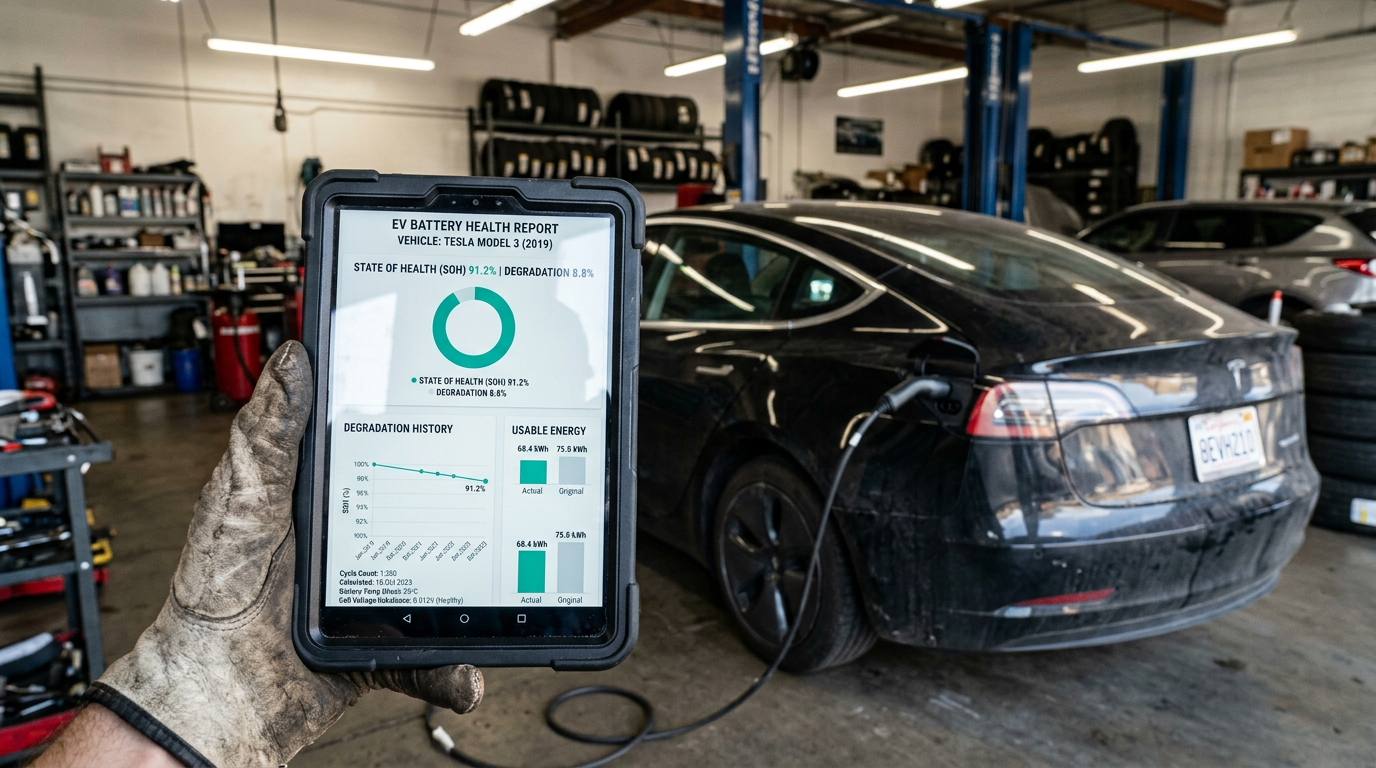
Every EV battery degrades over time, this is normal and expected. State of Health (SoH) is the metric that tells you how much of the EV battery’s original capacity remains. A new battery starts at 100 percent SoH. After several years of use, it might sit at 85-95 percent, meaning it can hold 85-95 percent of the charge it could when new.
What counts as acceptable? Most manufacturers consider a battery healthy as long as it retains at least 70-80 percent of its original capacity. In practice:
90-100 percent SoH: Excellent. The battery is performing like near-new. Expect minimal range reduction from the manufacturer’s stated figures.
80-90 percent SoH: Good. Noticeable but modest range reduction. A car originally rated for 300 miles might now achieve 240-270 miles, which is perfectly adequate for most drivers.
70-80 percent SoH: Acceptable but worth negotiating on price. Range reduction is significant enough to affect usability, especially in cold weather or on motorway journeys where real-world range already drops below official figures.
Below 70 percent SoH: Approach with caution. This level of degradation suggests either high mileage, frequent fast charging, or poor thermal management. Unless the price reflects this significantly, look elsewhere.
OBD-II Readers and EV-Specific Apps
The most reliable way to check battery health is with an OBD-II (On-Board Diagnostics) reader paired with an EV-specific app. An OBD-II reader is a small device that plugs into the diagnostic port found in every modern car (usually under the dashboard near the steering column). It communicates with the car’s computer and reads detailed data that the dashboard does not display.
Leaf Spy (Nissan Leaf): The gold standard for Leaf battery analysis. It shows individual cell voltages, temperature readings, state of health percentage, and total charge cycles. The Leaf’s battery is air-cooled and historically degrades faster than liquid-cooled competitors, making Leaf Spy essential for any used Leaf purchase. Available for around five pounds on Android and iOS.

TeslaFi / Tessie (Tesla): Tesla provides battery degradation data through its own app, but third-party services like TeslaFi and Tessie provide more detailed tracking over time, including capacity estimates, charging patterns, and degradation curves. If the seller has used these services, ask to see the historical data. Tesla’s built-in battery health indicator (available in newer firmware versions) also shows an estimated capacity percentage.
ABRP (A Better Routeplanner): While primarily a route planning app, ABRP tracks battery capacity over time when connected to your car. It supports dozens of EV models and provides capacity estimates based on real driving data. If the seller uses ABRP, their historical data can give you excellent insight into the EV battery’s trajectory. Our EV road trip planning guide covers ABRP in more detail.
Car Scanner ELM OBD2 / OBDEleven: General-purpose OBD apps that work with many EV models including Hyundai, Kia, Volkswagen, and BMW. They can read battery SoH data on supported vehicles, though the depth of information varies by manufacturer. Check compatibility with your specific model before purchasing.
What to Look For in the Data
Once you have the data from an OBD-II app, three numbers matter most.
State of Health (SoH) percentage. This is the headline figure. Cross-reference it with the thresholds above. If the car is three years old and the SoH is already below 85 per cent, that is a warning sign.
Individual cell voltage balance. An EV battery is made up of hundreds or thousands of individual cells. In a healthy battery, the voltage across all cells is tightly matched. A spread of more than around 30 millivolts between the highest and lowest cell can indicate a weak cell that will cause trouble later.
Charging history and DC fast-charge frequency. Heavy DC rapid charging accelerates degradation compared to slow home charging. If the data shows heavy reliance on rapid chargers, factor this into your assessment.
Manufacturer Warranties
Most manufacturers warrant their EV batteries for eight years or 100,000 miles (whichever comes first), typically guaranteeing at least 70 per cent capacity retention. This is the industry standard across Kia, Volkswagen, Audi, Hyundai, BMW and others in the UK, as confirmed by each manufacturer and Kia UK among others. Check the specific warranty terms for the car you are considering, and critically, check whether the warranty is still active. Some warranties transfer to second owners, others do not.
Red Flags When Buying a Used EV
SoH below 80 percent on a car under five years old: This suggests abnormal degradation that may continue. Unless the price is exceptionally low, walk away.
Seller refuses to allow an OBD-II scan: A confident seller with a healthy battery has nothing to hide. Reluctance to allow diagnostic checks is a significant red flag.
Inconsistent mileage and range claims: If the seller claims “it still gets great range” but the odometer shows high mileage and you cannot verify SoH, be sceptical. Our guide on why range anxiety is no longer a real problem explains modern range expectations in detail.

Excessive fast charging history: A car used primarily for long-distance motorway driving with frequent rapid charges will typically show more degradation than one charged mostly at home.
Salvage or accident history: Battery damage from impacts may not be immediately visible but can cause long-term issues. Always check the car’s full history through services like HPI Check.
Practical Checklist for Buying a Used EV
When it comes to EV Battery Health, before viewing a used EV, prepare the following:
1. Research the specific model’s battery reputation. Search forums and owner communities for known battery issues with your target car. Some model years or battery suppliers had specific problems that later models resolved.
2. Bring an OBD-II reader and the appropriate app. Budget twenty to fifty pounds for the hardware and app if you do not already own one. This is trivial compared to the cost of the car.
3. Check the battery warranty status. Contact the manufacturer or check the car’s service records to confirm warranty coverage and whether it transfers to you as a second owner.
4. Test the range yourself. Drive the car with a full charge and note the real-world range displayed. Compare this to the manufacturer’s original specification and account for the SoH reading.
5. Inspect charging port and cable condition. Physical damage to the charging port or a frayed cable suggests rough handling that may extend to the rest of the car.
6. Ask about charging habits. How the car was typically charged (home slow charger vs public rapid charger) tells you a lot about how the battery has been treated.
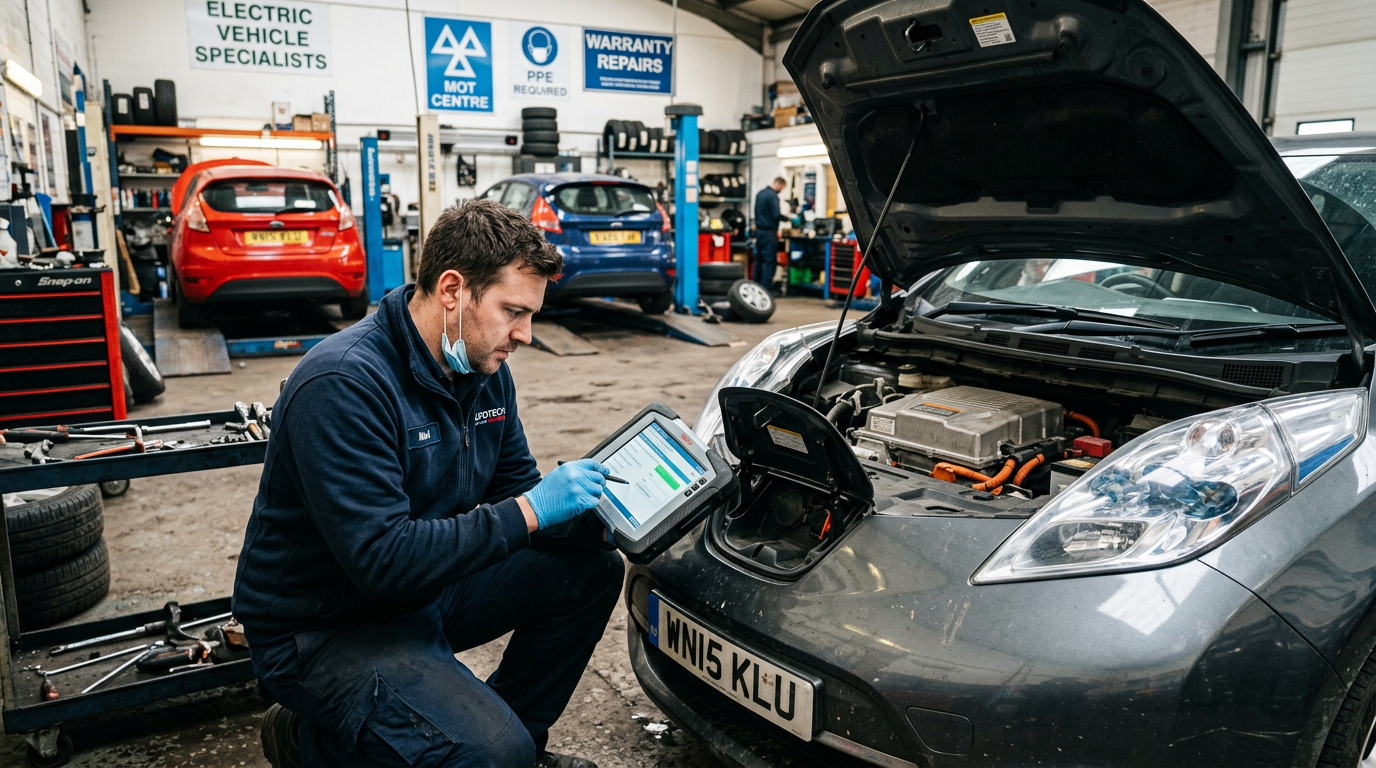
7. Get a pre-purchase inspection from an EV-specialised mechanic. General garages may not have the equipment or expertise to properly assess EV-specific components. The EV charging apps we recommend can also help you find EV-specialised service centres near you.
Checking EV Battery Health Is Essential
Buying a used EV is increasingly safe and sensible, batteries are lasting longer than early predictions suggested, warranties provide meaningful protection, and the tools to verify EV battery health are accessible and affordable. Do your homework, bring an OBD-II reader, and do not let a seller’s vague reassurances substitute for hard data. A thirty-pound diagnostic tool could save you thousands.
Proper EV battery health management is the difference between a car that lasts 15 years and one that needs expensive replacement at 8. Our EV battery health guide for 2026 covers everything from charging habits to storage temperatures. Follow these EV battery health principles and your vehicle will reward you with years of reliable service.
For a worked example of vetting a used EV’s battery before you buy, see Car Deal Expert’s used EV battery-health checklist.
Buyer action
Where to buy or check next
Use this as the final check before ordering a phone, changing network or trusting a headline monthly price.














Reader discussion
Leave a comment
Comments are moderated. Keep it useful, accurate, and on topic.