
UPDATED · News · 24 Jun 2026 · Daniel Reid
Every few months the maker forums talk themselves into a Bambu Lab “P2” — a next-generation CoreXY machine with some exotic motion trick, usually shorthanded as a “CoreXX”. The rumour never landed. What actually arrived, as 3D Printing Industry reported in October 2025, was the P2S: a £479 enclosed CoreXY that quietly answers most of what the speculation was reaching for, and does it at a price that makes the wishlist look beside the point.
So let me deal with the rumour first, because it shapes how you should read this launch. There is no confirmed “CoreXX” P2 sitting above the P2S in Bambu’s range. The P2S is the P2 generation for the desktop maker — pitched as the direct successor to the much-loved P1S — and Bambu has slotted it deliberately between its open-frame A-series and the industrial-leaning H2 machines. If you have been holding out for a mythical printer, the practical answer is that the thing you were waiting for is on the shelf under a different name. The interesting part is what Bambu chose to carry up from the cheaper P-series and what it borrowed down from the dearer H-series, because that mix is the whole story of who this machine is for.
What Bambu actually shipped
The headline numbers are conventional in the best sense. You get a 256 × 256 × 256 mm build volume — the same cube of usable space that made the P1S the default recommendation for anyone serious about printing functional parts at home. It is a fully enclosed CoreXY system, sold ready-to-print rather than as a kit, and it ships with the kind of reliability features that used to be reserved for far dearer hardware. For UK buyers that enclosure matters more than the spec line suggests: it is what lets you run ABS and the warpier filaments in a spare room or a cold garage through a British winter without a draught ruining the first layer.
Two upgrades matter more than the spec sheet lets on. The first is the extruder: Bambu has moved to a PMSM servo unit it brands “DynaSense”, replacing the stepper-driven feed of the P1S. In plain terms, a servo can sense and correct how much filament it is actually pushing rather than counting on open-loop steps, which is meant to tighten extrusion consistency and flag jams earlier. The second is the borrowed intelligence — Auto Flow Dynamics Calibration and AI failure detection that watches for spaghetti and nozzle blobs and stops the print before it wastes a spool. Both of those are H2-series tricks arriving in a sub-£500 box, which is the genuinely consequential thing here.
On paper the machine is rated at 600 mm/s, which is the CoreXY ceiling rather than a number you will hit on a detailed model — quality slicing settings, acceleration limits and the part geometry all pull the real figure down long before you get there. But the point stands: this is meaningfully quicker than the P1S it replaces, and the time saved compounds on the long multi-hour prints that are the reason anyone buys an enclosed machine in the first place.
The CoreXY question, settled at £479
Here is the part that ends the rumour cycle for me. The whole appeal of a hypothetical “CoreXX” was faster, cleaner, smarter printing in an enclosed box. The P2S delivers exactly that brief at £479 including VAT in the UK, with stock available from launch rather than the usual six-week queue. At that figure, the gap between “the printer makers fantasised about” and “the printer Bambu sells” is essentially closed. The forums were not wrong about what they wanted; they were wrong about the name and about how soon it would cost less than £500.
The machine the forums spent a year designing in their heads already exists — it just costs £479 and answers to a less glamorous name.
What you do not get is active chamber heating. The P2S uses passive chamber heating with adaptive airflow flaps and carbon filtration, not a powered heating element. For the materials most home makers actually run — PLA, PETG, the easier flavours of ABS — that is a non-issue; the enclosure traps enough ambient heat to keep those stable. If your ambitions run to high-temperature engineering filaments that genuinely need a hot, controlled chamber — think the polycarbonate and nylon composites people buy industrial machines for — this is the line where Bambu wants you looking up the range at the H2 machines instead. That tiering is deliberate, and it is the single most important thing to understand before you buy. Bambu has not crippled the P2S; it has drawn the boundary of what £479 honestly buys.
Where the AMS 2 Pro changes the maths
The version most people should be pricing is the Combo. For £699 including VAT — listed by authorised UK reseller Additive-X at that figure, or £582.50 before tax — you add the AMS 2 Pro, which feeds four filaments and unlocks multi-colour and multi-material printing as a system rather than a manual chore. The AMS handles the spool swaps, the purging and the filament tracking in software, which is the difference between multi-colour being a party trick and being something you actually use on a Tuesday evening.
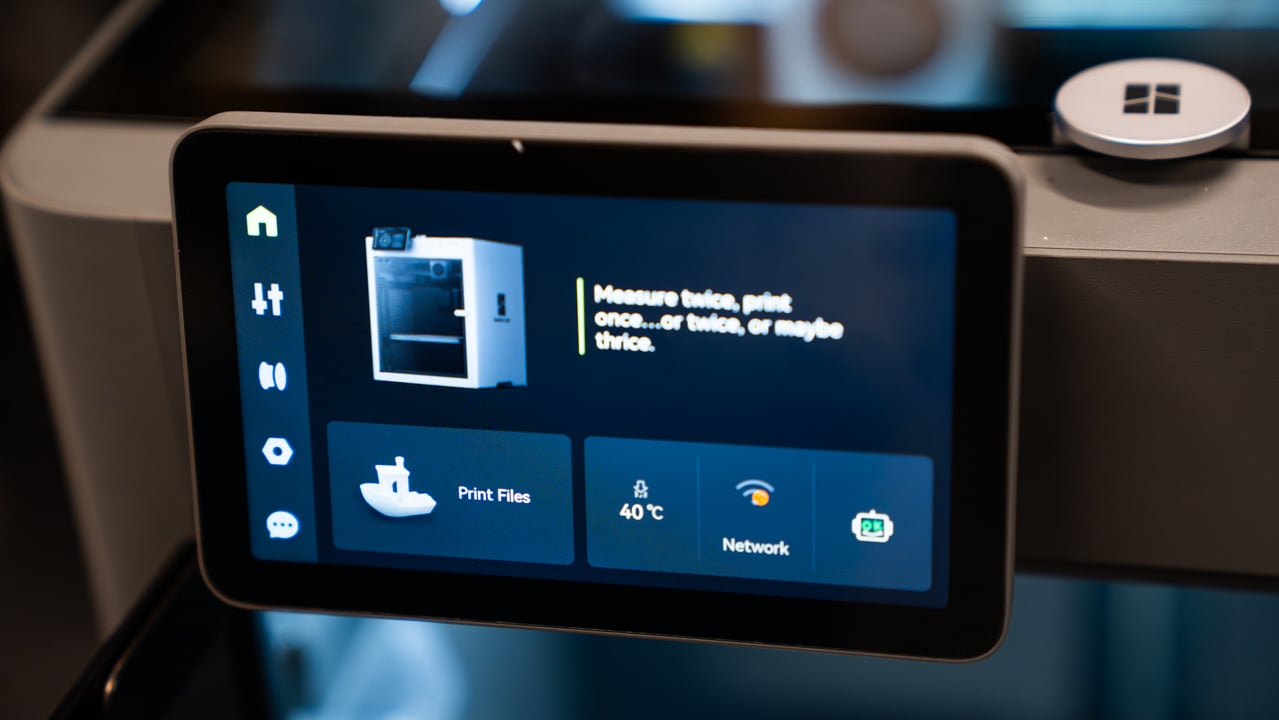
That £220 step from printer to Combo is the decision that actually matters, not the rumour. Multi-material is where Bambu’s ecosystem earns its reputation, and buying the AMS later as a bolt-on rarely feels as clean as having it from day one — you end up paying close to the same money for the unit and losing the integrated-from-launch tidiness in the bargain. If colour work or dissolvable supports are anywhere on your horizon, the Combo is the version to budget for and the £479 base model is a false economy. If you only ever print single-colour functional parts — brackets, jigs, replacement clips — the base machine is the honest choice and the AMS is money you do not need to spend.
One practical UK note: buy from an authorised seller. Additive-X and 3DJake both stock the line officially, which matters for warranty and for getting genuine consumables and nozzles rather than the grey-market parts that turn up when a product is in demand. At these prices the support path is part of what you are paying for.
The bits that would give me pause
Two things keep me honest about it. The passive chamber is a real ceiling, not a marketing footnote — anyone with engineering-grade material plans should treat the P2S as the wrong tool and price the H2 line instead, and no amount of slicer fiddling changes that. And the servo extruder and AI features, genuinely good as they read, are exactly the sort of new-generation hardware I would want a few months of community print hours behind before declaring bulletproof. A closed-loop extruder is more complex than the stepper it replaces, and complexity is where early-run reliability questions live. Early reliability on a fresh extruder design is the one variable a spec sheet cannot settle, and it is the thing I would watch the forums for over the autumn.
Neither is a reason to wait for a printer that is not coming. If you have been sitting on a P1S deciding whether to upgrade, or you have been priced out by the H2 and told yourself a cheaper enclosed CoreXY was around the corner — it is here, it is the P2S, and at £479 for the base machine or £699 for the Combo it is the most sensible enclosed printer Bambu has put in front of UK makers. I would buy the Combo, skip the base model unless you are certain you will never touch multi-material, and stop refreshing the rumour threads. The CoreXX you wanted already has a price tag.
Buyer action
Where to buy or check next
Use this as the final check before ordering a phone, changing network or trusting a headline monthly price.










Reader discussion
Leave a comment
Comments are moderated. Keep it useful, accurate, and on topic.