
Fifty quid to make your lights stop dying on you while you sit perfectly still on the sofa. That, stripped of the smart-home jargon, is the pitch for the Aqara Presence Multi-Sensor FP300 — and on the numbers laid out in TrustedReviews’ 2025 review, it is one of the more honest £49.99 purchases in the British smart home right now. The RRP is confirmed at £49.99 on Aqara’s official UK store, and PriceSpy UK currently tracks that same £49.99 as the best price going. No discount drama, no grey-import games — the question isn’t whether it’s cheap, it’s whether radar presence sensing is finally worth paying for in a UK home. I think it is, and here’s the bit that convinced me.
The problem every PIR sensor has, and why it matters here
Walk into almost any “smart” room in Britain and you’ll meet the same gremlin: the lights snap on when you arrive, then quietly switch themselves off ten minutes later while you’re still very much in the room. That’s not a fault. That’s exactly how a passive infrared (PIR) sensor is built to behave. PIR detects changes in heat — a body moving across its field of view. Sit still to read, work at a desk, or doze in front of the telly, and as far as a PIR sensor is concerned, the room is empty.
The FP300’s answer is mmWave radar. Where a PIR module watches for movement, the radar measures the room itself and notices that something the size and shape of a person is occupying it — breathing, fidgeting, doing nothing at all. Aqara pairs the two technologies rather than replacing one with the other: PIR for instant motion triggers, mmWave radar for genuine presence. Aqara’s own listing leans on that dual-sensing design, plus on-device AI that’s meant to filter out the usual false-trigger culprits — a fan oscillating in a heatwave, a cat patrolling the windowsill at 3am. That filtering is the bit TrustedReviews kept coming back to, because a presence sensor that cries wolf is worse than no sensor at all.
It’s not just a presence sensor — it’s a four-in-one
This is the detail the “presence sensor” label undersells, and it changes the value sum. The FP300 isn’t a single-purpose radar puck; it bundles four sensors into one coin-cell device. As well as the mmWave presence and PIR motion sensing, it carries a light (lux) sensor and reads temperature and humidity — the same rundown Aqara’s own datasheet sets out. That matters because it collapses a shopping list. A light sensor lets you write automations that only switch the lamps on when the room is genuinely dim, not just occupied. Temperature and humidity feeds give you triggers for heating or an extractor fan without buying a separate Aqara climate sensor at another £15 or so.
Reframe the £49.99 that way and it reads differently: you’re not paying fifty quid for radar, you’re paying it for radar presence, motion, ambient light, temperature and humidity in one battery-powered unit that mounts anywhere. For a single room you actually live in, that’s a lot of sensing for the money, and it’s the strongest part of the FP300’s case once you stop thinking of it as a one-trick device.
The coverage figures that decide where it actually works
Specifications are where smart-home kit either earns its keep or quietly disappoints, so the FP300’s matter. Per Aqara’s EU product page, you get a 120° field of view and a 6-metre detection range. For a typical British room — a 3.5 by 4 metre lounge, a home office, a hallway — that 6m reach comfortably blankets the whole space from a single corner, and the 120° spread means you’re not forced to mount it dead-centre on a ceiling to catch everyone.
That’s the practical difference from a motion sensor that only fires when you cross a narrow beam. A radar field that covers the room as a volume is what lets you build automations you can actually trust: lights that stay on while you’re sat still, heating or extraction that only runs when someone’s genuinely there, an office lamp that doesn’t betray you mid-video-call. The 6m/120° envelope is generous for the price bracket, and it’s the single number I’d check first against your own room before buying — a long, narrow hallway or an open-plan kitchen-diner will test that 6m reach in a way a snug box room never will.
The honest test of a presence sensor isn’t whether it turns the lights on. It’s whether they ever turn off while you’re still in the room. PIR fails that test by design; radar is the first affordable fix.
Battery life that doesn’t turn it into a chore
Here’s where the FP300 quietly separates itself from a lot of mains-hungry radar sensors. It runs on two CR2450 coin cells and, per the Aqara UK listing, lasts up to three years on Zigbee or two years on Thread. That is a genuinely big deal. Plenty of mmWave presence sensors demand a permanent USB-C tether, which means a visible cable, a spare plug, and a sensor that can only live where there’s a socket. A three-year coin-cell life means you can stick the FP300 in a corner of the ceiling or high on a wall and forget it exists until well into 2028.
The trade-off is honest and worth knowing: choose Thread for snappier, more modern mesh behaviour and you give up a year of battery; stay on Zigbee and you bank the longer life. For most UK households already running an Aqara or SmartThings Zigbee hub, Zigbee and its three years is the path of least resistance — and at £49.99 with no recurring cable or charging faff, the running cost over that lifespan is effectively a pair of coin cells. One caveat the reviewers are right to flag: those battery figures are Aqara’s own estimates, not independently proven over a full three-year field test, so treat them as a strong claim rather than a guarantee.
How it stacks up against the obvious rivals
At £49.99 the FP300 sits in a crowded part of the shelf, so the cross-shop matters. The closest sibling is Aqara’s own FP2, usually £80–£90 in the UK. The FP2 is the more capable sensor on paper — it adds proper multi-zone tracking, so it can tell which part of a room you’re in — but it’s mains-powered, which means a permanent USB-C cable and a socket nearby. The FP300 gives up that zoning, and that’s its single biggest functional limitation versus the FP2: it tells you someone is in the room, not whereabouts in it. For most lighting and heating automations, “someone is here” is all you need, and the FP300 banks battery freedom for it.
| Spec | Aqara FP300 | Aqara FP2 |
|---|---|---|
| UK price | £49.99 (Aqara UK store) | ~£80–£90 |
| Power | 2× CR2450 coin cell, up to 3 years on Zigbee (2 on Thread) | Mains, permanent USB-C cable |
| Position sensing | Room-level presence only | Multi-zone tracking (knows where in the room) |
| Best for | Battery freedom, lower price, most lighting/heating automations | Per-zone automations that need exact location |
Step down in price and you meet the motion-only crowd. A Philips Hue Motion Sensor (around £35–£45) or an Eve Motion is a battery PIR — it catches movement, not sustained presence, so it’ll drop you back into the lights-off-while-I-sit-still problem the FP300 exists to solve. Cheaper Sonoff or Tuya mmWave sensors do offer radar presence at similar money, but they’re frequently mains-powered single-purpose units without the FP300’s light, temperature and humidity sensing or its Matter support. Weigh those up and the FP300’s pitch is specific: presence-grade radar, four sensors in one, on a battery, for less than the mains-tethered FP2.
Where it fits in your setup — and the catch
On paper the FP300 is platform-agnostic in the way smart-home buyers keep demanding. Aqara lists Thread, Zigbee, Bluetooth and Matter support, with compatibility across Apple Home, Google Home, Amazon Alexa and Samsung SmartThings. Matter is the headline: it’s the standard meant to end the walled-garden nonsense, and a £49.99 presence sensor that speaks it is exactly the kind of low-risk way to test whether your ecosystem actually plays nicely before you commit to anything pricier.
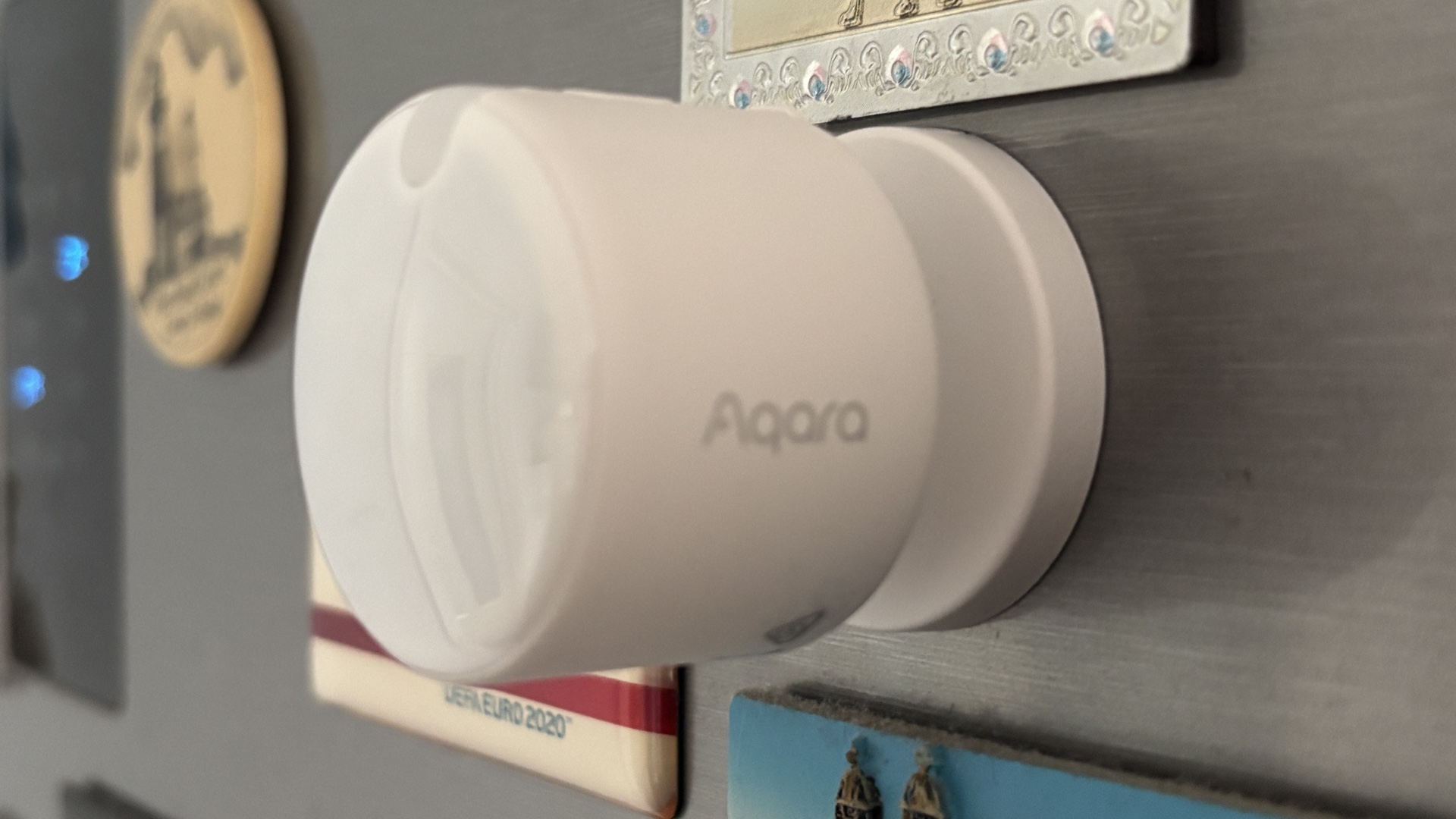
The catch — and there’s always one — is that presence-grade automations reward patience. Radar sensors need positioning and a little tuning to stop them seeing through a stud wall and counting the neighbour, or to dial in exactly how far “presence” should extend. This is not a peel-and-stick-and-done device in the way a basic door sensor is. Budget yourself an evening with the Aqara app, and check the FP300 user manual before you mount it, not after — the mounting height and angle do more for accuracy than any setting in software.
So would I spend the fifty quid?
Yes — with one condition. If your smart home is still entirely PIR-driven and the lights-off-while-I’m-sitting-here problem is the thing that nags you, the FP300 is the most sensible £49.99 upgrade I can point you at, and the fact that PriceSpy shows no-one undercutting the £49.99 RRP means you’re not waiting for a mythical sale. The coin-cell battery life and the four-in-one sensing are what tip it from “interesting” to “buy” — radar without the cable tax, plus light, temperature and humidity thrown in, is rare at this money.
Who should hold off? Anyone wanting a stick-it-and-ignore-it sensor for a single doorway — a cheap PIR still does that job fine and you don’t need radar to catch someone walking past. Anyone who genuinely needs to know where in a room a person is, for per-zone automations, should spend up to the mains-powered FP2 instead. And if you’ve no Zigbee, Thread or Matter hub at all yet, factor that cost in first; the sensor is half the story. But for the room where you actually live — the lounge, the home office — this is the sensor that finally makes “presence” mean what the marketing has been promising for years. I’d put it on the ceiling and stop thinking about it.
Buyer action
Where to buy or check next
Use this as the final check before ordering a phone, changing network or trusting a headline monthly price.







Reader discussion
Leave a comment
Comments are moderated. Keep it useful, accurate, and on topic.