
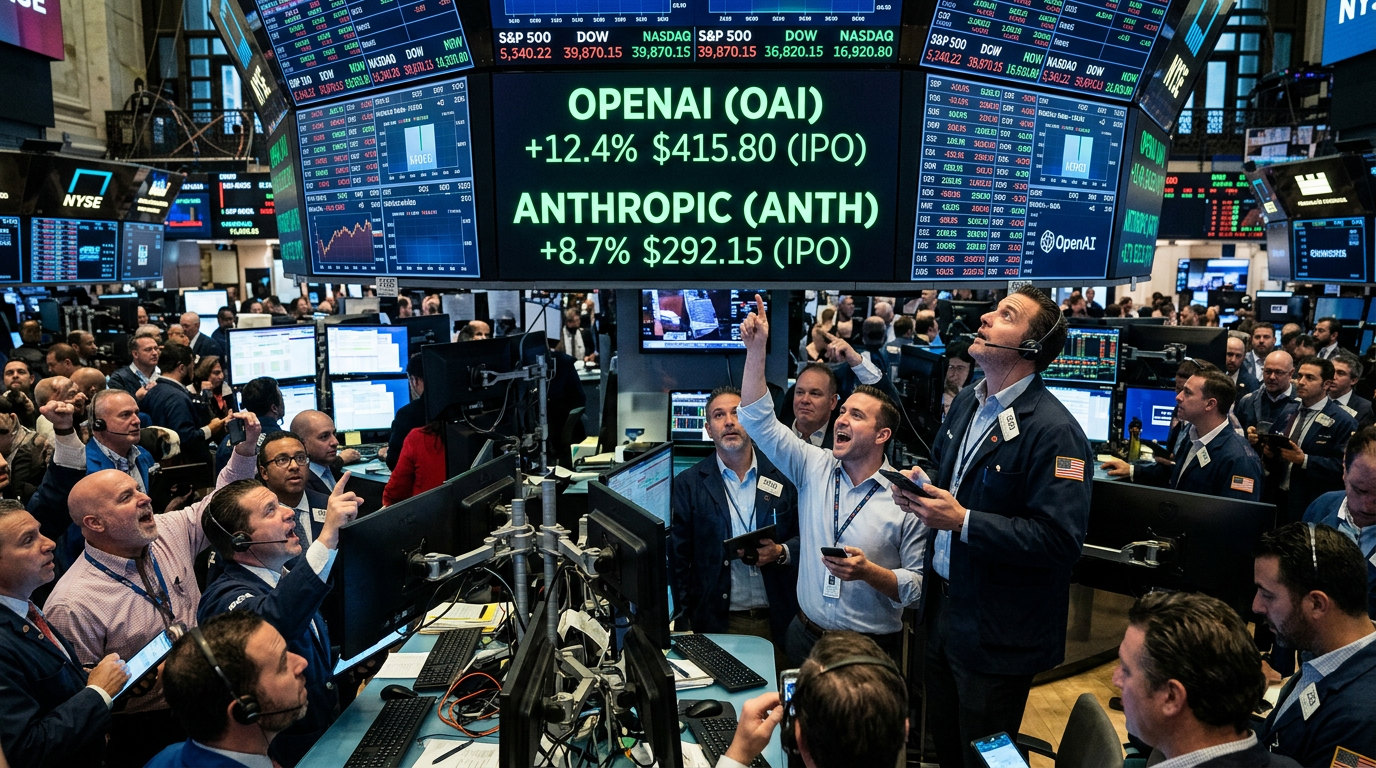
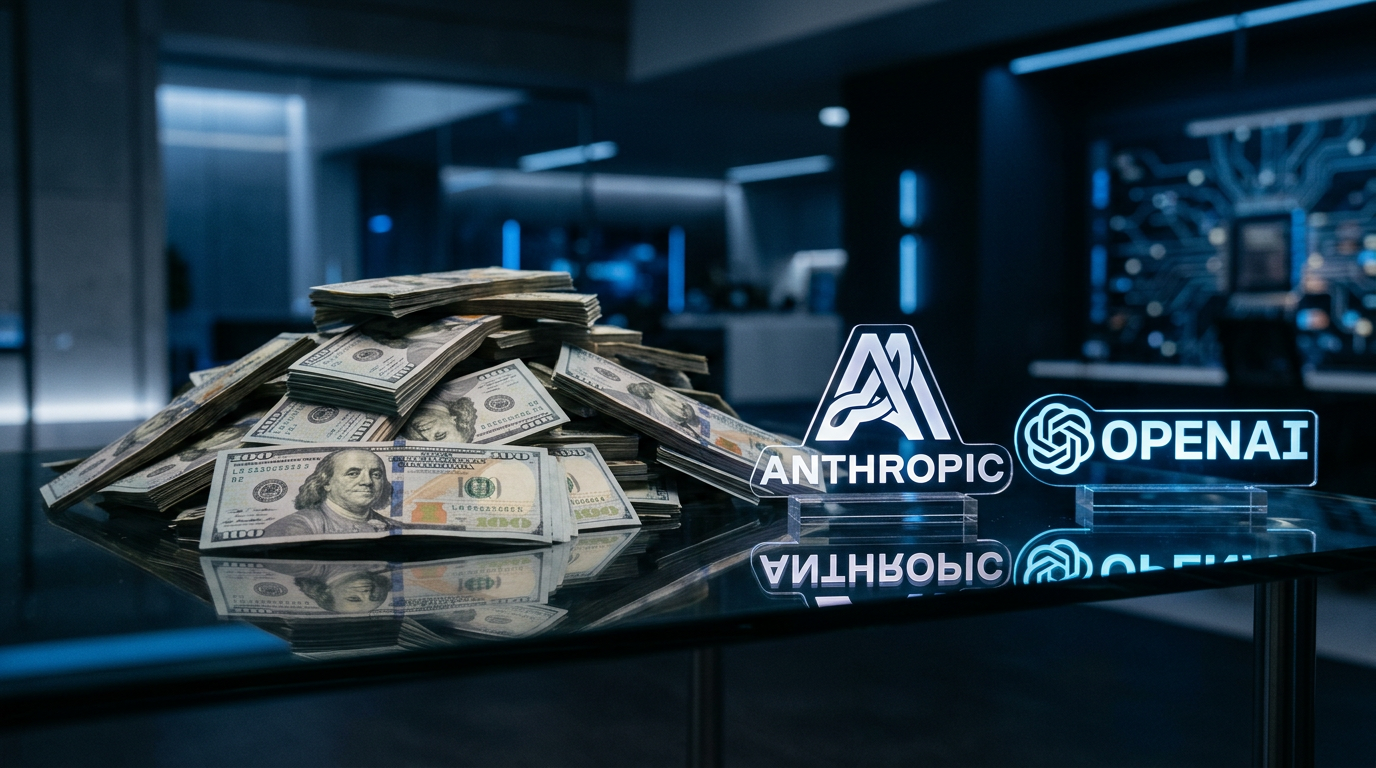
Two of the most valuable private companies in history are racing to go public in the same year, with the AI IPO 2026 potentially defining the decade. Anthropic, valued at around £304 billion ($380 billion), is considering an IPO as early as Q4 2026. OpenAI, valued at around £682 billion ($852 billion), is eyeing a similar timeline. Together they would represent well over £1 trillion in market capitalisation, and the biggest test of investor appetite for AI since the boom began.
Ai Ipo: Contents
- The Numbers Behind the Race
- Two Very Different Companies
- The Revenue Question
- Regulatory and Legal Wildcards
- Can the Market Absorb Both?
- What to Watch
The Numbers Behind the Race
The scale of these potential IPOs is almost difficult to comprehend. Anthropic closed a $30 billion (around £24 billion) Series G round on 12 February, pushing its post-money valuation to $380 billion (around £304 billion). At the time the company’s run-rate revenue was quoted at $14 billion (around £11.2 billion), and by March that figure had reportedly climbed to around $30 billion annualised, as Anthropic’s own announcement confirms.
OpenAI, meanwhile, closed a $122 billion (around £97.6 billion) funding round at an $852 billion (around £681.6 billion) valuation on 31 March, as CNBC reports. The company is openly targeting a Q4 2026 IPO at a £1 (about $1) trillion valuation, with bankers already circling.
Two Very Different Companies
This difference matters for investors. OpenAI’s broader product portfolio creates more revenue streams but also more complexity and risk, as the Sora debacle demonstrated. Anthropic’s narrower focus means its valuation rests almost entirely on the quality of its models and API revenue growth.
The Revenue Question
Both companies face a fundamental challenge that IPO investors will scrutinise: can they generate sustainable profits at scale? AI model training and inference costs are enormous. OpenAI’s Sora was reportedly burning roughly $1 million (around £800,000) per day before it was shut down, according to TechCrunch’s post-mortem. Even successful products like ChatGPT and Claude require vast compute infrastructure that eats into margins, which is central to the AI IPO 2026 debate.
Anthropic’s revenue trajectory, from $14 billion (around £11.2 billion) run rate in February to around $30 billion annualised by mid-March, is impressive. But at a $380 billion (around £304 billion) valuation, the company is priced for near-perfect execution. Any stumble in model quality, any delay in capability improvements, and the valuation multiple becomes very hard to justify.
OpenAI faces similar pressure at an even larger scale. The company’s $852 billion (around £681.6 billion) valuation implies extraordinary revenue growth that must materialise quickly once public investors are scrutinising quarterly earnings.
Regulatory and Legal Wildcards
Both companies also face significant regulatory uncertainty. Anthropic is currently battling the US Department of Defence in court after the Trump administration attempted to ban federal agencies from using Claude. A federal judge granted a preliminary injunction blocking the ban, citing classic illegal First Amendment retaliation, though an appeals court subsequently narrowed that protection in early April, as CNBC reports.
OpenAI faces its own legal exposure, including ongoing copyright lawsuits from publishers, authors, and content creators. The outcome of these cases could fundamentally alter the economics of AI model training.
For IPO investors, legal and regulatory risk is particularly uncomfortable because it’s binary: a favourable ruling changes nothing, but an unfavourable one could be catastrophic. Neither company can fully price this risk into their prospectus.
Can the Market Absorb Both?
The most practical question may be the simplest: is there enough investor capital to support both IPOs in the same year? Market analysts have flagged the sheer volume of capital required. At standard float percentages, Anthropic, OpenAI, and SpaceX combined would need to raise more from public markets in one quarter than the entire US IPO market produced in a decade.
This creates a first-mover advantage. Whichever company lists first will likely capture the initial wave of AI enthusiasm. The second may find a more cautious market, especially if the first listing doesn’t perform well in its early trading days. For more, see our AI coverage.
What to Watch
The AI IPO race of 2026 will be a defining moment for the technology industry. For everyday users of ChatGPT, Claude, and Gemini, the IPOs matter because public market pressure will shape how these companies prioritise features, pricing, and safety. Public investors demand growth, and sometimes that growth comes at the expense of the user experience that attracted people in the first place. For more, see our editorials.
Keep an eye on Q3 earnings reports, regulatory developments, and, perhaps most importantly, which company files its S-1 first. In a market this overheated, timing could matter as much as technology.
MMTW Editorial
Buyer action
Where to buy or check next
Use this as the final check before ordering a phone, changing network or trusting a headline monthly price.












Reader discussion
Leave a comment
Comments are moderated. Keep it useful, accurate, and on topic.