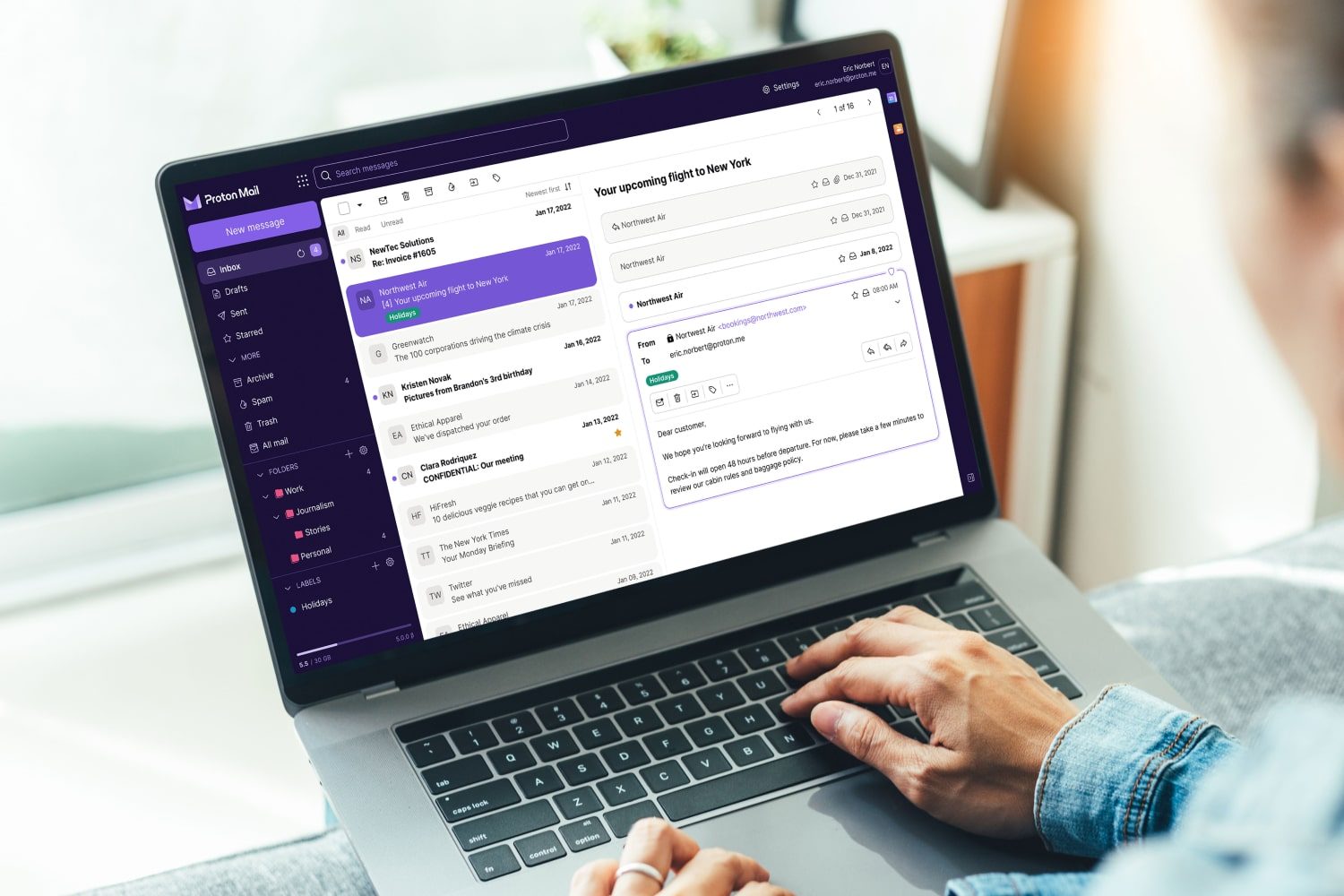
The question lands in my inbox almost weekly now, usually from a founder who runs a lean team and has just clocked their Google Workspace renewal: is there a version of all this that doesn’t quietly mine my company for data? Since 31 March 2026, when Proton folded its business tools into a single suite called Proton Workspace, my answer has stopped being “sort of” and started being “yes, and it’s closer to a real Google replacement than it’s ever been.” Proton’s own 31 March 2026 launch announcement laid out the shape of it; the first independent read I trust came a day later, in iFeelTech’s 1 April 2026 comparison of the two suites side by side.
So let me do the thing UK small businesses keep asking me to do: lay out what Proton Workspace actually is in 2026, what it costs in real money, and whether the privacy pitch survives contact with a normal working week.
What Proton actually shipped in March
Proton Workspace isn’t a rebrand of a mail app. It bundles Mail, Calendar, Drive, Docs, Sheets, Meet, VPN and Pass into one subscription — which is to say it now covers the same ground a small firm expects from Google Workspace, plus a password manager and a VPN that Google doesn’t throw in at all. The suite comes in two tiers, Standard and a heavier Workspace Premium that adds Proton’s Lumo AI assistant, more storage and larger meeting limits.
The headline that matters for existing customers: anyone already on the old Proton Business Suite was moved up to Workspace Standard for free, Proton Meet included. That’s the sort of gesture I’ve learned to be slightly suspicious of — free upgrades usually presage a price rework somewhere down the line — but on the day, it meant thousands of businesses woke up with encrypted video conferencing they hadn’t paid for. Proton says the platform now sits behind more than 100,000 businesses and, across its consumer and business base, over 100 million accounts — a figure the reviews repeat but which traces back to Proton’s own count rather than an audited third party, so I’d treat it as a direction of travel, not gospel.
The price question every UK SME asks first
Here’s where I have to manage expectations, because there is no sterling price. Proton bills UK companies in dollars or euros, with no separate UK tariff — so budget in the currency you’ll actually be charged in and treat any pound figure as a moving target that your card provider’s exchange rate and any non-sterling fee will nudge around each month.
Workspace Standard runs $12.99 / €12.99 per user per month on annual billing, or $14.99 / €14.99 if you pay monthly. Workspace Premium is $19.99 / €19.99 per user per month annually, rising to $24.99 / €24.99 on the monthly plan. At today’s rates that’s roughly a tenner a head for Standard and around £16 for Premium — close enough to Google’s Business Standard that price alone won’t decide this for you.
That’s the point I keep coming back to. Proton has stopped competing as the cheap, principled underdog and started charging like a peer. If you’re the kind of buyer who chases the lowest per-seat number, this was never going to be your suite — and honestly, a business that picks its core tooling on price is making a different mistake entirely. The case for Proton has to be made on what you get for parity money, not on saving a few quid.

Proton has stopped competing as the cheap, principled underdog and started charging like a peer — which means the privacy argument now has to stand on its own, not hide behind a discount.
What Premium actually buys you
The tier worth scrutinising is Premium, because that’s where the numbers get generous. Proton’s business support documentation puts it at 3 TB of storage per user, up to 20 custom email domains, Meet calls of 250 participants, and data-retention policies — the kind of admin control that turns a consumer-grade tool into something a compliance officer will sign off on. Twenty domains is a lot; most SMEs I talk to are juggling two or three brands at most, so that ceiling is really aimed at agencies and holding companies.
Proton Meet is the piece I’d flag to anyone who does client calls. It launched with the suite as end-to-end encrypted video conferencing, and even the free tier is usable: 50 participants, a 60-minute limit, and no Proton account required for guests. That last detail matters more than it sounds — the friction of “please create an account to join my call” has killed more encrypted-tool adoption than any missing feature. If a solicitor or an accountant can click a link and be in the room, the privacy story finally survives the handshake.
The AI layer, Lumo, is the part I’d treat with more caution. Proton names it and slots it into Premium, but the independent detail on what Lumo can genuinely do is thin — the third-party reviews don’t go much past the name. If an assistant is central to how your team works, I’d want to trial it before committing, the same way I’d tell a UK firm to actually pressure-test Claude against real tasks rather than take the marketing on faith. An AI feature you can’t yet evaluate is a line item, not a reason to switch.
Where it beats Google — and where it still can’t
The genuine advantage is structural. Google’s business model reads your metadata to sell you things and sharpen its products; Proton’s reads nothing because it’s built so it can’t. For a UK SME handling client records, health data or anything touching legal privilege, “the provider cannot see the contents” is not a marketing line — it’s a defensible answer when a client asks where their data lives. Add the bundled VPN and Pass, and you’re consolidating three separate subscriptions most firms already pay for. Here’s how the two suites actually line up on the points that decide it:

| Deciding factor | Proton Workspace | Google Workspace | Edge |
|---|---|---|---|
| Data model | End-to-end encrypted; provider can’t read content | Metadata read to sharpen ads and products | Proton |
| Bundled VPN + password manager | Included (VPN + Pass) | Sold/handled separately | Proton |
| Video meetings | Proton Meet, E2E encrypted, guests join with no account | Google Meet, mature but not E2E by default | Proton |
| Integrations & add-ons | Growing but limited | Decade-deep third-party ecosystem | |
| Price (per user/month, annual) | $12.99 Standard / $19.99 Premium | Rough parity (Business Standard) | Level |
| UK billing | USD/EUR, no GBP tariff | Local billing options |
Where Proton still can’t match Google is the connective tissue. Workspace lives inside a decade of habits, integrations and third-party apps that assume Google is there. Docs and Sheets are competent, but the real-time collaboration and the sprawl of add-ons aren’t at parity, and if your team runs on a stack of tools that all speak “sign in with Google,” migration is a project, not an afternoon. It’s the same tension I flagged when weighing Microsoft 365 Copilot Chat for small UK teams: the incumbent’s real moat isn’t the app, it’s everything already plugged into it.
There’s also the mundane reality that Google gives a lot away free before you pay a penny. If your operation genuinely runs on a couple of inboxes and shared folders, you may not need any of this yet — and there’s a fair argument for simply wringing every gigabyte out of the free Google allowance until you outgrow it. Proton earns its money when your data is the product you’re protecting.
The bit UK firms forget: where the data actually sits
One thing I’d put in front of any UK buyer weighing this is jurisdiction, because it’s the question your first data-conscious client will ask. Proton is Swiss, which places your data under Swiss privacy law and outside the direct reach of the US CLOUD Act — a genuine distinction from a US-headquartered incumbent when you’re trying to give a straight answer about where client records physically live. For a law firm or a clinic writing that answer into a data-processing agreement, “Swiss-hosted, end-to-end encrypted, provider cannot read it” is a far cleaner line than the caveats a hyperscaler’s standard contractual clauses drag in. It won’t matter to a marketing team sharing decks; it matters enormously the moment legal privilege or health data is in the folder. That’s the reader I’d point at Proton first, and the one for whom the parity price stops looking like a premium and starts looking like insurance.
The Google-by-default reckoning
For years my honest answer to “should we leave Google?” was no — the privacy alternative was too partial, too clunky, too obviously a mail app wearing a suit. What changed on 31 March is that Proton Workspace is now a complete-enough suite at a grown-up price, with encrypted video that guests can actually join and admin controls a compliance team will recognise. That closes the excuse gap.
So here’s my position, and I’ll plant it firmly: if you’re a UK SME whose product is trust — a law firm, a clinic, a financial adviser, a consultancy sitting on client secrets — Proton Workspace is no longer the idealistic option you talk yourself out of. It’s the one I’d default to, and I’d make Google justify staying rather than the other way round. If you’re a general team living inside Google’s integrations with nothing especially sensitive to guard, stay put; you’d be paying peer money to lose convenience you rely on daily. The suite finally clears the bar. Whether you should cross it comes down to a single question — is your data the thing you’re actually in business to protect? For a growing number of the founders emailing me, the answer is yes, and that’s exactly who this is built for.
How we compare
Buyer action
Where to buy or check next
Use this as the final check before ordering a phone, changing network or trusting a headline monthly price.












Reader discussion
Leave a comment
Comments are moderated. Keep it useful, accurate, and on topic.