
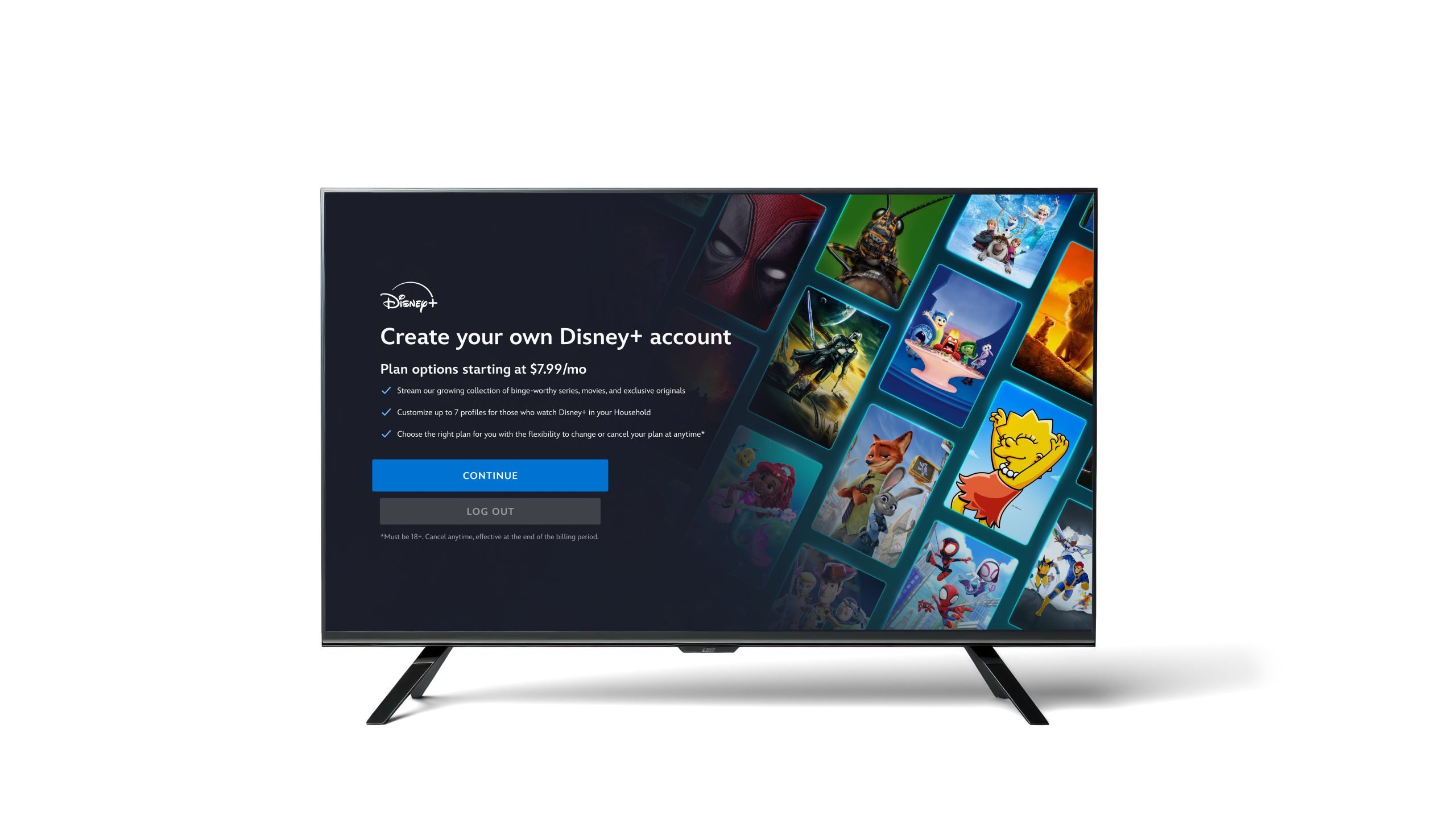
Disney+ password sharing now has a fixed price in the UK: £4.99 a month to add an Extra Member to a Standard with Ads account, or £5.99 a month on Standard and Premium plans, according to the Disney+ UK help centre. That one number tells you almost everything about where the service has landed. A borrowed login is no longer a grey area that Disney quietly tolerates; it is a product with its own line on the bill, its own signup flow and its own restrictions. If your sister in Leeds has been watching on your account from your old password, Disney would now like £5.99 a month for the privilege, or it would like her to open her own account.
None of this is new in 2026, which is precisely why it is worth explaining properly. Disney updated its UK subscriber agreement on 24 July 2024 to formalise the household rules, and enforcement began rolling out from late 2024. A year and a half on, the questions we still hear most are practical ones: what actually counts as a household, how does Disney know, what does an Extra Member cost on each plan, and when is it smarter to stop paying for someone else altogether? This guide answers all of them with the current prices, the exact menu labels, and the one piece of arithmetic Disney does not put on a poster.
Key facts
- Extra Member costs £4.99 a month on Standard with Ads and £5.99 a month on Standard or Premium, per the Disney+ UK help centre; one slot per account, own login, one concurrent stream.
- UK plan prices, confirmed on the Disney+ UK plan picker on 10 June 2026: Standard with Ads £5.99 a month; Standard £9.99 a month or £99.90 a year; Premium £14.99 a month or £149.90 a year. These prices were set on 30 September 2025, as Cord Busters reported at the time.
- Disney defines a Household as “a collection of devices associated with your primary personal residence that are used by the individuals who reside therein”.
- Enforcement uses shared internet connection details and device activity patterns; Disney states it does not use precise geolocation. Household changes need a one-time email passcode.
- The UK subscriber agreement was updated on 24 July 2024, with enforcement rolling out from late 2024.
What counts as a household under the 2026 rules
Disney’s definition is short and surprisingly literal. The Disney+ UK help centre’s account sharing article says: “A Household is a collection of devices associated with your primary personal residence that are used by the individuals who reside therein.” Read that twice, because the two load-bearing words are devices and residence. Your household is not your family, your surname or the people you love. It is the set of tellies, phones, tablets and consoles that regularly sign in from one home, used by the people who live in that home.
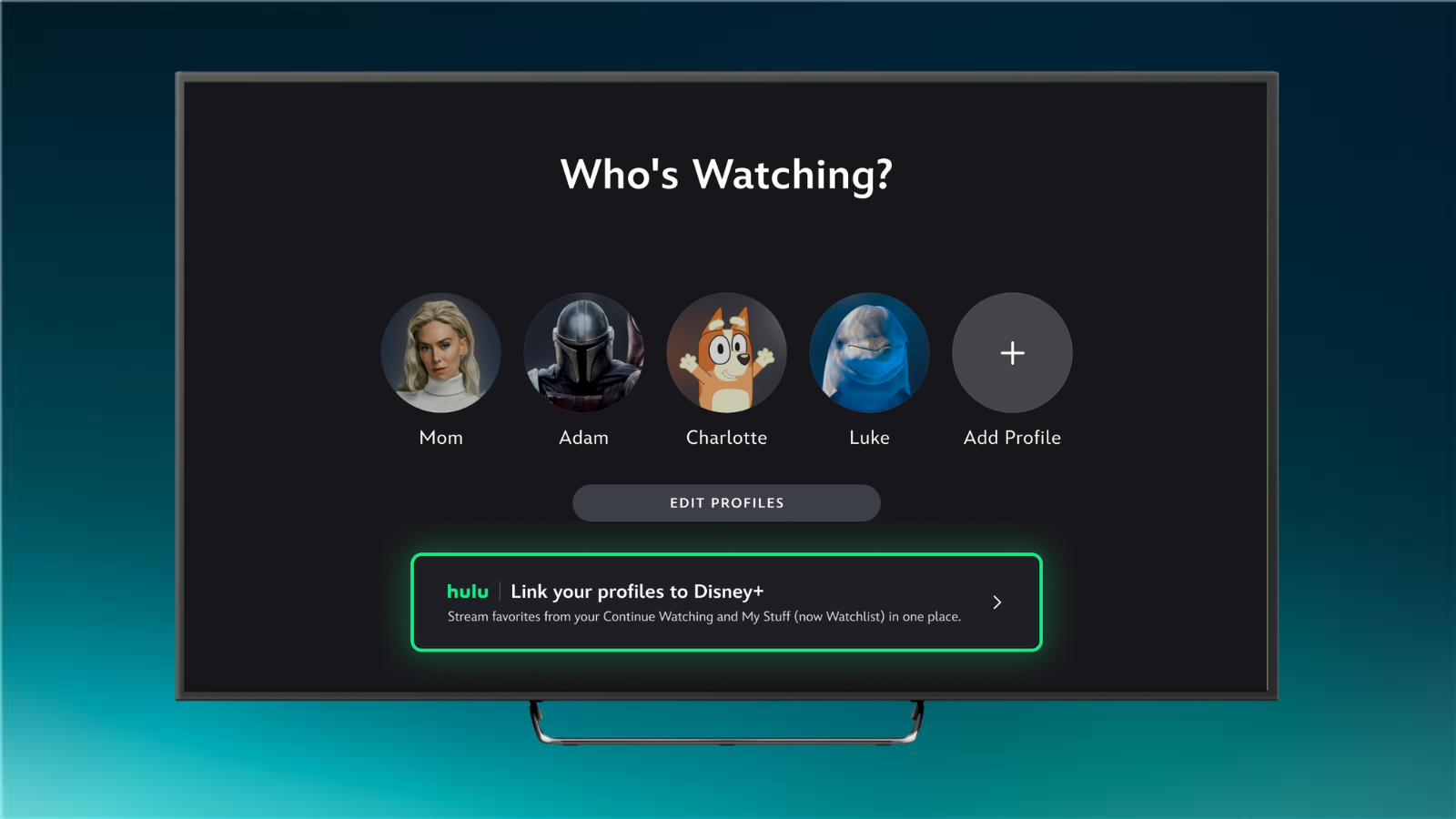
That framing settles most of the common cases. Two parents and three teenagers under one roof, each with their own profile on the Who’s Watching screen: one household, fully within the rules, no extra cost. An adult son who moved out in 2023 but still uses profile four: outside the household, and exactly the person the Extra Member add-on was designed to monetise. A partner who splits time between two flats is messier, and we cover the grey areas further down, because Disney’s own tooling acknowledges that real lives do not map neatly onto one address.
It helps to remember the history here, plainly stated. Disney announced its paid sharing programme in 2024, updated the UK subscriber agreement on 24 July 2024, and switched enforcement on from late that year, following the playbook Netflix had already run. By 2026 this is settled policy, not a crackdown in progress. The window where you could hope your shared login would slip through has closed, and the question has shifted from “will they notice?” to “which of the sanctioned options costs me least?”. If you are auditing the whole monthly outgoings pile, our breakdown of the real cost of AI subscriptions for UK households applies the same discipline to a different bill.
How Disney+ password sharing is actually enforced
Enforcement is the part most people get wrong, usually by assuming Disney tracks your location. The help centre is explicit on this point: Disney+ password sharing is policed using information about your internet connection and the devices signed into your account, and Disney states outright that it does not use precise geolocation. In practice, the system looks at which devices connect from which broadband connection, and how those activity patterns behave over weeks. A TV that has only ever streamed from a connection 200 miles from yours, every evening, does not look like your living room. It looks like someone else’s.
When the system decides a device sits outside your household, it does not silently bill you. It interrupts. On a television, the message reads “This TV doesn’t seem to be part of the Household for this account”, and the viewer is offered choices: confirm they are travelling, update the household, or take the paid routes. Changing your household, the action behind the “Update Household” button, requires a one-time passcode sent to the account holder’s email address. That passcode step is the quiet enforcement masterstroke, because it means the person borrowing your password cannot fix the prompt themselves. Every challenge ends up in your inbox, and you become the bottleneck for someone else’s evening viewing.

The design is friction, not punishment. Disney’s paid sharing explainer describes the system as managing “devices within a household” rather than hunting freeloaders, and the company has never published a strikes-and-bans regime for the UK. What it has built instead is a machine that makes borrowed access steadily more annoying than paying. Each prompt, each emailed passcode, each interrupted episode of whatever the household is mid-binge nudges the out-of-household viewer towards the two buttons Disney actually wants pressed: Add Extra Member, or start your own subscription.
What an Extra Member costs on each UK plan
The Extra Member add-on is Disney’s sanctioned version of sharing, and the pricing tracks your base plan. On Standard with Ads, an Extra Member costs £4.99 a month. On Standard and Premium, it costs £5.99 a month. Those figures come from the Disney+ UK help centre, and they sit alongside base prices that were set on 30 September 2025 and have held since, a change Cord Busters documented on the day. We re-checked the plan picker on 10 June 2026 and the published prices match the table below.
| Plan | Monthly | Annual | Extra Member |
|---|---|---|---|
| Standard with Ads | £5.99 | Not offered | £4.99/month |
| Standard | £9.99 | £99.90 | £5.99/month |
| Premium | £14.99 | £149.90 | £5.99/month |
The fine print matters as much as the headline figures. Each account gets exactly one Extra Member slot, so you cannot legitimise a whole friendship group. The Extra Member receives their own login with their own email and password, which is genuinely better hygiene than sharing yours, and they are limited to one concurrent stream. Disney’s explainer also notes that Extra Member is not available to subscribers billed through partner companies, so if your Disney+ arrives bundled through another provider’s bill, check the help centre before promising anyone a slot.
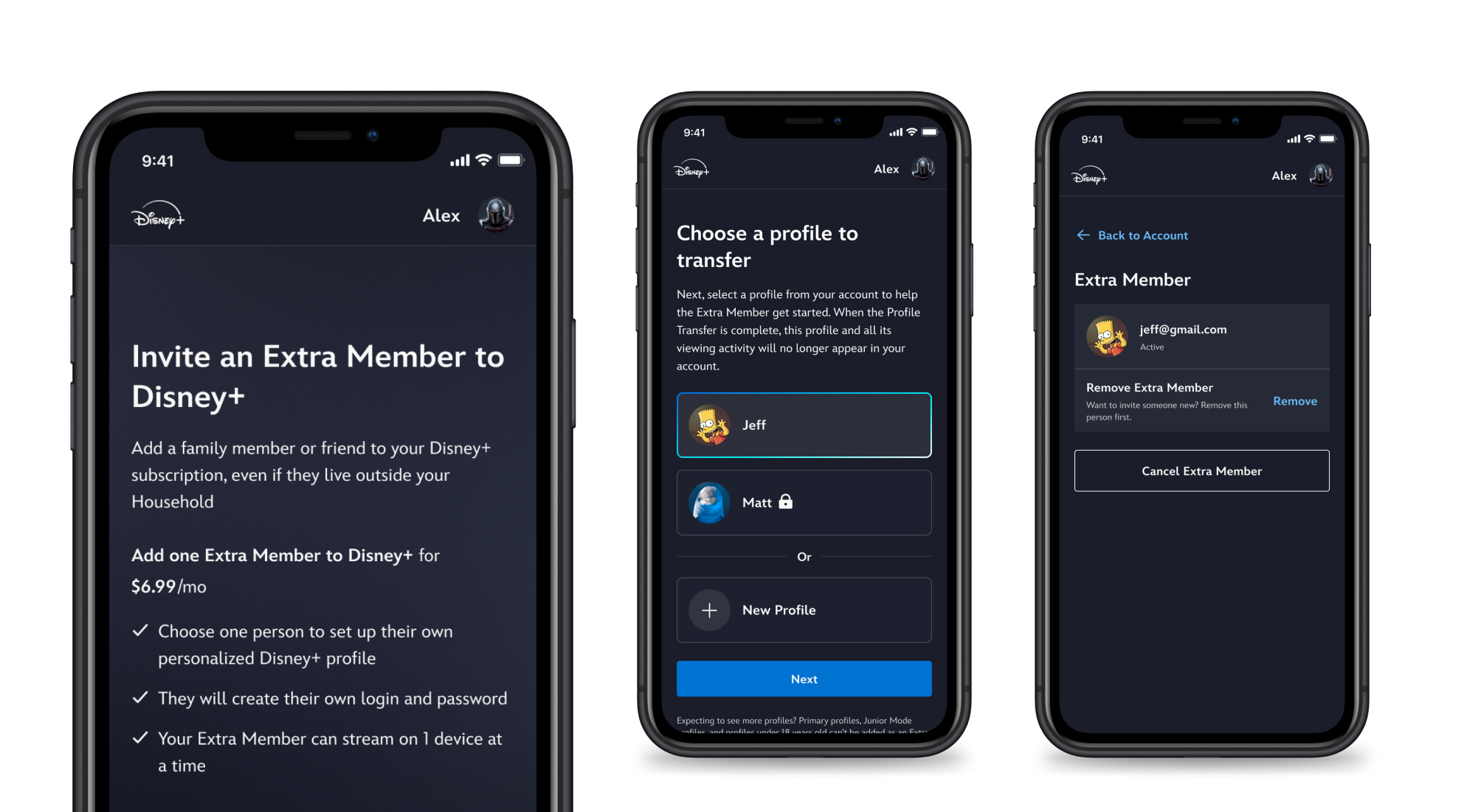
Now the arithmetic Disney does not advertise. An Extra Member on a Standard or Premium account costs £5.99 a month. A complete, independent Standard with Ads subscription also costs £5.99 a month. Same money. The standalone account brings its own household, no dependence on your billing, and no one-stream cap; the trade is that it carries adverts, while an Extra Member inherits access through your paid tier. If the person you are subsidising mostly watches on a phone and shrugs at ad breaks, paying £5.99 to bolt them onto your account instead of letting them pay £5.99 for their own is a transfer of money from you to Disney with no winner in your household. The Extra Member slot only earns its keep on Standard with Ads accounts, where £4.99 undercuts every standalone option, or for people who genuinely cannot abide advertising.
How to add an Extra Member or move someone off your account
Both sanctioned routes live in the same corner of the app, and both are quicker than the folklore suggests. To add someone, the account holder signs in on the web or mobile app and goes to Settings > Account > Household, where the “Add Extra Member” option sits alongside household management. You will need the invitee’s email address, and payment for the add-on lands on your bill, not theirs. The flow confirms the monthly price for your plan before you commit, and the Extra Member then sets their own password and gets a clean, separate login.
The politer long-term exit is Profile Transfer, which deserves to be better known. As the account holder, you can transfer an eligible profile off your account and into either a brand-new subscription or an Extra Member slot, and the profile keeps its watch history, recommendations and settings. That detail removes the real reason most adults cling to a shared account: nobody wants to lose four years of half-finished series and a meticulously curated watchlist. Three profile types cannot be transferred, per Disney’s explainer: the primary profile, profiles belonging to minors, and any profile set to Junior Mode.
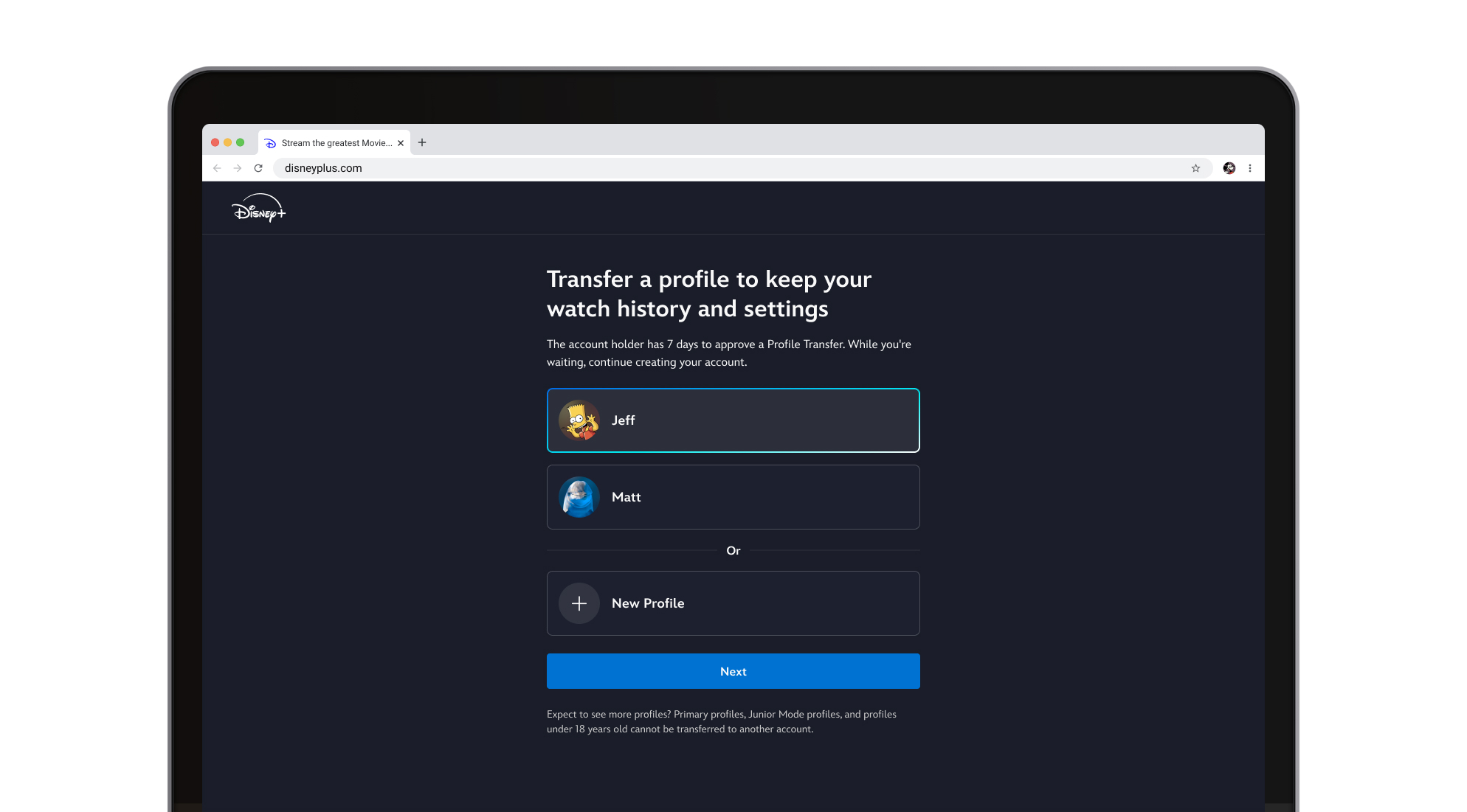
A worked example makes the choice concrete. Say you pay £14.99 for Premium and your brother has profile three. Option one: add him as your Extra Member for £5.99 a month, total £20.98 on your card, his viewing tied to one stream and your goodwill. Option two: transfer his profile to his own Standard with Ads account, he pays £5.99, you pay nothing extra, and he keeps his history. Option three, if he wants ad-free 4K: he takes his own Premium at £14.99 or the £149.90 annual rate, which works out around £12.49 a month. The only scenario where option one beats the others is when he refuses adverts but will not run his own billing; at that point you are not sharing a subscription, you are gifting one, and it is healthier to call it that.
What a separate account gets you in 2026
Whether any of these fees feel reasonable depends entirely on whether the person leaving your account would actually pay for Disney+ on their own. The UK catalogue in mid-2026 makes a stronger case than the brand’s nursery-coloured reputation suggests. Alongside the Marvel, Star Wars and Pixar libraries, the service has leaned hard into FX prestige drama and, more recently, British sport documentary. Disney Plus UK’s own YouTube channel is currently fronting two very different flagships: the fifth season of The Bear, and a documentary about Arsenal’s Bukayo Saka. The Saka trailer below is a fair sample of where the service is aiming in Britain: less castle, more Emirates.
For households with young children the calculation tilts further. A standalone Standard with Ads account at £5.99 buys an enormous amount of CBeebies-adjacent peace per pound, though if your children have drifted from Bluey on the sofa to games on a tablet, our look at Apple Arcade for UK families argues the subscription pecking order has shifted. The wider point is that streaming services are no longer judged in isolation. £5.99 for Disney+ competes with the same £5.99 that could go to music, games or cloud storage, and the way Spotify’s video podcast deal with Netflix blurs category lines shows every platform is now fighting for the same household pot.
It is also worth being clear-eyed about what you lose by leaving someone’s account: nothing structural. A transferred profile keeps its history, the apps are identical, and Disney+ runs on effectively every screen in the house, from smart TVs to a £39 streaming stick; our review of the Amazon Fire TV Stick HD covers the cheapest decent way to get any of these apps onto an older telly. The exit costs are social, not technical.
Travelling, students and second homes: the grey areas
The household rules sound rigid until you travel with them. Disney’s explainer is direct: as the account holder or a member of your household, you can keep watching on your supported devices when you are away from home. Phones and tablets that normally live at your address barely trigger the system at all. The friction arrives with televisions, because a TV in a hotel, a holiday let or someone else’s house is, by definition, a device that has never been associated with your residence.
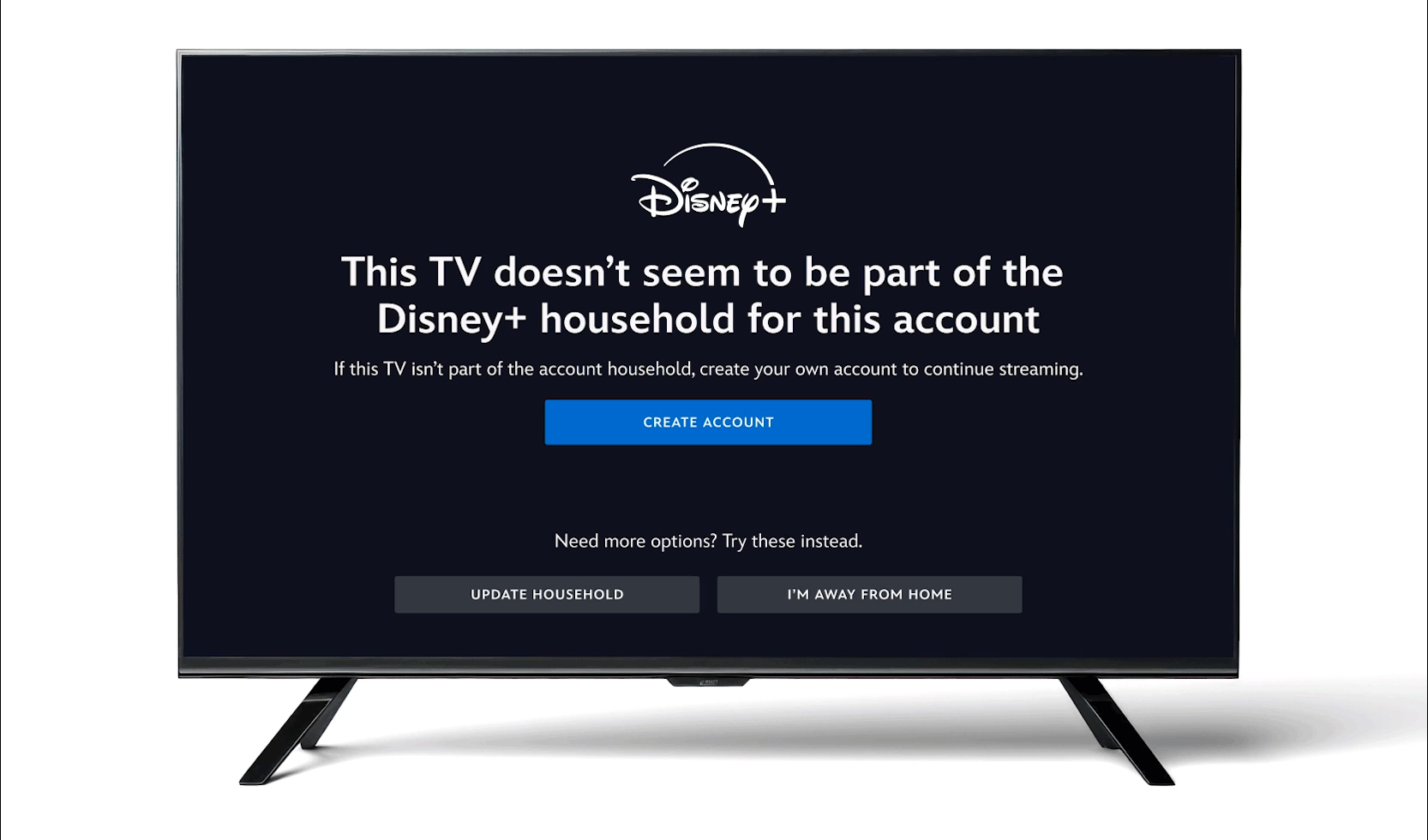
When that prompt appears, the honest traveller’s button is “I’M AWAY FROM HOME”, which grants temporary access on that TV after a one-time passcode arrives at the account email. If you have genuinely moved house, “Update Household” resets your household to the new connection, again gated by an emailed passcode. Students are the classic in-between case. A fresher streaming on a laptop in halls generally rides under the radar of a system built around TVs and fixed broadband, but a smart TV in a student house used nightly for nine months is establishing exactly the kind of activity pattern enforcement was built to spot. Disney has never published a UK student exemption, so the safe reading is that a term-time address is a separate residence.
Second homes sit in the same bucket. The rules attach your account to one primary personal residence, and there is no two-house tier. In practice, the “I’M AWAY FROM HOME” flow and mobile devices cover occasional weekends, while a TV that streams from the second property most of the year will keep generating challenges. Households in that position end up choosing between tolerating the passcode dance and paying for an Extra Member or second account, which is, of course, the outcome the system was designed to produce.
Where to check before you pay
Before you add an Extra Member, transfer a profile, or cancel anything, spend ten minutes on these checks. Prices and terms below were last checked on 10 June 2026.
- The Disney+ UK plan picker: Standard with Ads £5.99/month, Standard £9.99/month or £99.90/year, Premium £14.99/month or £149.90/year (last checked: 2026-06-10). The picker also lists 6-month saver rates with a minimum term, at £4.99, £7.99 and £10.99 respectively, which change the maths for new sign-ups.
- The help centre’s account sharing article for the current household definition and enforcement wording, in case terms move after this was written (last checked: 2026-06-10).
- The Extra Member signup path on your own account: Settings > Account > Household, then “Add Extra Member”, which displays the exact add-on price for your plan before you confirm.
- The money insight, worth restating: an Extra Member on Standard or Premium costs £5.99/month, identical to a whole Standard with Ads subscription. If the leaver tolerates adverts, cancelling their slot and pointing them at their own £5.99 account costs your household less and frees your one Extra Member slot for someone who actually needs ad-free access.
- Your annual-versus-monthly position: Standard at £99.90/year is roughly two months free against £9.99 monthly, but only if you will genuinely use it for twelve months.
- The rest of your subscription stack while you are in a cancelling mood; our guides to trimming subscription costs and downgrading to Spotify Free use the same audit logic, and Spotify Premium’s 2026 UK pricing is a useful benchmark for what £12 a month buys elsewhere.
One procedural note: if you are removing someone, do the Profile Transfer before you delete their profile. Transfer preserves the watch history; deletion does not, and there is no undo that the help centre documents.
Our verdict
The Disney+ household system is, by the low standards of streaming enforcement, honestly built. The rules are published, the definition is precise, the company says plainly that it is not using precise geolocation, and the passcode mechanism keeps control with the person paying the bill. Who should use Extra Member: subscribers on Standard with Ads, where £4.99 is the cheapest legitimate way to keep an out-of-household viewer attached, and Premium households supporting someone who refuses adverts. Who should not: anyone on Standard or Premium whose departing viewer would happily take a £5.99 Standard with Ads account of their own, because the prices are identical and the standalone account is simply more subscription for the same money. What would change our view: a second Extra Member slot, an annual rate for the add-on, or a genuine two-home household option, none of which Disney offers in the UK today.
| What we like | What we’d watch |
|---|---|
| Profile Transfer preserves watch history, removing the real cost of leaving a shared account | Extra Member at £5.99 exactly matches a standalone Standard with Ads sub, a deliberately unflattering comparison |
| No precise geolocation, with enforcement built on connection and device patterns instead | Only one Extra Member slot per account, with no path for larger split families |
| Emailed one-time passcodes keep household changes in the bill-payer’s hands | Prices have already moved once since the 2024 rules landed; the 30 September 2025 rise is unlikely to be the last |
Eighteen months into enforcement, the conclusion is unglamorous: the borrowed-password era of Disney+ in the UK is over, and the cheapest sanctioned route for most leavers is their own £5.99 account, not yours. Decide with the arithmetic, not the inertia.















Reader discussion
Leave a comment
Comments are moderated. Keep it useful, accurate, and on topic.