News · 3 Jun 2026 · MTW Editorial Team
Threads UK 2026 has quietly turned into one of the more interesting places for British creators to spend their time, and the past few months have brought a run of genuinely useful changes rather than cosmetic ones. Meta has shipped Live Chats, a feed-steering tool it calls Dear Algo, disappearing posts, custom feeds and a growing set of fediverse links, and several of those features are already available to UK accounts. This guide walks through what is real, what it does, and how to use each one sensibly if you are building an audience here rather than on X or Bluesky.
The aim is practical. Every feature described below has been confirmed on Meta’s own newsroom, with dates attached, so you are not reading about a rumour or a screenshot doing the rounds. Where a feature is rolling out gradually or is not yet confirmed for the UK, that is flagged plainly. The same discipline that helps when you assess a new wearable, such as our checklist for Meta AI glasses privacy checks UK wearers should run first, applies here: read the settings before you trust the defaults.
Key facts: what Threads is in 2026 and why now
Threads is Meta’s text-led social app, tied to your Instagram login and now to a wider Meta Account. Through 2025 and into 2026 it has shifted from a stripped-back Twitter clone into something with its own shape: real-time conversation around live events, lightweight ephemeral posting, and feeds you can shape yourself. The reason to pay attention now is that the feature set has matured at the same time the UK’s regulatory backdrop has tightened, so the way you post and the way you protect a younger audience both matter more than they did a year ago.
For UK creators weighing where to invest, the calculation is no longer simply about follower counts. It is about which tools let you reach people during a moment, which let you experiment without a permanent record, and which give you control over what your own feed surfaces. Those are the three threads, so to speak, running through everything Meta has announced.
Live Chats: real-time rooms built around big moments
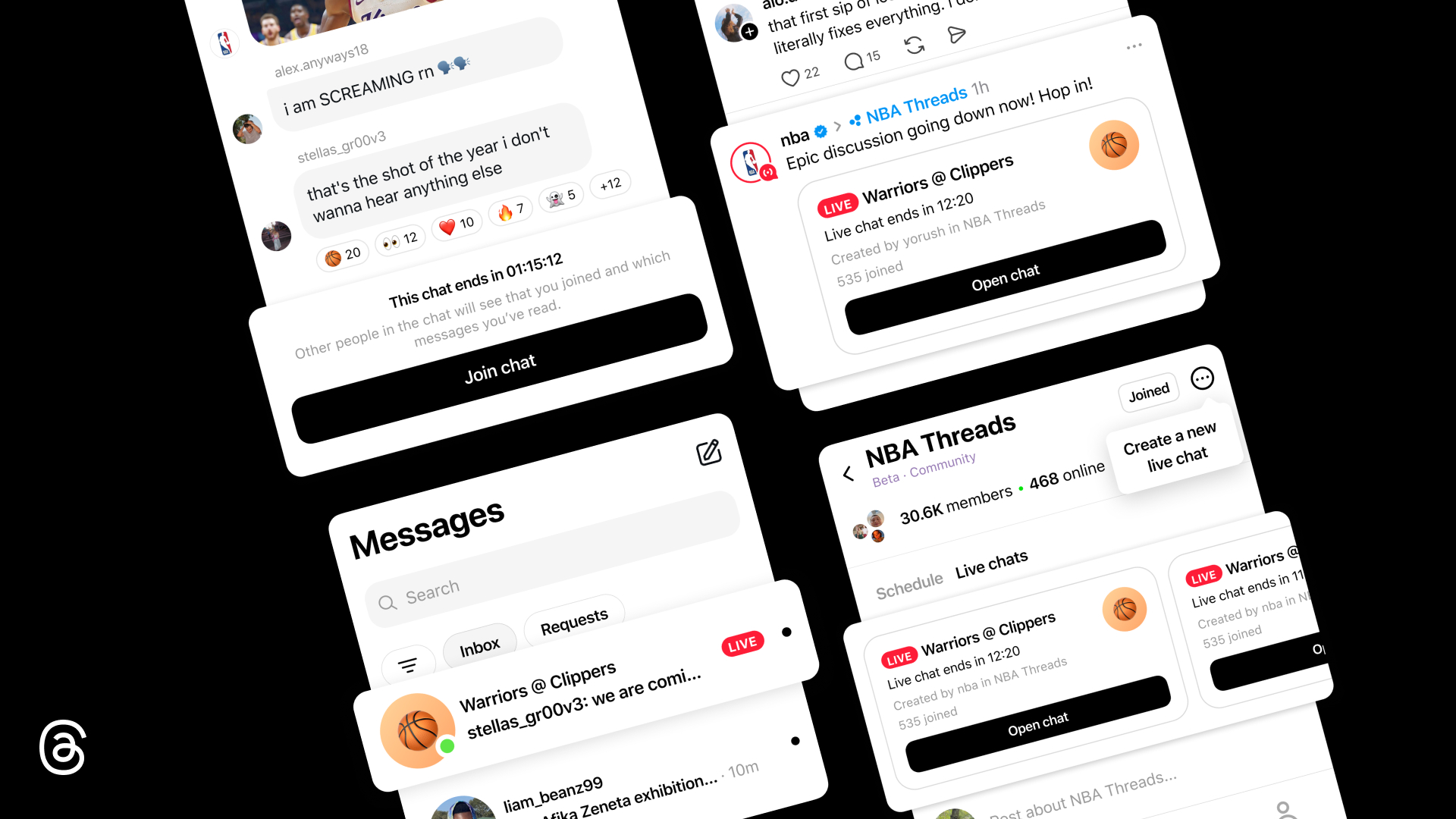
Announced on 22 April 2026, Live Chats are public, real-time group conversations that sit on top of a major cultural moment. Meta launched them inside the NBA Threads community during the Playoffs and Finals, with hosts including Malika Andrews, Rachel Nichols, Trysta Krick, David Rushing and Lexis Mickens. The format bundles live scores, real-time polls, countdowns and typing indicators into a single room, and the chats stay publicly discoverable after they end so latecomers can read back through them.
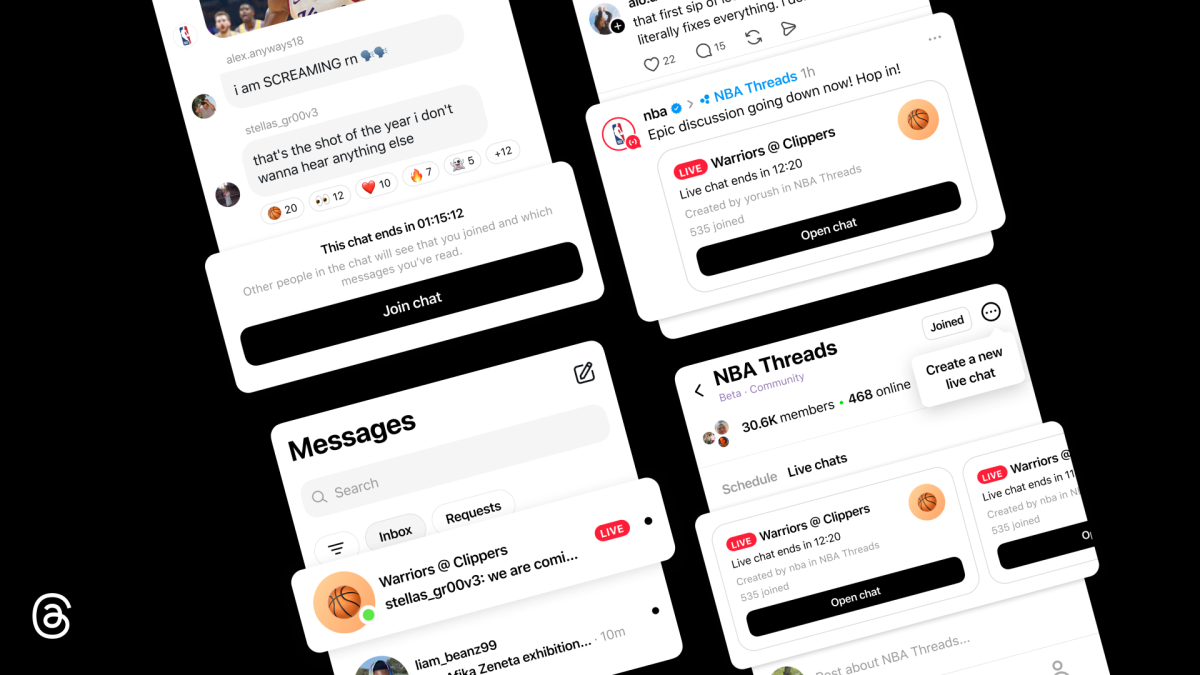
For now, only Community Champions and a set of selected creators can host a Live Chat, so this is not yet an open broadcast tool for every account. Meta has said co-hosting, play-by-play updates, lock screen widgets and the ability to share messages from a chat straight to your feed are on the way. If you cover sport, music or live television in the UK, the practical move is to join the relevant community early and take part in chats hosted by others, building the recognition that tends to precede an invitation to host. If your content is evergreen rather than event-led, this is one to watch rather than chase. The same event-timing instinct shows up in how UK fans approach big broadcast tie-ins such as the Spotify Memberships changes from the 2026 Investor Day, where the moment matters as much as the catalogue.
Dear Algo: telling the feed what you want today
Dear Algo, announced on 11 February 2026, is the feature most likely to change your daily experience, and it is confirmed for the UK. It launched in the United States, New Zealand, Australia and the United Kingdom from the start, with broader expansion planned. You post the words “Dear algo” followed by a request, for example “Dear algo, show me more posts about podcasts”, and Threads adjusts your feed for three days based on that instruction. The change is deliberately temporary, so it nudges rather than rewires what you see.
There is a social layer to it as well: you can repost someone else’s Dear Algo request to apply their preferences to your own feed, which turns feed-tuning into a discovery mechanism. For creators, that is the interesting part. A well-phrased Dear Algo post about your niche can become a small piece of shareable utility, pulling like-minded people toward the topic you cover. Treat it as a recurring prompt rather than a one-off, because the three-day window means the effect fades and the post can be repeated when a subject is timely. If you also write professionally, the habit of phrasing precise requests pairs neatly with the way we test tools in our roundup of the best AI writing assistant UK 2026.
Disappearing posts: low-stakes posting for ideas in progress
Disappearing posts, introduced on 27 October 2025 and often called ghost posts, are Threads posts that automatically archive after 24 hours. You switch them on with a ghost icon when composing. The privacy design is the point: only you can see who liked or replied, and replies route to your messaging inbox rather than appearing publicly under the post. That removes the permanence that makes some people hesitate before sharing an unpolished thought.
For UK creators, disappearing posts are a useful sketchpad. You can float a headline, test a joke or ask a quick question without it sitting on your profile forever or feeding a screenshot months later. The trade-off is reach: an ephemeral post is not building a permanent body of work, so reserve it for experiments and keep your considered, evergreen material as standard posts. Used well, it lowers the cost of posting often, which is the habit that tends to grow an audience here.
Custom feeds and the fediverse: choosing where your content travels
Two strands sit together here. Custom feeds, which Meta made shareable from 4 February 2025, let you build and pass around feeds organised by topic or list rather than relying only on the default algorithm. The fediverse work, expanded on 17 June 2025, added a dedicated fediverse feed that shows posts from federated accounts you follow in reverse chronological order, plus the ability to search for fediverse profiles directly, for example by typing a handle such as @[email protected] to surface that profile with the fediverse icon.
Because Threads shares posts to the wider fediverse through ActivityPub, content you publish can reach people on Mastodon and similar servers without them holding a Threads account. That is the strategic difference from X and Bluesky for a UK creator who wants reach beyond a single network. If you care about owning your audience over the long term, enabling fediverse sharing is worth doing early, while accepting that interaction from federated platforms can be patchier and that not every Threads feature carries across the boundary. This portability mindset is the same one that shapes how UK small businesses think about reach on messaging, as we cover in our look at WhatsApp Business AI for UK small businesses.
The clip above is a Meta creator spotlight, a reminder that the company is leaning into individual makers rather than only big publishers. That framing matters when you decide how much of your effort to move from X or Bluesky onto Threads: the platform is positioning itself around creators and communities, and the tooling follows that priority. For anyone splitting attention across hardware and software ecosystems, the wider Meta direction also shows up in products such as Meta AI glasses in the UK, where the same account and identity layer increasingly ties the experiences together.
Post insights and the analytics question
Honesty matters here. Threads surfaces basic engagement information, and a creator or business account gives you a clearer view of how individual posts perform, but Meta’s recent newsroom announcements have not described a major new post-analytics suite tied to the features above. The Dear Algo and fediverse posts in particular contain no mention of expanded metrics. So if you read a claim that Threads has launched detailed new dashboards in 2026, treat it with caution until Meta says so directly.

What you can do today is use the insights already present, switch to a professional account if you have not, and judge performance by what actually moves: replies, reposts and the conversations a post starts, rather than chasing a single vanity number. Threads rewards discussion, so a post that sparks 40 thoughtful replies is often worth more to your growth than one that collects passive likes. Keep your own simple record of what worked, because that habit will serve you whatever Meta ships next. The settings path for all of this runs through your Meta Account, which now connects Threads, Instagram and other Meta apps under one identity.
Privacy, teen safety and the Online Safety Act
The UK’s Online Safety Act, regulated by Ofcom, places duties on services to protect users and especially children from illegal content and, for services likely to be accessed by children, from content that is harmful to them. Ofcom has been publishing and enforcing codes of practice through 2025 and 2026, including measures around age assurance and the protection of minors. For a creator, the relevance is that platform behaviour and your own conduct both sit inside that framework, so understanding the safety tools is not optional housekeeping.
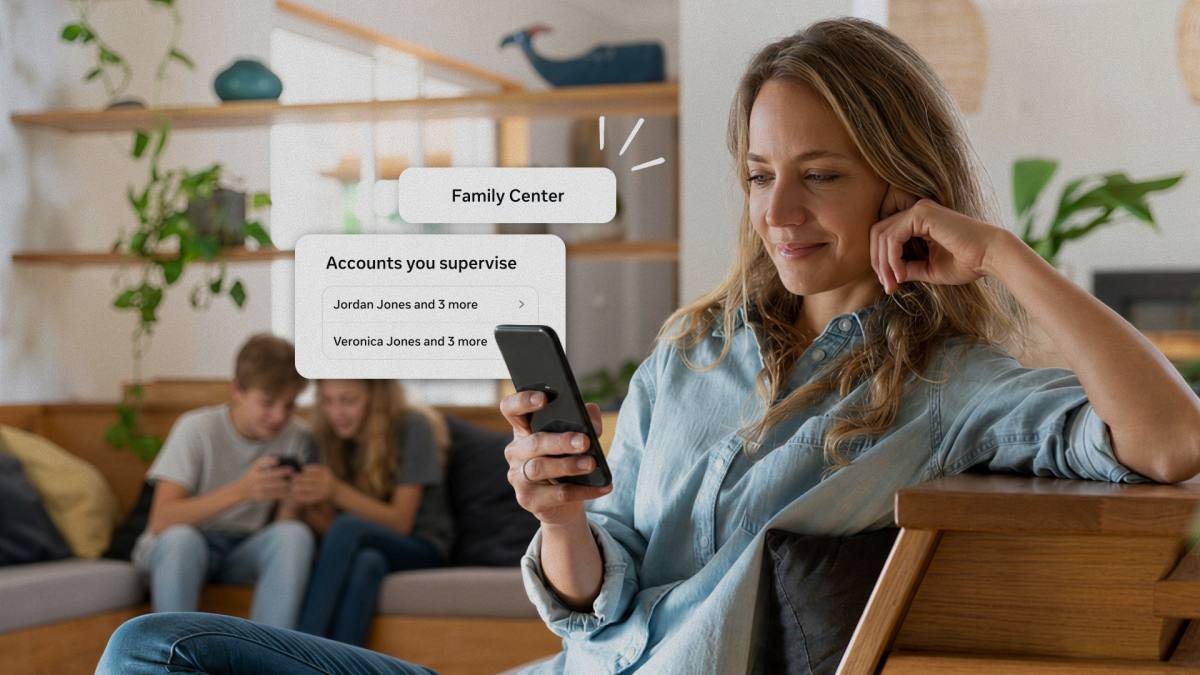
On the Meta side, the relevant building blocks are Teen Accounts and the supervision tools announced on 12 May 2026. Teen Accounts apply automatic privacy settings, limits on who can contact a young person, and controls on the content they see, and Meta says content that breaches its Community Standards or its 13+ protections will not be shown to teens. The May supervision update lets parents see the general topics their teen engages with, manage supervision across Instagram, Facebook, Messenger and Meta Horizon through Family Center with a single invitation, and Meta reported that US teen enrolment in supervision had more than doubled year on year. These tools are largely framed around Instagram and the wider Meta family, so check exactly which controls reach Threads for your account before assuming parity. If you want a worked example of auditing settings before trusting defaults, our guide to Ray-Ban Meta as an accessibility tool in the UK shows the same careful approach applied to hardware.
Threads versus X and Bluesky for UK creators
The honest comparison is about strengths, not winners. Threads gives you Instagram’s distribution, real-time Live Chats around events, Dear Algo for nudging your feed, and ActivityPub portability into the fediverse. X still holds the largest real-time news conversation and the broadest reach for breaking commentary. Bluesky, also built on an open protocol, appeals to people who want algorithmic choice and a calmer, more technical community. For most UK creators the sensible answer is not to abandon one for another but to match the platform to the job.
If your work is visual or lifestyle-led and already lives on Instagram, Threads is the lowest-friction expansion because the account and audience are shared. If you trade on instant news reaction, X remains hard to replace. If you value a portable, open network and want to hedge against any single platform’s decisions, splitting effort between Threads and Bluesky, both of which lean on open protocols, is a reasonable hedge. The cross-platform identity question keeps coming up across Meta’s products, which is why we keep returning to it in pieces such as our look at Samsung and Google AI eyewear in the UK and the privacy tests those devices demand.
Settings paths: where each feature lives
Most of these controls live in two places. Posting features such as disappearing posts and Dear Algo are surfaced in the composer itself: look for the ghost icon when writing a post, and simply type “Dear algo” to steer your feed. Account-level controls, including fediverse sharing, professional account settings and links to supervision, run through your profile settings and the wider Meta Account. Because Meta is consolidating identity across its apps, the same Meta Account screen increasingly governs Threads, Instagram and related services, which is why getting that account tidy is worth ten minutes of your time.
| Feature | Detail to know |
|---|---|
| Live Chats | Announced 22 April 2026; real-time event rooms with live scores, polls and countdowns; hosting limited to Community Champions and selected creators |
| Dear Algo | Announced 11 February 2026; live in the UK; type “Dear algo” plus a request to steer your feed for three days; repostable |
| Disappearing posts | Announced 27 October 2025; ghost icon in composer; archives after 24 hours; replies go to your inbox |
| Custom feeds | Shareable since 4 February 2025; build and pass around topic or list feeds |
| Fediverse sharing | Expanded 17 June 2025; dedicated fediverse feed and profile search via ActivityPub |
| Supervision tools | Announced 12 May 2026; Family Center, Teen Accounts and parental insight into a teen’s algorithm |
Where to check or set things up next in the UK
Threads is free, so there is nothing to buy, but a few official destinations are worth bookmarking. Meta’s newsroom at about.fb.com is where every feature here was confirmed, and it is the place to check whether a tool has reached the UK before you rely on it. Ofcom’s site sets out the Online Safety Act duties and the codes that affect both platforms and creators, which is the right reference if you publish content that younger users might see. Inside the app, your Meta Account settings are where you enable fediverse sharing, switch to a professional account and review who can contact you.
If your Threads use is tied to hardware, the usual UK retailers still matter for the devices around it. Currys, John Lewis, Argos, Amazon UK, Very and AO.com all carry the phones and accessories you post from, and it is worth checking price, delivery windows, warranty terms and returns before you commit to any of them. Network options from EE, Vodafone, Three and the wider VodafoneThree estate affect how reliably you can post live during an event, so a quick coverage check at your usual venues is sensible if Live Chats are part of your plan.
Our verdict
Our view is that Threads has earned a place in a UK creator’s routine in 2026, but as a complement rather than a replacement. Dear Algo and disappearing posts are the two features we would adopt immediately, because they are live in the UK, low risk and genuinely change how you post and what you see. Live Chats are promising but gated, so for most accounts they are something to participate in now and plan to host later. The fediverse work is the quiet strategic win, giving your content portability that neither a closed network nor a single login can match.
| What we like | What we’d watch |
|---|---|
| Dear Algo is live in the UK and makes feed control simple and shareable | Live Chat hosting is limited to Community Champions and selected creators |
| Disappearing posts lower the cost of posting often without a permanent record | Several teen-safety tools are framed around Instagram, so Threads parity needs checking |
| Fediverse sharing gives real content portability beyond a single network | No major new post-analytics suite has been announced alongside these features |
What would change our recommendation is clear evidence that Live Chat hosting has opened up to ordinary accounts, that supervision and safety controls map fully onto Threads in the UK, and that Meta has shipped the deeper analytics creators keep asking for. Until then, treat Threads as a strong, improving second home: use the tools that are confirmed for the UK, keep your evergreen work as permanent posts, and let the fediverse carry your reach further than any single app can.












Reader discussion
Leave a comment
Comments are moderated. Keep it useful, accurate, and on topic.